
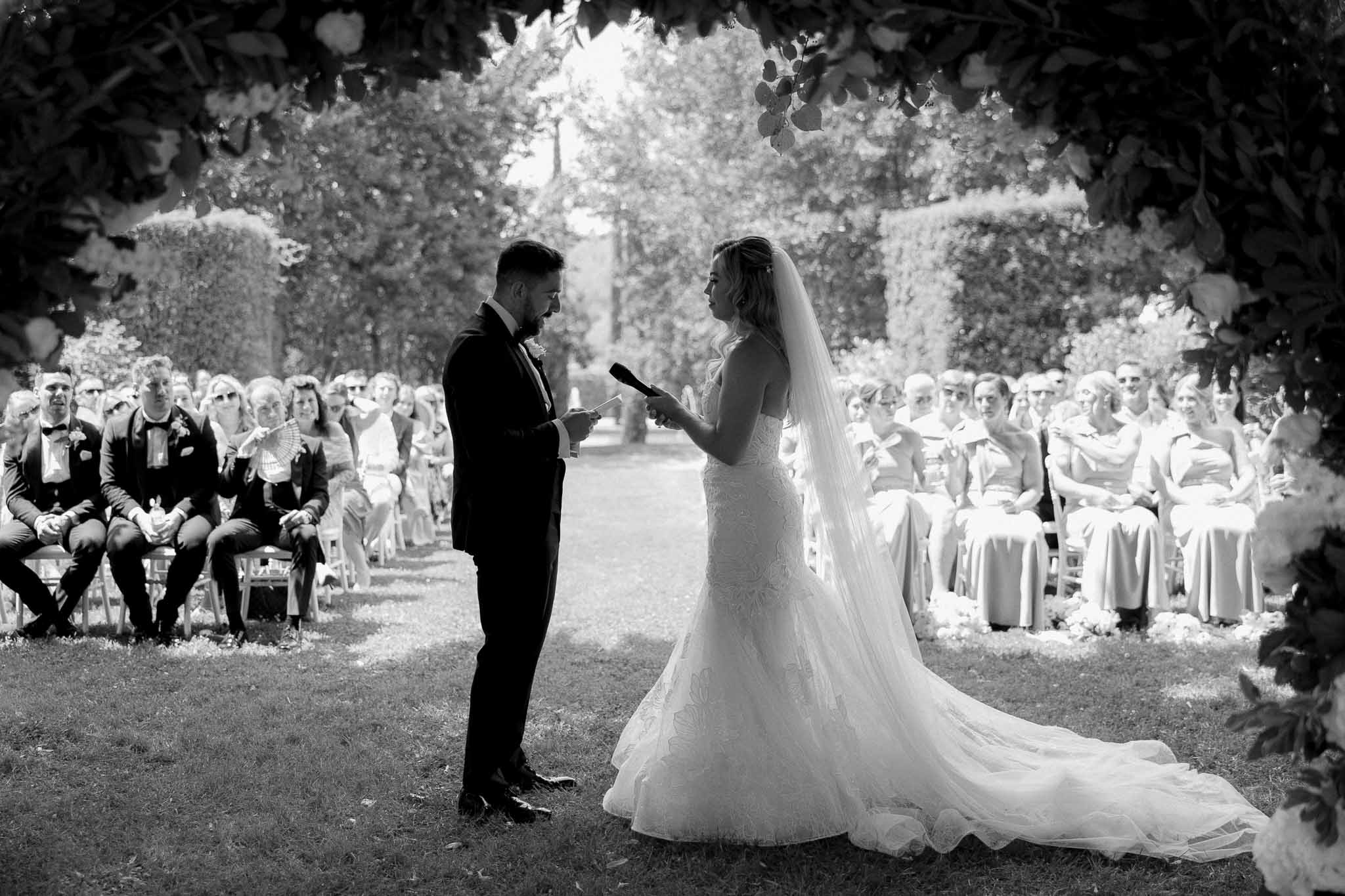
Writing Wedding Vows in France
Writing vows for a French wedding is both simpler and more personal than most couples expect. The symbolic ceremony gives you complete freedom. No prescribed words. No mandated structure. No legal script to follow. For a broader view of every step involved, see the complete French destination wedding planning resource.
You stand in a garden or a stone courtyard, facing the person you love, and say exactly what you mean. The challenge is not the rules. It is the blank page. How vows work at French ceremonies, the difference between personal vows and the civil code declarations, how to write for a bilingual audience, ideal length, and the mistakes that trip up international couples. It sits within our French wedding traditions chapter. For how vows fit into the full ceremony and evening arc, see our guide to the French wedding day structure.
Key Takeaways
- At a French symbolic ceremony, couples have complete freedom to write and deliver personal vows. There is no prescribed text, format, or language requirement.
- The French civil ceremony at the mairie uses fixed declarations from the Civil Code (Articles 212 to 215), which the maire reads aloud. Couples do not write vows for this ceremony.
- Ideal vow length is 200 to 300 words per person, approximately 90 seconds to two minutes when read aloud at a natural pace.
- For bilingual audiences, each partner can deliver vows in their own language, with an optional brief summary in the second language for family members.
- Read from a printed page. Never memorise. Emotions on the day make recall unreliable, and the stress of remembering detracts from being present.
How Do Wedding Vows Work at a French Symbolic Ceremony?
A symbolic ceremony in France is a fully personalised celebration with no legal standing, held at the wedding venue rather than the mairie. It is the main ceremony that guests attend, the one with the arch draped in olive branches, the processional down the lavender-lined aisle, the reading by your best friend, and the vows you wrote at the kitchen table at midnight. An estimated 80 to 90 percent of international couples marrying in France hold a symbolic ceremony, and personal vows are central to it. The setting matters: an outdoor ceremony at a garden venue or château courtyard shapes how intimate the moment feels. The vow exchange typically happens midway through the ceremony, after the officiant's introduction, readings, and any musical interludes, and before the declaration of intent and ring exchange. Each partner reads their vows directly to the other. The audience listens but is not the primary focus. The best vows feel like overhearing something private and deeply honest.
Your celebrant will guide the structure. Most build the ceremony so that vows arrive at the emotional peak: after the readings have set the tone, before the rings formalise the commitment. Some couples prefer to deliver vows after the ring exchange, as a closing statement. Either order works. Discuss placement with your celebrant during the preparation meetings, which typically happen two to three months before the wedding.
The Writing Process
Start with the raw material, not the final draft. Spend ten minutes answering one question: "What made me certain this was the person I wanted to build my life with?" Do not edit. Do not structure. Just write. The answer to that single question often contains the emotional core of everything that follows.
From there, work through four angles. What does love mean in this specific relationship? Which moments revealed something you did not expect? What does daily life together actually feel like? How have you changed because of this person? The everyday details, the Tuesday morning coffee habit, the way they handle a crisis, the inside reference that makes you both laugh, resonate more with guests than grand declarations because they reveal the real texture of a relationship.
Shape the raw material into a three-part arc: an opening image or honest admission, the substance (reflections, stories, specific details), and forward-looking promises. The opening line is almost always written last because it needs to set up everything that follows. End with commitments. This is where vows become vows in the literal sense. What you pledge, what you will protect, what you will build.
What Is the Difference Between Vows and the French Civil Code Declarations?
The French civil ceremony at the mairie is a legal process governed by the Code Civil. The maire reads Articles 212 to 215 aloud. These articles establish the mutual obligations of marriage: shared life, mutual respect, fidelity, assistance, and shared responsibility for the household and children. Each partner then confirms their agreement. This is the declaration of intent, not personal vows. The wording is fixed by law. There is no room for personalisation, no opportunity to read your own text, and very little variation between one mairie and the next. Article 212 states that spouses owe each other mutual respect, fidelity, help, and assistance. Article 213 establishes shared authority in the household. Article 214 addresses shared financial responsibility. Article 215 confirms the shared choice of family home. The text is read in French. For international couples, the maire may provide a brief translation or summary, but this is courtesy, not obligation. Your witnesses are technically required to understand French, though in practice this is rarely enforced.
The symbolic ceremony is where personal vows live. Because the symbolic ceremony has no legal framework, everything, the language, the length, the tone, the content, is yours to decide. This freedom is the point. The civil ceremony handles the law. The symbolic ceremony handles the heart. Most couples who have completed both describe the civil ceremony as the administrative step and the symbolic ceremony as the real wedding.
| Element | Civil Ceremony (Mairie) | Symbolic Ceremony (Venue) |
|---|---|---|
| Personal vows | Not permitted | Fully customisable |
| Language | French (legally required) | Any language or combination |
| Officiant | Maire or deputy | Professional celebrant, friend, or family member |
| Legal standing | Legally binding | None (emotional and spiritual) |
| Personalisation | Very limited (music may be possible) | Complete freedom: readings, rituals, music, vows |
| Duration | 15 to 30 minutes | 45 to 75 minutes |
How Do You Write Vows for a Bilingual Audience?
Bilingual vows at French destination weddings are common, and the couples who handle them well follow one principle: write in the language you feel in, then provide access to the second language without translating line by line. A vow delivered in French, then repeated word-for-word in English, takes twice as long and lands with half the emotional impact. The repetition turns a declaration into an exercise. Three approaches that work well, drawn from ceremonies at château venues and destination estates across France. For the broader question of managing two cultures, see our guide to blending traditions: Native language delivery with a brief summary. Each partner reads their full vows in their strongest language. After, they offer a three-to-four-sentence summary in the second language for the other partner's family. The emotional weight lands in the native tongue. The summary ensures inclusion. This is the approach recommended by most experienced celebrants working with international couples in France.
Alternating paragraphs. Write the vows so that one paragraph is in English and the next in French (or vice versa). Each partner alternates. Both language groups hear substantial content in their own language without the stop-start of sentence-by-sentence translation. This requires more writing skill but creates a distinctive rhythmic effect.
Printed bilingual text. Deliver the vows in one language while the printed ceremony programme includes the full text in both. Guests who do not speak the delivery language can follow along in real time. This is the simplest solution and works for any language combination.
How Long Should Wedding Vows Be?
The professional recommendation from experienced celebrants is 200 to 300 words per person, which takes approximately 90 seconds to two minutes when read aloud at a natural pace. This is the range where vows carry enough substance to feel meaningful without testing the audience's attention or the reader's composure. Shorter vows (under 150 words) can feel underwhelming after months of anticipation. A single paragraph, however heartfelt, may not do justice to the moment. Longer vows (over 400 words) risk losing emotional intensity. The audience's focus drifts. The reader's voice tires. The specificity that makes vows powerful gets diluted by volume. Small differences between the two sets of vows are completely normal. One partner may write 220 words, the other 280. This is not a problem. Vows are not a competition for length. What matters is that both partners agree on the emotional register, whether the tone will lean romantic, reflective, or light-hearted, before either begins writing.
What Do International Couples Get Wrong About Vows in France?
The blunder that experienced planners warn about first is treating vow writing as a performance. Couples search online, borrow phrases that sound impressive, and end up reading words that do not belong to them. Partners can always tell. Guests can always tell. The borrowed sentiment sits awkwardly in the reader's mouth, like wearing someone else's clothes. Write the way you actually speak. If you would never say "henceforth" in conversation, do not put it in your vows. The same principle applies to the croquembouche moment later in the evening: authenticity carries further than polish. A second mistake is memorising rather than reading. Every experienced celebrant gives the same advice: read from a printed page. The emotional intensity of the moment makes recall unreliable. You will be nervous. Your voice will shake. The sun may be in your eyes. A printed page in your hands is a safety net that lets you be present rather than performing a memory exercise. Reading from a page is expected, normal, and far less stressful than trying to recite from memory.
A third mistake, specific to destination weddings, is writing vows that require cultural context the audience does not have. A reference to a shared moment at a pub in London makes sense to the couple but leaves French guests without context. Choose details that are self-explanatory or universally relatable: the way someone laughs, a habit that drives you lovingly mad, a promise about the future. These translate across any language or culture.
A fourth mistake is leaving vow writing until the final week. The first draft needs rest. Write it, set it aside for several days, then return and read it aloud. If any sentence makes you cringe or feels borrowed, cut it. If any sentence makes your voice catch, keep it. Aim to finish the first draft three to four weeks before the wedding, leaving time for two or three rounds of editing. Couples at destination weddings find that the travel and preparation time in France provides natural space for this reflection.
The Declaration of Intent: Choosing Your Words
The declaration of intent is the formal question posed by your celebrant, usually just before or during the ring exchange. It is the moment where each partner affirms their commitment with "I do" or "I will." In a symbolic ceremony, the wording is entirely customisable. Your celebrant will offer options or write one tailored to the couple. Two response formats are standard. The "I do" format uses a question ending with "If so, answer, 'I do.'" This is the most widely recognised form, familiar from film and cultural tradition. The "I will" format uses a forward-looking question: "Will you love, comfort, and honour them?" This emphasises ongoing commitment rather than a single moment of agreement. Common styles range from concise and traditional ("Do you take [Name] to be your husband/wife, to love and cherish from this day forward?") to modern and values-focused ("Do you pledge to be honest, faithful, and kind, and to respect them for who they are, not who you want them to be?").
The declaration of intent is the one moment in the ceremony where both partners say the same words. It should feel natural in both voices. After the declaration, the ceremony moves toward the ring exchange and then the ouverture de bal and evening celebrations.
Frequently Asked Questions
Do most couples at symbolic ceremonies write their own vows?
An estimated 70 to 80 percent of couples at symbolic ceremonies in France write their own personal vows. The remainder use a combination of the celebrant's suggested wording and personalised elements. Your celebrant can provide a template or framework if the blank page feels overwhelming. Starting with a structure and adding personal details is a valid approach that still results in authentic, individual vows. Outdoor venue settings with natural beauty often inspire the most personal writing.
Can we include humour in our vows?
Yes, and the best vows often do. A single honest, funny observation about your partner can cut through the emotion and make the moment more real, not less. The key is balance: one or two light moments within a sincere overall tone. Vows that are entirely comedic risk undermining the gravity of the commitment. Vows that are entirely serious risk feeling heavy. A gentle blend is the sweet spot.
Should we share our vows with each other before the ceremony?
Most celebrants recommend agreeing on the parameters (length, tone) without sharing the actual content. The surprise is part of the emotional impact. However, sharing with your celebrant is advisable. They can flag any tonal mismatches, ensure the two sets complement each other, and adjust the ceremony flow around the vow content. Your celebrant is a creative partner, not just a timekeeper. Your wedding planner can also facilitate the conversation.
What if I cry and cannot finish?
This happens regularly and is completely welcomed. It is a sign of presence and connection, not a failure. Take a breath. Pause for as long as you need. Your partner, your celebrant, and your guests will wait. Naming the emotion out loud ("I told myself I would not cry") often releases the tension and allows you to continue. In rare cases, a pre-arranged backup reader, a sibling or close friend, can step in. Simply knowing this safety net exists is usually enough to prevent needing it.
Can we include readings or quotes alongside our vows?
Readings and quotes typically sit in a separate part of the ceremony (delivered by friends or family members), not within the personal vows themselves. Vows are strongest when they are entirely your own words. If a particular poem or quote deeply resonates, your celebrant can place it as a reading immediately before or after the vow exchange, creating a thematic connection without diluting the personal nature of the vows.
Is it appropriate for same-sex couples to follow the same vow structure?
Absolutely. The symbolic ceremony in France has no gendered language requirements. Celebrants working with LGBTQ+ couples adjust pronouns and terminology to match each couple's preferences. The emotional structure of vows, reflection, commitment, promises, is universal. See our guide to LGBTQ+ weddings in France for more on inclusive ceremony planning. Couples exploring multicultural wedding formats will find additional guidance on multi-faith vow structures.
Explore Every Guide in This Chapter
Deep-dive into each topic covered above.