
Wedding Transportation in France
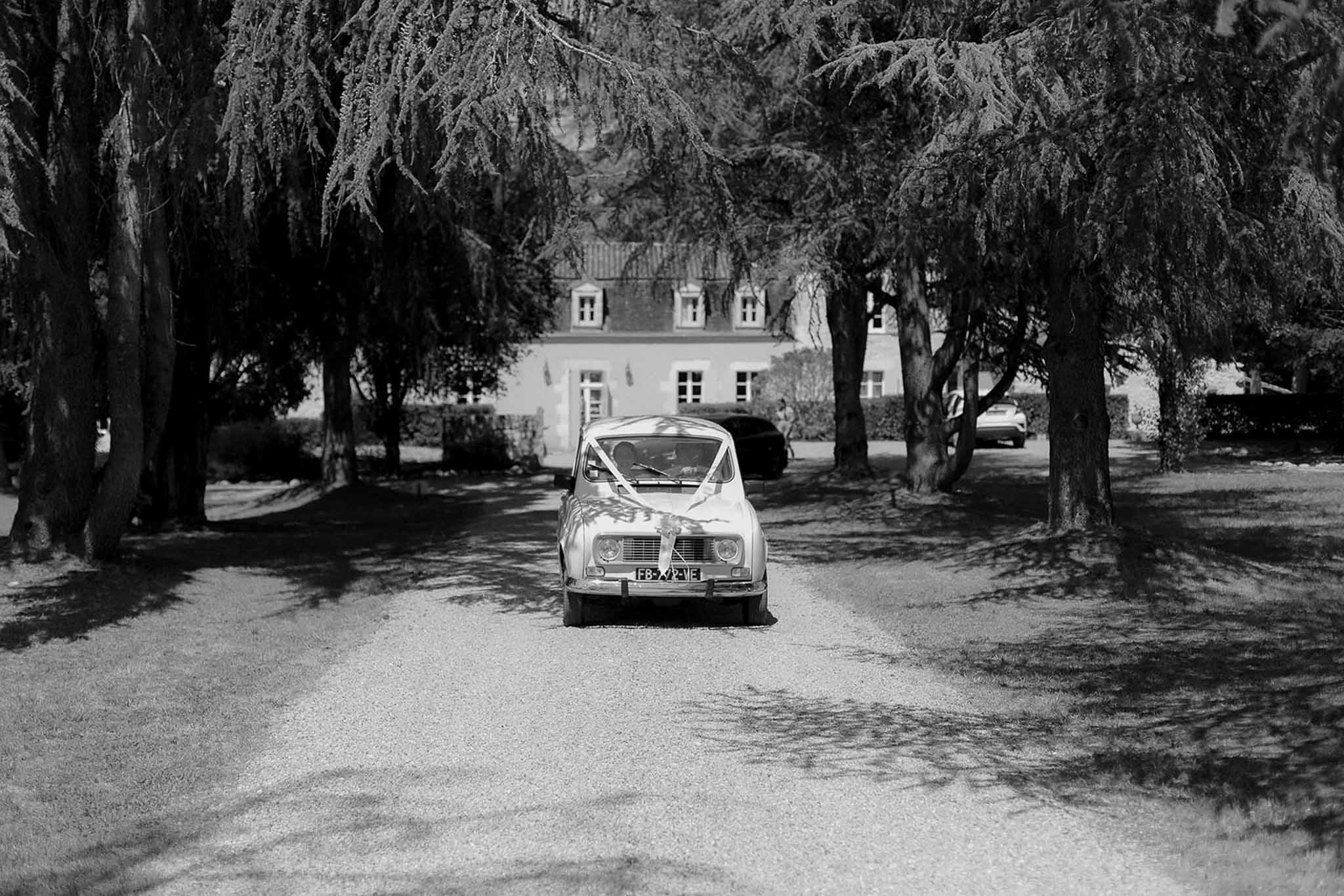
Transport at a French wedding is a logistics problem disguised as a style choice. The vintage Citroën for the couple's arrival photographs well, but it is the guest shuttle between the hotel and the venue at 11pm that determines whether the evening actually works. Rural France has no Uber, limited taxis, and public transport that stops before the apéritif begins.
If your guests cannot get to the venue and back safely, the wedding does not function. Below is the practical transport infrastructure you need, the French drink-drive laws that make shuttles mandatory rather than generous, and the budget to set aside. This forms part of the full planning guide for destination weddings in France. For the full chapter, see our complete final details guide.
Key Takeaways
- Shuttle services between guest accommodation and the venue are essential at rural French weddings. There is no Uber in the countryside, taxi availability is unreliable, and the drink-drive limit makes driving after the reception illegal for most guests.
- The French drink-drive limit is 0.5g/L of blood alcohol (0.2g/L for drivers with less than 3 years' experience). This is lower than the limit in England, Wales, and Northern Ireland (0.8g/L), and the same as Scotland's limit of 0.5g/L. After a French wedding dinner with wine at every course, no guest should be driving.
- A minibus (8 to 16 seats) costs €200 to €500 per trip. A coach (30 to 50 seats) costs €400 to €800 per trip. Budget for at least 3 shuttle runs: one to bring guests to the venue, one mid-evening return (10 to 11pm for early leavers), and one late-night return (2 to 3am).
- Book transport 4 to 6 months before a summer wedding. Local shuttle and minibus companies in popular wedding regions (Provence, Bordeaux, Loire) fill their peak-season calendar quickly.
- The couple's wedding car is a separate line item: €300 to €800 for a vintage vehicle with driver for 2 to 4 hours.
What Transport Options Exist in Rural France?
The starting point for transport planning is understanding what does not exist. Rural France does not have ride-hailing apps, regular bus services in the evening, or a surplus of taxis waiting at a rank. Outside of cities (Marseille, Lyon, Bordeaux, Toulouse, Nice), transport is either pre-arranged or it does not happen. Private shuttle / minibus. This is the primary solution. A local transport company provides a minibus or coach with a driver for the evening. The vehicle runs a loop between the venue and the accommodation hubs (the hotel in town, the cluster of gîtes, the main car park). You define the schedule: arrival run, mid-evening run, late-night run. The driver handles the routes. Your guests sit back and enjoy the ride. Companies range from dedicated wedding transport providers to local coach hire firms. Your venue coordinator or wedding planner will have 2 to 3 they work with regularly.
Pre-booked taxis. In areas where individual taxis are available, pre-booking a fleet for the end of the evening is an alternative to a shuttle. This works in regions with more taxi coverage (the Riviera, the outskirts of Bordeaux or Aix-en-Provence) but is unreliable in deep rural areas (the Dordogne, rural Normandy, the Ardèche). Taxis for a 20-minute journey at midnight cost €40 to €80 each way. For 10 taxis, this approaches the cost of a minibus that carries all 10 people at once.
Rental cars with designated drivers. Some guest groups self-organise with rental cars and volunteer designated drivers who stay sober for the evening. This works only if the designated driver genuinely commits and does not have a glass of wine at the apéritif. Given the French drink-drive limit (0.5g/L, which means effectively zero alcohol for most people), the designated driver is truly dry for the evening. For most guest groups, a shuttle is the kinder and safer solution.
How Do Shuttles Work?
The standard shuttle plan for a French wedding runs three loops. Loop 1: Arrival. The shuttle collects guests from their accommodation at a set time (typically 3:30 to 4pm for a late-afternoon ceremony) and delivers them to the venue. If guests are staying in multiple locations, the shuttle runs a circuit: hotel first, gîte cluster second, venue last. Communication is critical. Tell guests the exact pickup time and location on the printed schedule card in their room. Loop 2: Early return. A shuttle leaves the venue at 10 to 11pm for guests who want to leave before the dancing. Elderly guests, families with children, and guests who are tired from travel will use this. Do not make them feel guilty. The early shuttle is a hospitality provision, not a concession. Loop 3: Late return. The final shuttle leaves at 2 to 3am (or whenever the music stops). This is the main run, carrying the majority of off-site guests back to their accommodation.
Costs depend on vehicle size and distance.
- A 16-seat minibus for a 20-minute route costs €200 to €400 per trip
- For three loops, budget €600 to €1,200 for one minibus
- If you need two vehicles (one for the hotel, one for the gîtes), double the budget
- A coach for 40 to 50 guests costs €400 to €800 per trip, which is more cost-effective for larger groups
- For broader guest travel logistics including airport transfers, see our dedicated guide
What Is the French Drink-Drive Limit?
The legal blood alcohol limit for driving in France is 0.5g/L (0.05%). For comparison, the limit in England, Wales, and Northern Ireland is 0.8g/L (0.08%), Scotland matches the French limit at 0.5g/L, and the US limit varies by state but is typically 0.8g/L. The French limit is among the strictest in western Europe, and for drivers with fewer than 3 years of experience (permis probatoire), the limit drops to 0.2g/L, which effectively means zero alcohol. At a French wedding dinner with champagne at the apéritif, wine with every course, and a toast with the pièce montée, a guest who has driven to the venue will exceed the legal limit long before the cheese course. This is not a judgement on consumption. It is a mathematical certainty. Two glasses of wine put most adults over the 0.5g/L threshold. The penalties are serious. Driving with a blood alcohol level between 0.5 and 0.8g/L is a contravention carrying a €135 fine, 6 licence points, and possible suspension. Above 0.8g/L, it becomes a criminal offence (délit) carrying up to €4,500, 2 years' imprisonment, and automatic licence revocation.
The practical implication is clear: shuttles are not a courtesy. They are a legal necessity. Communicate this to guests, particularly UK guests who are used to a higher limit and may misjudge their capacity to drive legally in France.
How Do You Budget for Guest Transport?
| Service | Cost (2026) | Notes |
|---|---|---|
| Minibus (16 seats), per trip | €200 to €400 | 20 to 30-minute route, local company |
| Coach (40 to 50 seats), per trip | €400 to €800 | More cost-effective for large groups |
| 3-loop shuttle plan (1 minibus) | €600 to €1,200 | Arrival + early return + late return |
| 3-loop shuttle plan (2 minibuses) | €1,200 to €2,400 | Multiple accommodation locations |
| Couple's vintage car (with driver) | €300 to €800 | 2 to 4 hours, Citroën DS, classic convertible, or horse and carriage |
| Pre-booked taxi (per journey) | €40 to €80 | 20-minute journey, supplement after midnight |
For a 100-guest wedding with off-site accommodation split between a hotel and 3 gîtes, budget €1,500 to €3,000 for the full transport plan including arrival, early return, and late-night shuttles. This is a non-negotiable line item. Cutting transport is the false economy that creates the most problems on the night. For how this fits into the overall wedding budget framework, see our dedicated guide.
Related Articles
- Final details: the complete guide
- Guest travel logistics
- Guest accommodation options
- Structuring a multi-day wedding weekend
- Wedding budget guide
- Venue pricing explained
- Exclusive-use wedding venues in France
- Wedding venues with accommodation
- Countryside wedding venues in France
- Browse all wedding venues in France
Frequently Asked Questions
Can guests use ride-hailing apps in rural France?
No. Uber operates in Paris, Lyon, Nice, Marseille, and a few other cities, but coverage does not extend to rural areas where most wedding venues are located. Bolt and other services have similar urban-only coverage. Do not assume that guests can call a ride. Pre-arranged shuttles or pre-booked taxis are the only reliable options outside city centres.
Should the couple provide a wedding car for themselves?
A dedicated wedding car is traditional but optional. A vintage Citroën DS, a classic convertible, or a horse-drawn carriage provides a photographic moment as the couple arrives at or departs from the ceremony. Budget €300 to €800 for 2 to 4 hours with a driver. If budget is tight, a friend with a clean, attractive car can serve the same purpose. The guest shuttle is the higher priority.
What if some guests insist on driving themselves?
Provide the shuttle information and the French drink-drive limit clearly on the wedding website. Guests who choose to drive are responsible for their own compliance with French law. You can provide non-alcoholic drink options at the wedding for designated drivers. But you cannot monitor or control individual behaviour. The shuttle is there for everyone who wants it, and communicating its availability firmly and early is the couple's responsibility.
Explore Every Guide in This Chapter
Deep-dive into each topic covered above.