
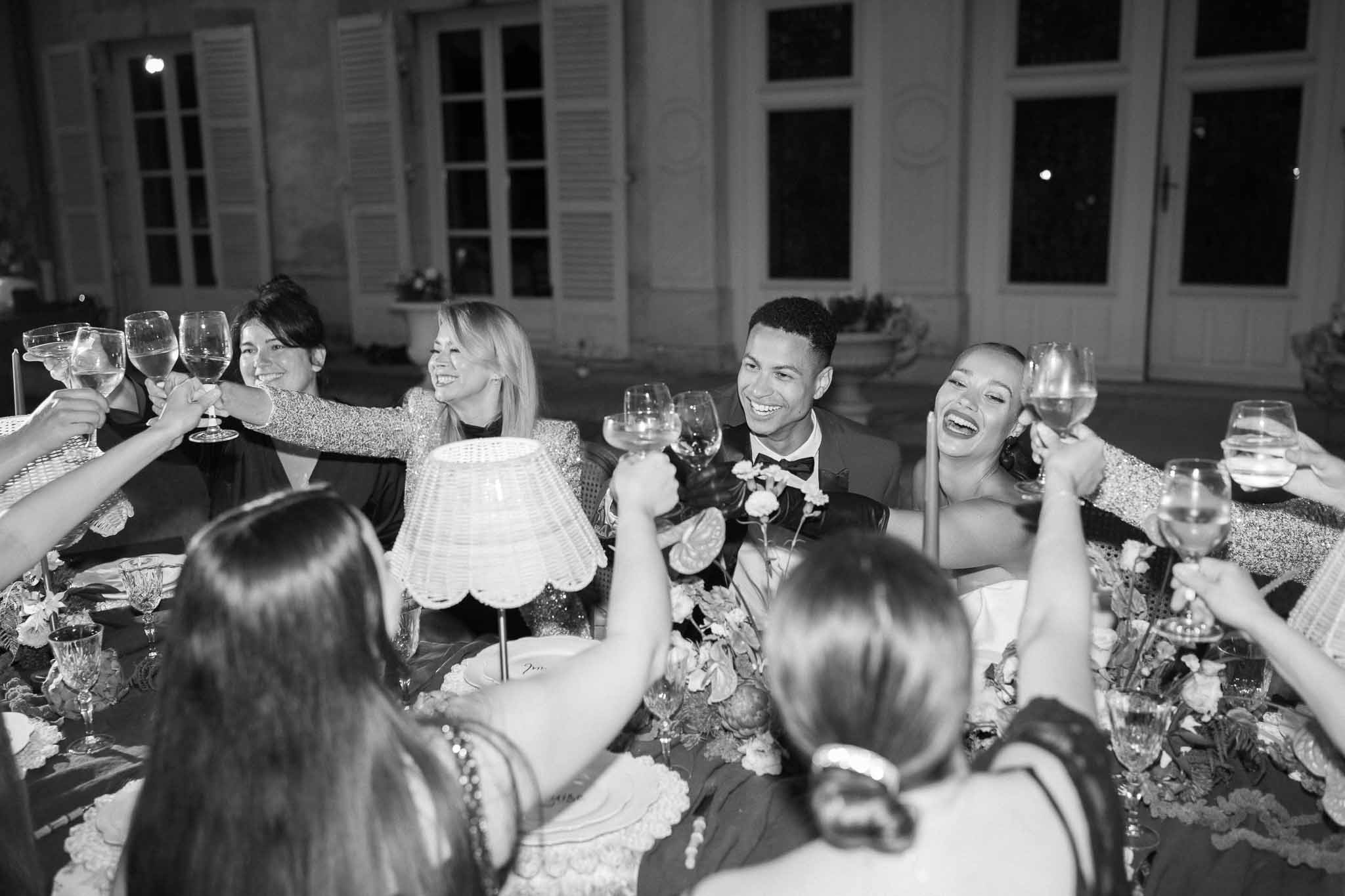
Vin d'Honneur, La Soirée & French Wedding Day Structure
A French wedding day runs on a rhythm entirely its own. Where British and American weddings compress ceremony, drinks, dinner, and dancing into five or six hours, a French celebration stretches from late afternoon through the small hours, with each phase carrying genuine purpose and its own visual identity. The vin d'honneur is not a drinks reception.
The dinner is not a meal. La soirée is not an afterparty. Each is a distinct chapter in a day designed to build, not rush. This guide walks you through the full architecture of a French wedding day, from the unhurried morning preparations to the moment guests are still dancing at 4am, as part of our complete guide to French wedding traditions and culture. For a broader view of every step involved, see planning your destination wedding in France from start to finish.
Key Takeaways
A French wedding day runs on a rhythm entirely different from British and American celebrations, stretching from late afternoon through the small hours with each phase carrying distinct purpose and visual identity. Ceremonies begin between 4 and 6pm to catch the golden hour light, followed by a vin d'honneur lasting 1.5 to 3 hours with substantial canapes that function as a complete social occasion. A two-tier guest list is standard in France: a broader circle attends the vin d'honneur while a smaller group stays for the four-to-five-hour sit-down dinner with speeches scattered between courses rather than grouped at the start. The ouverture de bal transitions the couple's first dance into a communal moment as family members join the floor within seconds. Dancing peaks between midnight and 3am, with the best celebrations continuing to 4 or 5am at venues without curfew restrictions.
- French weddings start later (ceremony at 4 to 6pm) and run much later (dancing peaks midnight to 3am, with the best celebrations continuing to 4 or 5am).
- The vin d'honneur is a complete social occasion lasting 1.5 to 3 hours with substantial canapés, not a brief holding pattern before dinner.
- A two-tier guest list is standard in France: a broader circle attends the vin d'honneur, while a smaller group stays for the sit-down dinner.
- Dinner lasts four to five hours, with speeches scattered between courses rather than grouped at the start.
- The ouverture de bal (first dance) transitions quickly into a communal moment as family members join the couple on the floor within seconds.
What Is the Structure of a French Wedding Day?
A French wedding day follows a six-phase arc that begins with unhurried morning preparations and ends well past midnight. The ceremony takes place between 4 and 6pm, timed to catch the late afternoon light. Dinner does not begin before 8pm. Dancing peaks between midnight and 3am. Across the venues listed on French Wedding Style, this structure holds remarkably consistent whether the setting is a Provençal mas in golden stone or a glass-walled domaine in the Languedoc. The timeline below reflects what experienced French wedding planners specialising in destination celebrations working with international couples in France consider standard for a summer château wedding.
Scroll →
| Time | Phase | Duration | What Happens |
|---|---|---|---|
| 10am | Preparations | 4 to 6 hours | Hair, makeup, getting ready. Unhurried, sociable. Often at the venue itself. |
| 4 to 6pm | Ceremony | 45 to 75 minutes | Symbolic or religious ceremony. Golden hour light. Readings, vows, ring exchange. |
| 5 to 8pm | vin d’honneur | 1.5 to 3 hours | Champagne, canapés, socialising. Full social occasion with substantial food. |
| 8pm onward | Dinner | 4 to 5 hours | Multi-course seated meal. Speeches between courses. Wine pairings. |
| 11pm to midnight | Pièce montée | 20 to 30 minutes | Dessert ceremony. Croquembouche or alternative. Sparklers, group moment. |
| Midnight to 4am+ | La soirée | 3 to 5 hours | Dancing, late-night food, communal celebration. Peaks around 1 to 2am. |
For international couples, the most important shift is pace. Nothing feels rushed. The morning preparation is genuinely relaxed, not a sprint to be camera-ready by noon. Guests arrive to the ceremony rested and dressed for an evening that stretches ahead of them. The vin d'honneur gives everyone time to connect before the more structured dinner begins. French guests expect a proper late night. Still going at 4am means it was a great wedding.
How Does the French Timeline Compare to UK and US Weddings?
| Element | UK / US Typical | French Typical |
|---|---|---|
| Ceremony start | 1 to 3pm | 4 to 6pm |
| Drinks reception | 1 hour | 1.5 to 3 hours (vin d'honneur) |
| Dinner | 2 hours | 4 to 5 hours |
| Speeches | Grouped before or during dinner | Scattered between courses |
| Dancing starts | 8 to 9pm | 11pm to midnight |
| End of night | 11pm to midnight | 3 to 5am |
What Is a vin d’honneur and How Does It Differ from a Drinks Reception?
A vin d'honneur (literally "wine of honour") is a formal post-ceremony reception that functions as a complete social occasion in its own right. It lasts 1.5 to 3 hours and includes champagne, wine, cocktails, and substantial canapés that go well beyond the handful of passed bites common at an Anglo-American drinks hour. The vin d'honneur is one of the most distinctive elements of a French wedding. It serves as the transition between ceremony and dinner, but calling it a "transition" understates its importance. For many guests, particularly those attending only this portion, it is the main event.
The food at a vin d'honneur is generous. Think charcuterie displays on tiered stone platters, local cheeses arranged on vine leaves, foie gras on toast points, smoked salmon cornets, warm tarts filled with Provençal vegetables, oyster bars in season. A well-catered vin d'honneur in Provence or south-west France feels closer to an apéritif dinatoire than a simple drinks reception.
An apéritif dinatoire takes this concept further: a cocktail-style dinner where passed and stationed canapés replace the seated meal entirely. Some couples choose an apéritif dinatoire as an alternative to the formal dinner, particularly for smaller weddings or those with a more relaxed vision. The food is more substantial, often six to eight different items served in succession, with enough volume that guests leave satisfied. It costs less than a full sit-down dinner and works well at venues where long outdoor evenings are the draw.
How Does the Two-Tier Guest List Work?
The two-tier guest list is a long-standing French tradition that allows couples to celebrate with a broader community without the cost of seating every guest for a five-course dinner. It works simply: a larger group is invited to the ceremony and vin d'honneur, while a smaller group stays for the sit-down dinner and la soirée. Based on destination weddings featured on French Wedding Style over 15 years, a typical split is 120 to 150 guests for the vin d'honneur and 80 to 100 for dinner.
This is not considered rude in France. It is culturally expected. Colleagues, neighbours, extended family, and acquaintances understand that an invitation to the vin d'honneur is a genuine welcome, not a consolation prize. The vin d'honneur is such a complete occasion, with champagne, food, socialising, and time with the couple, that the distinction feels natural rather than exclusionary.
For international couples, this tradition can feel uncomfortable at first. The instinct is to invite everyone to everything or no one at all. But the economics make a compelling case. A five-course dinner in France costs €120 to €250 per person depending on region and your choice of traiteur. Adding 40 guests to the vin d'honneur only costs €25 to €50 per head. The two-tier list lets you include people who matter without doubling your catering budget.
How to Communicate the Two-Tier Invitation
Clarity prevents awkwardness. French couples handle this with two separate invitation cards: one for the full day and one for the ceremony and vin d'honneur only. International couples can adapt this with clear wording on a wedding website. Phrases like "We would love you to join us for the ceremony and champagne reception" signal the scope without making it feel lesser. Avoid the word "only." Frame the vin d'honneur as what it is: a celebration worth attending.
Why Does French Wedding Dinner Last Four to Five Hours?
A French wedding dinner is structured around four to six courses served at a deliberate, conversational pace, with speeches, toasts, and guest performances woven between dishes rather than clustered at the start. The meal itself is the entertainment. This is fundamentally different from the UK model, where dinner is often a hurdle between the ceremony and the party. In France, dinner is the party. It occupies the emotional centre of the evening.
A typical progression: an amuse-bouche or starter served with white wine, a fish or seafood course, a meat main with red wine, a cheese course served before dessert (always before, never after), and then dessert followed by the pièce montée. Some menus add a palate cleanser, the trou normand, a small scoop of calvados-laced sorbet served between heavier courses to refresh the palate. Each course arrives with its own wine. Tables are set with multiple glasses. Bread sits directly on the tablecloth, not on a side plate, a small cultural detail that catches foreign guests by surprise.
The four-to-five-hour duration is not about slow service. It is about deliberate pacing. Between courses, guests talk. Speeches happen. A friend plays guitar. Children run between tables. The atmosphere shifts from focused attention during courses to animated conversation between them. By the time the croquembouche appears, often wheeled out on a trolley with sparklers blazing, the room has been building energy for hours. For couples interested in how music traditions shape the evening, the contrast between quiet dinner and loud party is deliberate.
When Do Speeches Happen at a French Wedding?
Speeches at a French wedding are scattered through the meal rather than grouped into a single formal block. This is one of the most noticeable cultural differences for British and American couples, who are accustomed to speeches happening consecutively, often before food is served or immediately after the main course. In France, a toast or short speech is given between courses, breaking the meal into segments punctuated by laughter, tears, and applause.
The effect is transformative. Instead of a 45-minute speech block that tests even the most patient audience, each contribution lasts three to five minutes and arrives when energy is high, right after a course is cleared and before the next one lands. Guests stay engaged because every speech feels like an interlude, not an obligation. The best French wedding planners advise no more than five or six speeches total, spaced across the evening, with the most emotional contributions (parents, best friends) placed between the main course and dessert when attention is at its peak.
A practical note for bilingual weddings: if speeches happen in two languages, alternate rather than translate. A French speech by the groom's father followed by an English speech by the bride's sister keeps the rhythm moving. Consecutive translation of each speech halves the energy and doubles the duration. Your ceremony celebrant or MC can manage these transitions smoothly.
The Guest Singing Tradition
One of the most genuinely moving French wedding traditions involves guests preparing songs, skits, or performances for the couple. These are not spontaneous. Friends and family rehearse for weeks, sometimes months. A group of university friends might rewrite the lyrics to a classic chanson. Siblings might create a video montage with narration. Cousins might perform a choreographed dance in the courtyard between courses.
These performances are woven into the evening alongside formal speeches. They can be hilarious, deeply sentimental, or both. For international couples, the tradition offers a way to include guests in the celebration beyond simply attending. Mention it in your wedding communications: "If you would like to prepare a song, toast, or performance, we would love it. Please let our MC know in advance so we can plan timing." Allocating 30 to 45 minutes across the evening for guest contributions is typical.
How Late Does a French Wedding Go?
A French wedding that ends at midnight is considered to have finished early. Dancing typically begins between 11pm and midnight, after dinner winds down and the pièce montée has been served. The ouverture de bal (first dance) opens the floor. In French tradition, family members join the couple within the first minute, turning the first dance into a communal celebration rather than a spotlight performance. From there, the party builds.
Peak energy on the dance floor hits between midnight and 2am. The best French wedding DJs and bands know how to sustain this through a mix of French classics, international hits, and well-timed tempo shifts. Daft Punk, Stromae, David Guetta, and Angèle sit alongside Earth, Wind & Fire and classic Motown. The playlist reflects the bilingual, international character of most destination weddings in France.
La soirée, the evening party phase, continues until 3, 4, or even 5am at venues without curfew restrictions. Late-night food appears around 2 to 3am: traditionally soupe à l'oignon (French onion soup), though modern alternatives include croque-monsieur stations, burger bars, and cheese boards. This late food sustains energy and brings guests back to the table for a final communal moment. By 4am, the crowd has thinned to the couple's closest friends and family, still dancing, still laughing, still in no hurry to end the night.
International couples should check their venue's sound curfew and music vendor rules before planning the evening timeline. Isolated château estates in rural Provence or the Dordogne often allow indoor music until 4 or 5am. Venues closer to habitation may enforce a 2am limit. This single detail, the curfew, shapes the entire second half of the evening.
For couples blending their home traditions with French customs, the timeline adapts. The six-phase arc accommodates cultural additions, from a Scottish cèilidh before the ouverture de bal to an Indian baraat procession before the ceremony. The structure is flexible. The rhythm is not.
What Do International Couples Get Wrong About the French Wedding Timeline?
The assumption that costs real money is scheduling the day too early. British couples planning a destination wedding in France in particular tend to set the ceremony at 2pm, which compresses the vin d'honneur and forces dinner to start before the golden hour light has faded. A 2pm ceremony means dinner at 5 or 6pm, which is culturally awkward in France (restaurants do not even open for dinner before 7pm) and wastes the best light of the day. Start the ceremony at 4pm or later. Trust the French timeline.
Just as damaging is underestimating dinner duration. Couples who allow two hours for dinner and schedule first dance at 10pm find themselves running behind by 11pm, with dessert still to come. A four-course dinner with speeches takes four hours minimum. Plan accordingly. Work backwards from when you want dancing to start, and you will find that an 8pm dinner start and midnight first dance is the natural French rhythm.
A parallel issue is treating the vin d'honneur as optional. Some international couples, trying to simplify logistics, skip straight from ceremony to dinner. This removes the most relaxed, social, and visually striking phase of the day. The vin d'honneur is when the best candid photographs happen: guests with champagne in a courtyard bathed in amber light, children chasing each other across gravel paths, the couple circulating freely for the first time as a married pair. Do not skip it.
Glossary of French Wedding Day Terms
A vin d'honneur is the formal post-ceremony champagne reception, lasting 1.5 to 3 hours, with substantial canapés. It functions as a complete social occasion.
An apéritif dinatoire is a cocktail-style dinner where passed and stationed canapés replace the formal seated meal. It is more substantial than a vin d'honneur but less structured than a sit-down dinner.
La soirée is the evening party phase that follows dinner, typically beginning around 11pm to midnight and continuing until 3 to 5am. It encompasses the first dance, dancing, and late-night food.
The ouverture de bal (literally "opening of the ball") is the French first dance tradition. Family members join the couple on the floor within seconds, making it a communal moment rather than a performance.
The pièce montée is the traditional French wedding dessert centrepiece. The classic version is a croquembouche (tower of caramel-bound choux pastry), though modern alternatives include macaron towers and tiered dessert displays.
Frequently Asked Questions
Can we shorten the French wedding day if our guests are not used to late nights?
You can adjust the timeline, but cutting too aggressively works against the natural rhythm. The most effective compromise is starting the ceremony at 4pm rather than 5 or 6pm, which brings dinner forward to 7:30pm and dancing to 10:30pm. This gives guests who prefer an earlier night the chance to leave by midnight while the celebration continues for those who want to stay. Cutting the vin d'honneur short (to one hour) also saves time without losing the tradition entirely.
Is it acceptable to have a first dance in the American or British style?
Completely. Your DJ or band leader can manage the transition. Ask them to keep the floor clear for the full first song, then invite family to join for the second. French guests will not be offended. They will simply wait for the invitation to join. Communicate your preference during the planning meeting with your entertainment vendor.
Do we need to serve late-night food?
It is strongly expected if your wedding runs past 2am. Guests who have been dancing for two or three hours need fuel. Traditional soupe à l'oignon costs €8 to €15 per person through most traiteurs. Modern alternatives (croque-monsieurs, sliders, crêpes) cost €10 to €20 per person. The cost is modest relative to the impact on guest energy and satisfaction.
How do we handle the two-tier guest list without offending people?
Frame the vin d'honneur invitation positively, not as a lesser invitation. Use language like "Join us to celebrate with champagne after the ceremony" rather than "You are invited to the ceremony and drinks only." In French culture, the distinction is understood and accepted. For international guests less familiar with the tradition, a brief note on your wedding website explaining the French custom removes any ambiguity.
What time should we tell guests the wedding starts?
Invitation time should be 15 to 30 minutes before the ceremony. For a 5pm ceremony, invite guests for 4:30pm. This allows seating, pre-ceremony music, and a settled atmosphere before the processional. Do not invite guests for 4pm and start the ceremony at 5pm. An hour of waiting with no indication of timing creates restlessness.
Can we have speeches in a single block like a British wedding?
You can, but the French scattered approach works better for longer meals. A 30-minute speech block followed by four hours of dinner without interruption creates a lull. Spacing three to five speeches between courses keeps energy high and gives each speaker a more attentive audience. If you prefer the grouped model, place speeches between the starter and main course when attention is still fresh.
What happens if it rains and the vin d'honneur was planned outdoors?
Most French wedding venues have a covered backup for the vin d'honneur: a covered terrace, an orangery, a vaulted reception hall. Ask your venue about their Plan B during the first visit. The best venues in Aix-en-Provence, the Bordeaux region, and the Normandy countryside all maintain indoor alternatives specifically for the vin d'honneur phase.
Explore Every Guide in This Chapter
Deep-dive into each topic covered above.