
French Venue Types Explained
International couples searching for a wedding venue in France encounter a vocabulary that has no equivalent in the UK, US, or Australian property market. Château, domaine, mas, bastide, manoir, abbaye: each word describes a specific architectural tradition with distinct implications for your wedding day, from the catering model and guest capacity to the ceremony options and overall atmosphere. This guide is a comprehensive reference to French venue types for destination weddings, drawn from the 438 properties listed on French Wedding Style and decades of editorial experience covering the French wedding industry. For a broader view of every step involved, see the full planning guide for destination weddings in France.
Key Takeaways
France has at least nine distinct wedding venue categories, each with different architectural roots, pricing structures, and practical implications for how a destination wedding unfolds. Châteaux account for 54% of all FWS-listed venues with a median site fee of €8,750, though the label spans everything from a 12th-century fortress to a 19th-century country house. A domaine is an agricultural estate typically offering more outdoor space and a relaxed character. A mas is a Provencal farmhouse built for farming families. A bastide is a grander Provencal manor sitting between a mas and a château in scale. Villa weddings are common on the Riviera but often lack professional kitchens, generator capacity, and adequate parking for large events. Understanding these distinctions before you start contacting venues saves weeks of misdirected enquiries and prevents mismatched expectations about the catering model, ceremony options, and overall atmosphere.
- France has at least nine distinct venue categories, each with different architectural roots, pricing structures, and practical implications for a destination wedding.
- Châteaux account for 54% of all FWS-listed venues, but "château" spans everything from a 12th-century fortress to a 19th-century country house. The median site fee is €8,750.
- A domaine is an agricultural estate. A mas is a Provençal farmhouse. A bastide is a grander Provençal manor. Confusing them leads to mismatched expectations.
- Villa weddings are common on the Riviera but often lack professional kitchens, generator capacity, and adequate parking for large events.
- The venue type determines your catering model, ceremony options, accommodation capacity, and supplier logistics more than any other single factor.
What Are the Main Types of French Wedding Venue?
France's architectural heritage produces a wider range of wedding venue types than almost any other European country. The main categories are château, domaine, mas, bastide, villa, manoir, hotel, abbaye, and salle des fêtes. Each type reflects a specific regional building tradition, social history, and relationship to the land.
A château in the Loire Valley was built to project aristocratic power. A mas in Provence was built to shelter a farming family from the mistral. A domaine in Languedoc was built to produce wine. These origins shape everything that matters to a couple planning a wedding: the layout of the grounds, the size of the kitchen, the availability of ceremony spaces, and the approach to catering and vendor management.
Understanding these distinctions before you start contacting venues saves weeks of misdirected enquiries. A couple searching for a "rustic farmhouse feel" who books a 17th-century château will find formal salons and gilded mirrors rather than exposed stone and long wooden tables. Conversely, a couple expecting a grand ballroom who books a mas will find a courtyard, a converted barn, and a kitchen designed for family meals rather than 120-guest sit-down dinners. The vocabulary is not interchangeable. Each term carries specific architectural and practical meaning.
How Does a Château Differ from a Domaine?
A château is a residential building of historical significance, constructed for aristocracy, military defence, or royal favour. Across the FWS venue collection, 54% are classified as châteaux, making this the dominant venue type in the French wedding market. The median site fee for a château wedding venue in France is €8,750, though the range spans from €3,000 for a modest rural property in the Lot to over €50,000 per day for a landmark Parisian estate.
Châteaux typically feature formal reception rooms with high ceilings, period architecture, manicured gardens with structured geometry, on-site accommodation in the main building or annexes, and ceremony spaces including terraces, orangeries, and grounds. The key challenge is that "château" covers enormous variation. A 12th-century fortified castle in Périgord operates very differently from an 18th-century neoclassical country house in the Loire. Always look past the label to the actual building.
A domaine, by contrast, is an agricultural estate. The word translates directly as "domain" or "estate" and implies land that is worked: vineyards, olive groves, lavender fields, or mixed agriculture. A domaine wedding venue often includes multiple buildings spread across the property, a working agricultural operation alongside the event business, more outdoor space relative to indoor space, and a relaxed, rural character rather than formal grandeur. The critical distinction is function versus status.
A château was built to impress. A domaine was built to produce. Many domaines have been converted into event venues while retaining their agricultural character, which gives them an authenticity that appeals to couples seeking something less formal. Pricing for domaines runs lower than comparable châteaux in the same region, typically €4,000 to €15,000 for a weekend, because the architecture lacks the historical prestige that drives château pricing upward.
What Is a Mas, and How Does It Compare to a Bastide?
Both mas and bastide are Provençal terms, and confusing them is one of the most frequent mistakes international couples make when searching for wedding venues in the south of France. A mas (pronounced "mah") is a traditional Provençal farmhouse. The architecture is low-slung, built from local stone, with thick walls designed to keep interiors cool in summer and retain warmth in winter.
A mas was built by farming families, not aristocrats. The structures are practical: small windows to block the mistral, an interior courtyard for shelter, and outbuildings originally used for livestock, olive pressing, or grain storage. As wedding venues, converted mas properties deliver a distinctly rural, relaxed atmosphere with stone walls, terracotta floors, fig trees, and lavender. Guest capacity is usually smaller, typically 60 to 100, because the buildings were designed for domestic life rather than entertaining.
A bastide is a grander Provençal country house. The word originally described a fortified medieval town, but in the context of rural properties, it refers to a manor house that sits between a mas and a château in both scale and formality. Bastides feature taller proportions than a mas, formal gardens rather than working farmland, better-finished interiors with period details, and larger reception capacity. A bastide was the country residence of a Provençal merchant or minor noble, not a farmer.
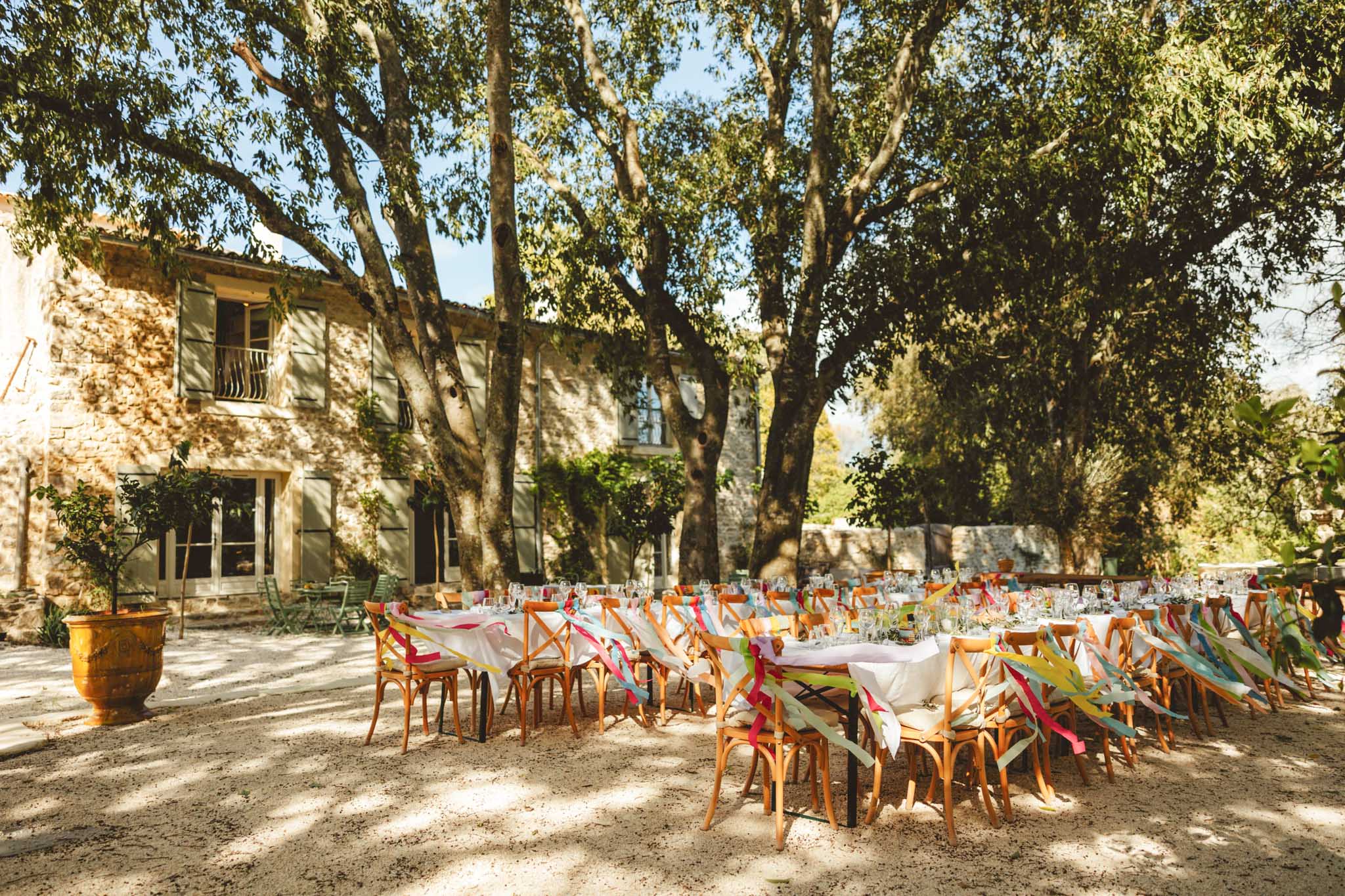
The difference matters for wedding planning because bastides typically offer more polished reception spaces, larger kitchens suited to professional traiteurs, and structured outdoor areas with fountains, allées, and parterre gardens. Both mas and bastide venues are concentrated in Provence, the Luberon, and the Alpilles. A couple seeking a barefoot outdoor celebration with long trestle tables under plane trees will find that in a mas. A couple seeking a Provençal setting with more formal structure and larger capacity should look at bastides.
What Should Couples Know About Villa Weddings in France?
A villa wedding in France typically means a private residential property on the Mediterranean coast, most commonly the Côte d'Azur between Cannes and Monaco. Villa venues are distinct from châteaux and domaines in several important ways that directly affect wedding logistics. Villas are residential properties first and event spaces second.
The architecture prioritises sea views, swimming pools, and outdoor terraces over grand reception halls. A villa wedding delivers intimacy, privacy, and a holiday atmosphere that guests remember. The best Riviera villas offer ceremony terraces overlooking the sea, pool areas for welcome drinks and after-parties, and gardens that work for both ceremonies and seated dinners under 80 guests.
The practical challenges are significant and routinely underestimated. Many villas lack professional-grade kitchens, which means your traiteur must bring mobile cooking equipment. Electrical capacity is often single-phase domestic supply, insufficient for full event lighting, a band, and catering equipment simultaneously. Generator hire becomes mandatory.
Parking is frequently limited, especially on hillside Riviera properties, making guest shuttle transport essential. Noise restrictions in residential coastal communes are strictly enforced, with outdoor music curfews as early as 22:00. Villa weddings are best suited to smaller guest lists of 40 to 80 and couples who prioritise atmosphere over infrastructure. For larger groups, a Riviera château or domaine will deliver more reliable logistics.
When Does a Hotel Venue Make More Sense Than a Private Estate?
Hotel weddings in France occupy a different category from private estate venues, and for certain couples, they solve problems that no château or domaine can. A hotel venue provides professional on-site catering with a tested kitchen and trained staff, accommodation for all guests under one roof, a dedicated events team with experience managing weddings, and liability insurance, permits, and compliance handled by the property. The trade-off is creative control.
Hotel venues work from set menus, approved timelines, and standardised room layouts. You are unlikely to bring your own traiteur, choose your own wines from a local cave coopérative, or run the reception past the hotel's contracted hours. The venue feels polished and reliable rather than personal and adventurous.
Hotel venues make the most sense for couples who value convenience over customisation, have a large international guest list where booking individual accommodation would be a logistical challenge, are planning a winter wedding where outdoor spaces are less relevant, or want a single point of contact managing every aspect of the venue experience. The pricing model is usually per-head rather than a flat site fee, which makes hotel weddings easier to budget but often more expensive at scale.
For 100 guests at a 4-star property in Provence, expect €200 to €350 per person for the reception package alone, before accommodation. The total for a full weekend can rival or exceed a mid-range château, but with significantly less flexibility.
Which Venue Type Delivers the Best Experience for Destination Weddings?
For international destination weddings in France, the venue types that consistently perform best share three characteristics: on-site accommodation, exclusive use for the full weekend, and space for both ceremony and reception. Exclusive-use venues allow guests to treat the property as a private retreat, which is the defining appeal of a French destination wedding. Across the FWS database, 72% of venues offer exclusive use. Properties with on-site accommodation (median: 33 beds in 13 rooms) eliminate the logistical burden of shuttle transport and allow welcome dinners, pool days, and farewell brunches to happen on site.
Châteaux and domaines with accommodation lead the destination wedding market because they deliver this combination at scale. A Loire Valley château sleeping 30 guests with formal gardens for the ceremony, a converted orangery for dinner, and a pool for the day-after brunch provides a self-contained wedding weekend. A Bordeaux wine estate offering 20 rooms, a barrel room for dinner, and vineyard walks delivers the same.
Bastides and mas properties work well for smaller destination weddings of 40 to 80, particularly when the couple values authenticity over grandeur. Villas suit intimate celebrations under 60. Hotels work when accommodation logistics outweigh the desire for creative control. The "best" type is the one that matches your guest count, style, and tolerance for hands-on planning.
Scroll →
| Venue Type | Typical Capacity | Site Fee Range (Weekend) | Best For | Key Consideration |
|---|---|---|---|---|
| Château | 80 to 250 | €3,000 to €50,000+ | Grand celebrations, formal receptions, heritage lovers | Wide variation in condition and services. Always visit before booking. |
| Domaine | 60 to 200 | €4,000 to €15,000 | Relaxed outdoor weddings, vineyard settings, creative freedom | Working agricultural estates may have seasonal restrictions. |
| Mas | 40 to 100 | €3,000 to €12,000 | Intimate Provençal weddings, rustic style, smaller guest lists | Limited kitchen infrastructure. Traiteur needs mobile equipment. |
| Bastide | 60 to 150 | €5,000 to €18,000 | Provençal character with more formal structure than a mas | Fewer available than mas or château properties. |
| Villa | 30 to 80 | €5,000 to €30,000 | Intimate Riviera celebrations, sea views, holiday atmosphere | Often lacks professional kitchen, generator, and parking. |
| Manoir | 60 to 120 | €3,000 to €12,000 | Norman or Breton character, half-timbered architecture | Concentrated in Normandy and Brittany. Good value compared to southern properties. |
| Hotel | 50 to 300 | Per-head pricing: €200 to €350/person | Convenience, large guest lists, winter weddings | Less creative freedom. Set menus and timelines. |
| Abbaye | 60 to 150 | €4,000 to €20,000 | Couples seeking spiritual atmosphere and historic architecture | Listed-building restrictions on décor, noise, and structural changes. |
| Salle des fêtes | 50 to 200 | €200 to €2,000 | Budget-conscious couples comfortable with a community hall setting | Minimal aesthetics. Rarely used by international couples. |
What Venue-Hunting Couples Consistently Misunderstand About French Properties
"Château" is not a quality guarantee. The word covers an enormous range. A listed 15th-century property with full restoration and a professional events team operates in a different category from a partially renovated 19th-century house that the owner markets as a château because it has a turret. The label tells you about the building's historical classification, not its suitability as a wedding venue. Always look at the actual facilities, kitchen specification, accommodation standard, and vendor infrastructure rather than the name on the gate.
Venue type does not determine price. A converted mas in the Luberon can cost more per weekend than a large château in the Lot. Location, season, and demand drive pricing more than architecture. Couples who dismiss all châteaux as "too expensive" or assume all domaines are "more affordable" will miss properties that fit both their style and their wedding budget perfectly. The median château hire of €8,750 across the FWS database challenges the assumption that these venues are only for six-figure budgets.
Catering implications vary by venue type. 66% of FWS-listed venues require couples to source their own traiteur, either from the open market (37%) or from a recommended supplier list (29%). Only 18% have in-house catering. This is standard at domaines, mas properties, and many châteaux. A hotel venue typically handles catering in-house.
A villa may lack the kitchen infrastructure for any serious catering operation. Before falling in love with a venue's appearance, confirm the catering model. It will determine your total budget more than the site fee itself. Our guide to the three catering models at French wedding venues explains exactly what each arrangement means for your planning and your budget. For detailed cost breakdowns by pricing model, read our guide to all-inclusive versus dry-hire wedding costs in France.

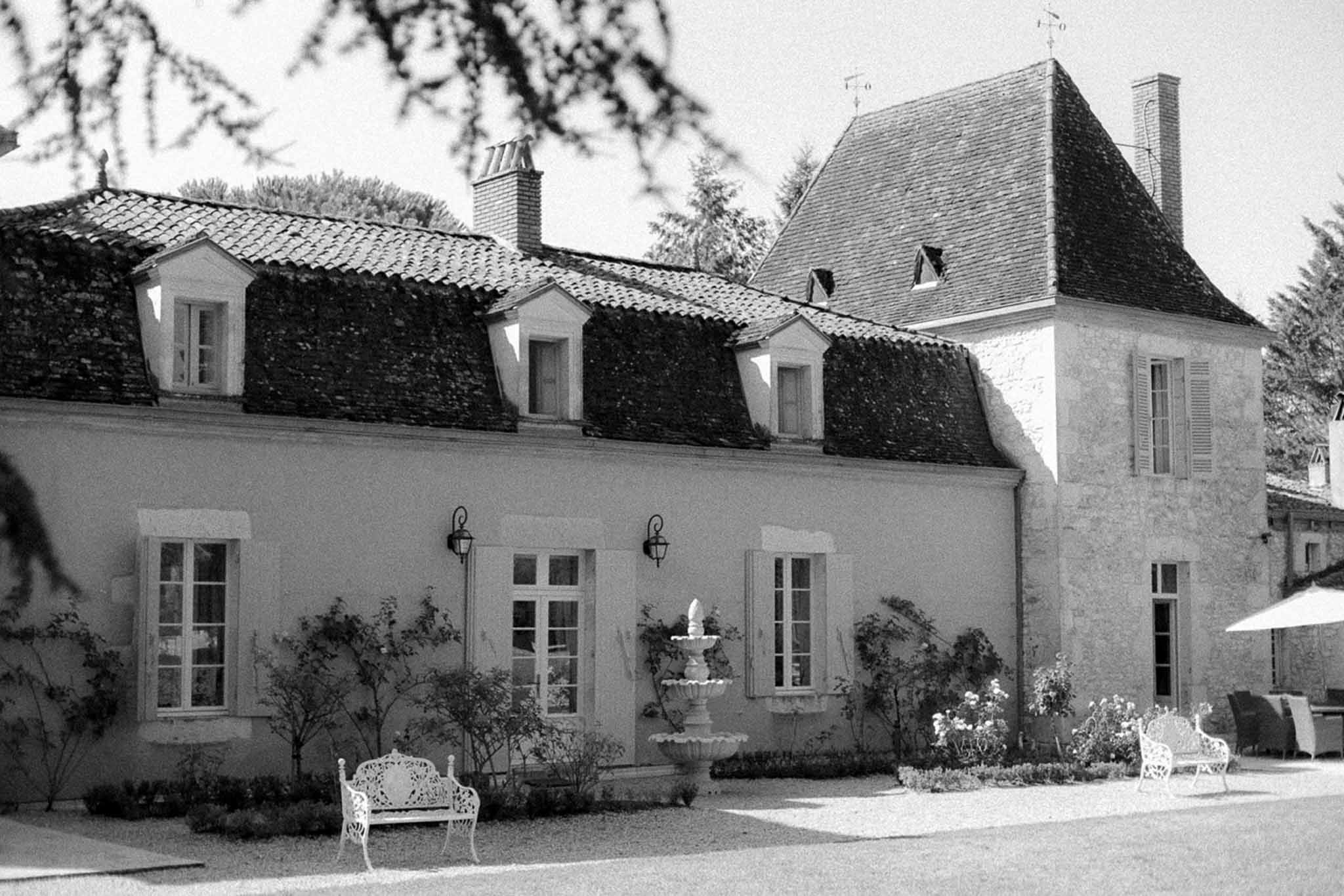
Some venue types are invisible in English-language searches. Manoirs, the Norman and Breton equivalent of a country manor, offer half-timbered colombage architecture, apple orchards, and proximity to both Paris and the Channel ports. They represent outstanding value compared to equivalent properties in Provence or the Loire, yet they rarely appear in international couples' shortlists because the word "manoir" does not carry the same instant recognition as "château." Similarly, abbayes (former abbeys and monasteries) deliver extraordinary atmosphere and acoustics but come with listed-building restrictions that affect décor, noise levels, and structural modifications. Understanding the full range of French venue types gives you access to properties that other couples overlook. See how this couple brought this to life at Château de Bonaventure in Nouvelle-Aquitaine.
Related Articles
These six guides expand on the venue type decisions covered above, from the 50 essential questions to ask during a French venue visit to the detailed cost comparison between all-inclusive and dry-hire models. The venue pricing guide explains how site fees, packages, and hidden extras work across each property type, while the château and rustic venue roundups provide shortlists filtered by region, capacity, and budget. The venue visit guide covers what to look for on the ground, including kitchen specification, accommodation standard, and vendor infrastructure, details that photographs and brochures consistently fail to convey. Together these articles form the complete venue selection chapter within the French Wedding Style planning series.
- 50 questions to ask your French wedding venue
- Visiting venues in France: what to look for
- How French wedding venue pricing works
- All-inclusive versus dry-hire venue costs in France
- Château wedding venues in France
- Rustic wedding venues in France
Frequently Asked Questions
Can a property be both a château and a domaine?
Yes, and many are. A château with working vineyards or agricultural land is often marketed as both "Château de X" and "Domaine de X." The distinction matters for setting expectations. If the venue emphasises its domaine character, expect a more rural, relaxed atmosphere with outdoor ceremony spaces among vines or olive groves. If it emphasises its château character, expect formal interiors, period furnishings, and structured gardens. When enquiring, ask specifically about the reception spaces and ceremony areas rather than relying on the name alone.
Which venue type is cheapest for a French wedding?
A salle des fêtes (community hall) is the lowest-cost option at €200 to €2,000, but it provides a blank-canvas space with no atmosphere, catering, or accommodation. Among dedicated wedding venues, rural domaines in the Dordogne, Lot, and Gers offer the strongest value, with site fees of €3,000 to €8,000 for a full weekend including accommodation. Mas properties in inland Provence (Vaucluse, Var hinterland) also offer competitive pricing. The key is comparing total cost, not just the site fee: a €4,000 domaine requiring €15,000 in additional logistics costs more than a €12,000 all-inclusive hotel.
Are bastide venues only found in Provence?
The term bastide has two distinct meanings in French architecture. In Provence, it refers to a country manor house and this is the meaning most relevant to wedding venue searches. In south-west France, particularly the Dordogne and the Lot, "bastide" refers to a planned medieval town built on a grid pattern, such as Monpazier or Domme. These bastide towns occasionally have venue spaces (town squares, covered market halls), but the properties marketed as "bastide wedding venues" are almost exclusively Provençal manor houses in the Bouches-du-Rhône, Var, Vaucluse, and Alpes-de-Haute-Provence departments.
What is a domaine viticole and can we hold a wedding there?
A domaine viticole is a wine-producing estate. Many accept weddings, particularly in Bordeaux, Languedoc, Burgundy, and the Rhône Valley. The appeal is obvious: ceremony among the vines, reception in a converted chai (barrel hall), and the estate's own wine served throughout the evening. The practical consideration is that a working vineyard has seasonal demands. Harvest (vendange) typically runs from mid-August to early October, and many domaines viticoles restrict or refuse weddings during this period. Confirm harvest dates when enquiring, and budget for the fact that most wine estates operate on a dry-hire model where you source your own traiteur.
Start with the venue type that matches your vision, not the one with the best photos. A couple who knows they want a relaxed outdoor celebration can skip every château listing and focus on domaines and mas properties. A couple who wants formal grandeur can ignore villas entirely. The vocabulary narrows the search before you send a single enquiry. Browse all wedding venues in France filtered by type, or return to our complete guide to finding your venue for the full chapter.
Explore Every Guide in This Chapter
Deep-dive into each topic covered above.