
Seating Plans: French Table Shapes & Etiquette
Seating at a French wedding is not a suggestion. It is a plan de table: assigned seats, not just assigned tables. Every guest has a specific chair at a specific table, and a hand-lettered card with their name marks their place. This level of formality surprises international couples who are used to assigning guests to a table and letting them choose where to sit.
In France, the hosts decide, and the arrangement reflects family hierarchy, social dynamics, and practical considerations that the plan de table has encoded for centuries. The room itself also dictates terms. A vaulted stone hall in a Loire château works differently from an open courtyard in Provence. The cultural expectations, the layout options, and the practical decisions that determine whether your dinner runs smoothly or descends into confusion. This forms part of our complete guide to planning a destination wedding in France. For the full chapter, see our complete final details guide.
Key Takeaways
- The French plan de table assigns each guest a specific seat, not just a table. Escort cards or a display board at the dining room entrance show guests their table number, and individual place cards at each setting show the exact seat.
- The couple traditionally sits at the centre of the top table (table d'honneur), flanked by parents and witnesses (témoins). The in-laws sit next to the spouse from the other family, not their own child.
- Long banquet tables and round tables are both used at French weddings. Long tables create a more convivial, family-style atmosphere. Round tables allow more flexible groupings and easier conversation within each table.
- The room dictates the layout. Narrow vaulted halls need long tables. Wide courtyards can accommodate either. Low ceilings favour round tables, which keep sightlines open. High ceilings suit long tables, which fill the space with drama.
- Finalise the seating plan 10 to 14 days before the wedding, after the final RSVP deadline. Expect 2 to 3 changes in the final week as guest numbers shift.
How Does French Seating Etiquette Differ?
The key difference is specificity. At an Anglo wedding, guests typically receive a table number and find any empty seat at that table. At a French wedding, every guest receives a specific seat. The distinction matters because French seating carries social information. Where you sit relative to the couple, the families, and the other guests signals your importance and your relationship to the hosts. The table d'honneur (top table or head table) seats the couple at the centre. To the couple's immediate left and right sit the parents: traditionally, the groom's mother and the bride's father on one side, the bride's mother and the groom's father on the other. This alternating arrangement, where in-laws sit beside the spouse from the opposite family, is the classic French convention. It facilitates cross-family conversation and signals the union of two families.
The témoins (witnesses, the French equivalent of best man and maid of honour) sit at the top table or at the closest adjacent table. Grandparents sit at a table of honour near the couple. Siblings and their partners are placed at tables adjacent to the families.
For the remaining tables, the French approach groups guests by social connection but alternates men and women around each table. Man, woman, man, woman. This gendered alternation is traditional and still widely observed, though modern French couples increasingly relax it. International couples can follow or break this convention as they prefer, but French guests will expect it.
Long Tables or Round?
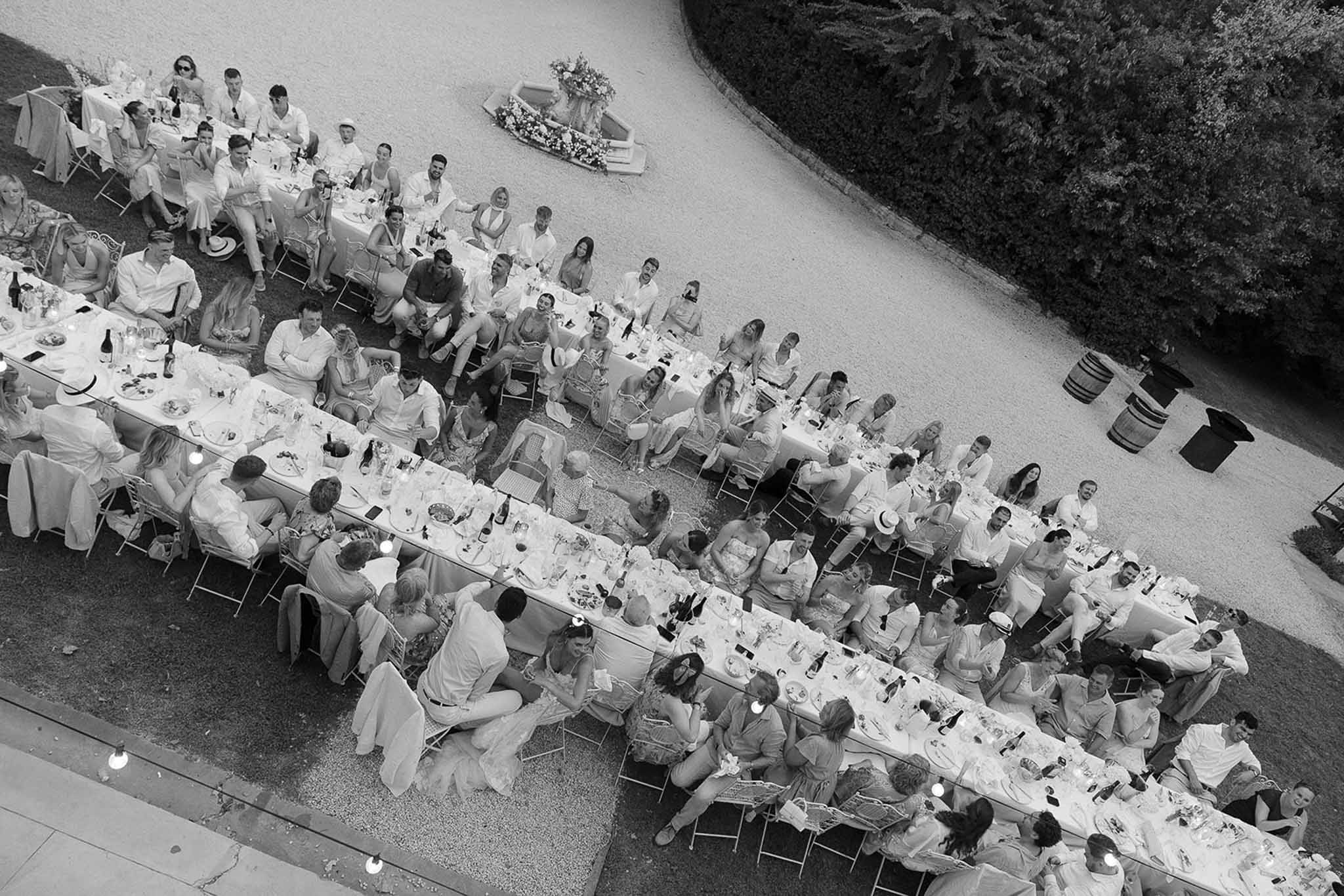
Long banquet tables create a communal, celebratory atmosphere. Guests sit on both sides of a single long surface, sharing platters, passing wine, and talking across the table. The visual impact is dramatic: a continuous line of candles, flowers, and glassware stretching the length of the room or courtyard. Long tables work well for weddings of 60 to 120 guests, where 2 to 4 parallel tables fill the space. They are the traditional choice at French château weddings and the format most commonly seen in real weddings featured on French Wedding Style. The limitation of long tables is conversation range. Guests can comfortably talk to the 2 to 3 people on either side and 2 to 3 people directly opposite. Beyond that radius, the table is too wide and too noisy. This means seating placement is critical. Pair guests who will enjoy each other's company in adjacent seats. Do not assume that being at the same table is enough.
Round tables (typically seating 8 to 10) allow more flexible social groupings. Every guest can see and speak to every other guest at the table. Conversation flows naturally around the circle. Round tables suit weddings with diverse guest groups who do not all know each other, because the table format encourages interaction.
Round tables require more floor space per guest than long tables. A round table seating 10 guests occupies more area than the equivalent section of a long table for 10. In narrow rooms, round tables may not fit. In wide courtyards, they can feel scattered unless carefully positioned.
| Factor | Long Tables | Round Tables |
|---|---|---|
| Atmosphere | Communal, family-style, dramatic | Intimate, conversational, flexible |
| Conversation | 2 to 3 people each side | Entire table (8 to 10 guests) |
| Floor space | Efficient: fits narrow rooms | Requires more width per guest |
| Visual impact | High: continuous tablescape | Moderate: repeated centrepieces |
| Service | Plated or family-style platters | Plated preferred (platters are awkward on rounds) |
| Best for | 60 to 120 guests, château dining halls, courtyard dinners | 80 to 200 guests, marquees, wide spaces |
How Does the Room Dictate the Layout?
Every French wedding venue has a primary dining space with its own constraints. The room shape, ceiling height, doorway positions, and fixed features determine which table format works before any aesthetic preference comes into play. Vaulted stone halls (common in Loire and Normandy châteaux) are typically long and narrow with low arched ceilings. Long tables running the length of the room are the natural and often the only option. Round tables would waste the side space and leave awkward gaps against the walls. The low ceiling creates intimacy, and the stone walls reflect candlelight in a way that amplifies the atmosphere. Open courtyards (common in Provence and the South-West) offer the most flexibility. Both long tables and round tables work. Long tables running parallel, a single U-shape, or clusters of round tables can all fill the space effectively. The key constraint is overhead coverage: if the dinner is outdoors, consider how a sudden rain shower would be managed. A clear-span marquee over the courtyard protects the seating without blocking the views.
Orangeries and glass-walled reception rooms suit round tables particularly well. The room is typically wide, the ceilings are high, and the windows provide views on multiple sides that round tables do not block. Long tables can obscure sightlines and feel imposing in a glass structure.
Marquees and tented spaces work with either format. The advantage of a marquee is that you define the space rather than adapting to it. Work with your rental company to position the tent, the dance floor, the bar, and the tables in an arrangement that creates flow from the apéritif area into the dining space and then onto the dance floor. At most château venues in France, the marquee is positioned adjacent to the main building, allowing guests to move between indoor and outdoor spaces throughout the evening.
What Is a Plan de Table?
The plan de table is the physical seating chart displayed at the entrance to the dining area. It is one of the first things guests see when they move from the apéritif to the dinner, and in France, it is treated as a design element of the wedding itself. The traditional format is a framed board or mirror listing each table number with the names of the guests seated at that table. Modern alternatives include individual escort cards (each guest receives a card with their name and table number), a digital display, or a creative installation (luggage tags, pressed flowers with names, a hand-drawn map of the tables). The format is a style choice. The function is practical: every guest needs to find their table quickly and without confusion. At the table itself, individual place cards mark each guest's specific seat. These are typically small folded cards with the guest's name hand-written or printed in a calligraphic style. The place card is placed above the charger plate or on the folded napkin.
For printed day-of stationery including place cards and table plans, see our dedicated guide. Your stationer can produce the plan de table and place cards as part of a coordinated suite that matches the invitation design.
Related Articles
- Final details: the complete guide
- Day-of stationery and printed details
- French dining traditions at weddings
- Traditional French wedding menu
- Lighting for French wedding venues
- Decorating a French château for a wedding
- Invitation wording for a French wedding
- Château wedding venues in France
- Large wedding venues in France
- Browse all wedding venues in France
Frequently Asked Questions
Can we have open seating instead of a plan de table?
You can, but French guests will find it unusual. Open seating works at very small weddings (under 30 guests) or very casual celebrations. At a seated dinner of 60+ guests, a plan de table prevents the awkward scramble of guests circling tables looking for seats, avoids the situation where two people end up at a table where they know nobody, and ensures that the couple controls the social dynamics of the evening. The plan de table exists because it works.
How do we handle couples who are separated by the alternating men-women rule?
Married and long-term couples can be seated together or separated, depending on the table. At the top table and family tables, the alternating convention is observed. At friend tables, you can relax the rule and seat couples next to each other if they prefer. Ask in advance. Some couples enjoy being separated for the dinner (it forces new conversations). Others are uncomfortable with it. The plan de table is yours to design.
When should we finalise the seating plan?
Set the RSVP deadline for 3 to 4 weeks before the wedding. Finalise the seating plan 10 to 14 days before, once the final guest count is confirmed. Expect 2 to 3 last-minute changes (cancellations, plus-ones confirmed late, dietary updates). Print the plan de table and place cards no more than 5 to 7 days before the wedding to minimise reprints.
Explore Every Guide in This Chapter
Deep-dive into each topic covered above.