
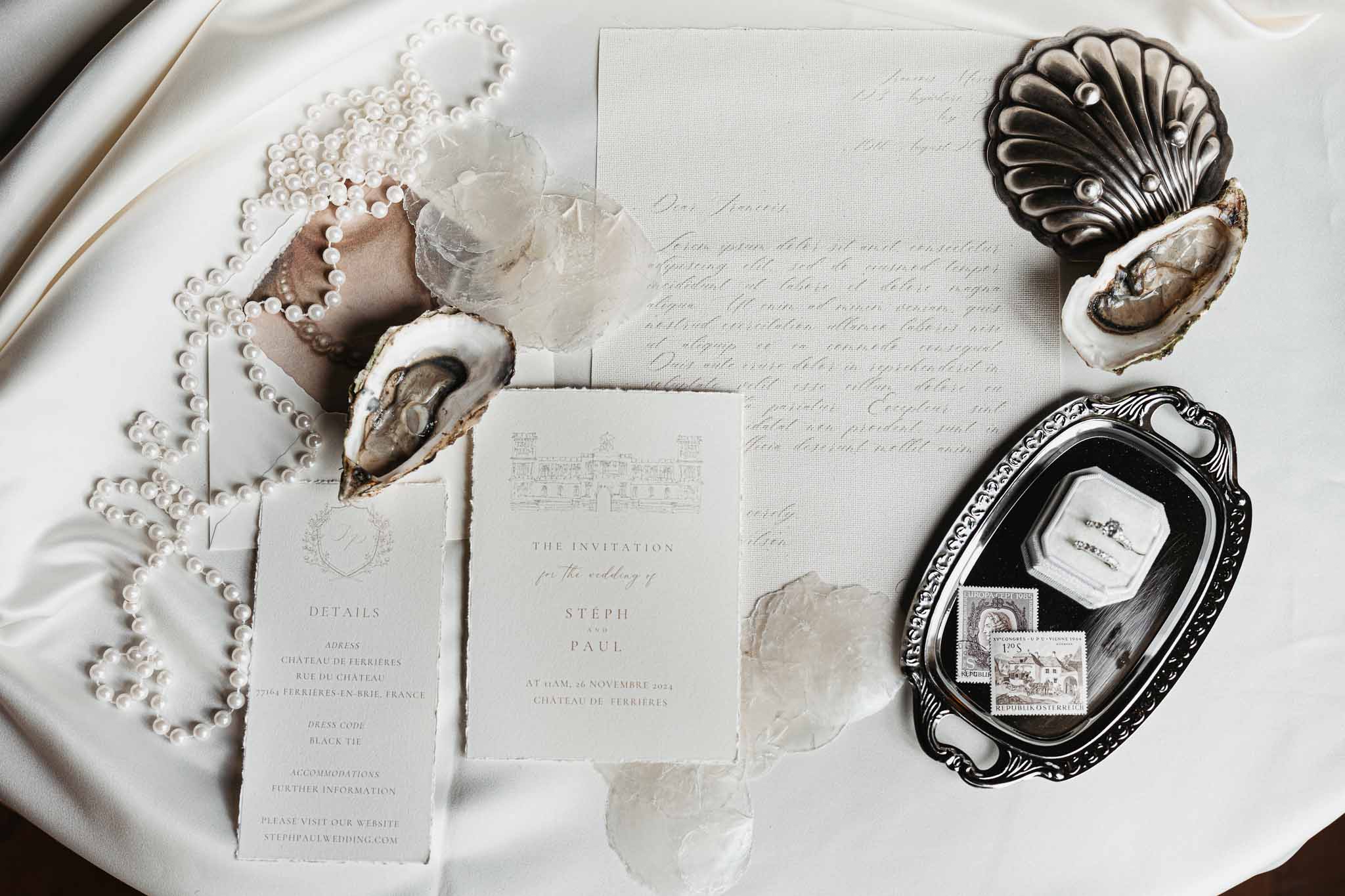
Save-the-Date Timeline for French Weddings
Save-the-dates for a French destination wedding need to go out earlier than you think. Your guests are not driving 40 minutes to a local hotel. They are booking international flights, taking extended leave from work, and arranging childcare across time zones. The timeline that works for a UK or US wedding does not apply. Below is exactly when to send, what to include, the digital versus printed debate, and the mistakes that leave your guests scrambling. For the full stationery journey from first announcement to the last place card, see our complete invitations and stationery guide. For a broader view of every step involved, see our step-by-step destination wedding planning guide for France.
Key Takeaways
- Send save-the-dates 9 to 12 months before a destination wedding in France. This gives international guests time to book affordable flights and request leave during peak holiday periods.
- Include the date, location (city and region, not just venue name), wedding website URL, and a note that formal invitations will follow. Do not include registry information at this stage.
- Digital save-the-dates work well for international guest lists and arrive instantly. Printed versions carry more weight for formal celebrations. A hybrid approach serves both needs.
- The biggest timing mistake is sending save-the-dates less than six months out, which forces guests into expensive last-minute flight bookings and limits accommodation options near rural venues.
How Early Should You Send Save-the-Dates for a French Destination Wedding?
Nine to twelve months before the wedding date. This is not aspirational. It is the baseline for any destination wedding in France with international guests. Based on destination weddings we have featured over 15 years on French Wedding Style, the couples who achieve the highest attendance rates are those who give guests a full year's notice. The save-the-date is not the invitation. It is the flag in the ground that says: hold this weekend, details to follow. The 9-to-12-month window accounts for three practical realities. First, international flights to regional French airports (Toulouse, Marseille, Bordeaux, Nice) are significantly cheaper when booked 6 to 9 months ahead rather than 6 to 8 weeks. A guest flying from Sydney to Provence can save €400 to €800 per person by booking early. Second, popular rural accommodation near wedding venues in regions like the Dordogne or the Loire Valley fills up during summer months. Guests need time to secure rooms.
For peak-season weddings (June through September), lean toward the 12-month mark. For shoulder-season dates (April, May, October), 9 months is sufficient. For holiday weekends (Easter, bank holidays, Bastille Day in July), send them 12 months out regardless of season. Your guests are competing with every other traveller for those dates.
Scroll →
| Wedding Season | Send Save-the-Date | Send Formal Invitation | RSVP Deadline |
|---|---|---|---|
| Peak summer (June to August) | 12 months before | 5 to 6 months before | 8 to 10 weeks before |
| Shoulder (April, May, September, October) | 9 to 10 months before | 4 to 5 months before | 8 weeks before |
| Off-peak (November to March) | 8 to 9 months before | 4 months before | 6 to 8 weeks before |
| Holiday weekends (any season) | 12 months before | 5 to 6 months before | 10 weeks before |
What Should a Destination Wedding Save-the-Date Include?
A save-the-date for a French wedding must include six pieces of information. The date itself. Your names. The location, stated as city or town plus region (not just the venue name, which means nothing to someone who has never visited France). The country. A wedding website URL where guests can find travel details as they become available. And a single line confirming that a formal invitation will follow. Do not include accommodation details, dress code, registry information, or a detailed schedule at this stage. The save-the-date is a prompt to hold the date, not a planning document. Overloading it creates confusion and invites premature questions you may not have answers to yet. Your wedding website is the right home for logistics. The save-the-date points to it. One element that many destination couples add, and should: a note about the multi-day nature of the celebration. "We're planning a weekend celebration from Friday 19 to Sunday 21 June" tells guests to book multiple nights, not just one.
A brief travel hint also helps. "The venue is 45 minutes from Toulouse airport" gives guests an immediate mental map. They can start browsing flight options the day they receive the save-the-date. This is the kind of practical detail that separates a thoughtful destination wedding from one that leaves guests guessing.
Digital or Printed: Which Works Better for International Guests?
Digital save-the-dates arrive instantly, cost nothing to post, and allow you to include a clickable link to your wedding website. For a guest list spread across three or more countries, these are significant advantages. A printed save-the-date mailed from France to Australia takes 10 to 14 days and costs €2 to €3 per card in international postage alone. Multiply that by 80 households, and you have spent €160 to €240 before the stationery is even printed. Printed save-the-dates carry more weight. Literally and emotionally. A well-designed card on heavy stock, arriving in a hand-addressed envelope, creates a moment. It goes on the fridge, the mantlepiece, the kitchen pinboard. It signals that this is not a casual event. For couples planning a formal celebration at a French château, that physical presence matters. The save-the-date sets the visual tone for everything that follows.
The hybrid approach works best for most destination couples. Printed cards for close family, the wedding party, and VIP guests. Digital for the broader guest list, sent via email or a platform like Paperless Post that maintains design quality. Both versions link to the same wedding website. Both carry the same information. The difference is the medium, not the message.
If you choose digital only, invest in good design. A well-designed digital save-the-date on a platform with RSVP tracking and calendar integration feels intentional. A jpeg attached to a group email does not. Couples who want the efficiency of digital with the polish of print should look at Paperless Post, Minted Digital, or Greenvelope, all of which offer destination wedding templates with map integration.
What Mistakes Do Couples Make with Save-the-Date Timing?
Sending too late is the most damaging mistake, and it happens constantly. Couples who send save-the-dates six months before a July wedding in Provence discover that flights from London to Marseille have doubled in price, the gîtes near their venue are fully booked, and two key guests cannot get time off work because they have already committed their summer leave. Every month of delay costs your guests money and reduces attendance. Sending too early is a rarer problem but real. More than 14 months ahead, guests may forget, lose the card, or dismiss it as premature. The sweet spot is the 9-to-12-month window. Early enough for practical planning, close enough that the wedding feels real and exciting. Sending to an incomplete list creates awkwardness. If one friend in a group receives a save-the-date and another does not, conversations start. Finalise your guest list (at least the A-list) before sending any save-the-dates. Adding names later is fine. Having someone feel excluded because they heard about it secondhand is not. See how this couple brought this to life at Château de Varennes in Burgundy.
Another mistake is failing to account for postal delays. If you choose printed save-the-dates and mail them from France, allow two to three weeks for European delivery and three to four weeks for delivery to the US, Australia, or Asia. Post offices in rural France do not always have the fastest processing times. Our guide to travel logistics your guests need when planning their trip to France explains the specifics. Send them in one batch, all on the same day, so all guests receive them within the same window. Staggered arrival creates a "did you get one?" conversation you want to avoid.
Related Articles
- Invitations and stationery for a French wedding: the complete guide
- French wedding invitation wording and etiquette
- What your destination wedding website must include
- Day-of stationery: menus, programs, and place cards
- Choosing a wedding planner in France
- Seasonal climate guide for weddings in France
- Destination wedding venues in France
- Browse all wedding venues in France
Frequently Asked Questions
Should save-the-dates be bilingual?
If your guest list includes both French and English speakers, yes. The save-the-date is shorter and simpler than a formal invitation, so bilingual formatting is straightforward: one language on each side of the card, or both on the same face with clear visual separation. For a predominantly English-speaking guest list marrying in France, English alone is acceptable at the save-the-date stage, with bilingual formatting reserved for the formal faire-part.
Do we need to send a save-the-date if we have a wedding website?
Yes. The save-the-date is the announcement that prompts guests to look at the website. Without it, guests do not know the website exists. The save-the-date creates the moment of communication. The website provides the depth. One cannot replace the other. Even if you share the date verbally with close friends early on, a formal save-the-date ensures every guest receives the same information at the same time.
What if we have not chosen our venue yet?
You can send a save-the-date with "Provence, France" or "Dordogne, France" as the location, without naming a specific venue. This gives guests the date, the destination, and the region for flight research purposes. Update the wedding website with the venue once confirmed. Do not delay the save-the-date beyond the recommended window just because the venue is not finalised. The date and region matter more to your guests at this stage than the specific property.
Should we include plus-one information on the save-the-date?
Address the save-the-date to the specific people invited. If a couple is invited, address it to both names. If a single guest is not being offered a plus-one, address it to their name only. Do not add a line about plus-ones on the save-the-date itself. The formal invitation is where you confirm exactly who is invited. Addressing the save-the-date correctly sets the expectation without an awkward explicit statement.
Can we use a magnet save-the-date for a destination wedding?
Magnets work well because they stay visible on the fridge for months, which is exactly what you want for a wedding that requires advance travel planning. The extra postage cost for the slightly heavier weight is modest. Design-wise, magnets suit informal and semi-formal celebrations. For a very formal black-tie wedding at a grand château, a flat card on heavy stock may feel more appropriate. Match the format to the tone of the wedding you are planning.
Explore Every Guide in This Chapter
Deep-dive into each topic covered above.