
50 Questions to Ask Your French Wedding Venue
Every international couple researching French wedding venues will find generic checklists online, and every one of those checklists misses the questions that actually matter in France. Commune noise regulations, the legal difference between arrhes and acompte deposits, whether a quoted price includes TVA, how the traiteur model works, whether the venue takes commission from recommended suppliers: these are the questions that prevent expensive surprises after you have signed a contract. 50 France-specific questions organised by theme, drawn from the 438 venues listed on French Wedding Style and the patterns we see repeated across hundreds of destination weddings every year. For a broader view of every step involved, see our complete guide to planning a destination wedding in France.
Key Takeaways
- Generic venue checklists miss France-specific issues: commune noise regulations (arrêtés préfectoraux), deposit law (arrhes vs acompte), VAT treatment (HT vs TTC), traiteur models, and symbolic ceremony permissions.
- 66% of French wedding venues require couples to source their own traiteur. Confirming the catering model is the most important question you can ask.
- Only 50% of FWS-listed venues provide tables and chairs. 74% do not include a sound system. Never assume furniture or equipment is included.
- The difference between arrhes and acompte in a French contract determines whether you can cancel without paying the full balance.
- Ask every question before signing. French venue contracts are legally binding documents, and cultural politeness should never override financial diligence.
Pricing and What Is Included
The first group of questions addresses the site fee (frais de location) and everything it does and does not cover. French venue pricing operates differently from UK or US models, and assumptions made at this stage cascade through every subsequent budget decision. Start here before discussing dates, menus, or décor. A quoted price of €15,000 may or may not include TVA (French VAT at 20%), tables and chairs, on-site accommodation, or sound equipment. Only 50% of FWS-listed venues provide furniture as standard, and 74% do not include a sound system. These exclusions can add €4,000 to €10,000 to your budget beyond the headline figure. Seasonal pricing variations compound the problem further, with the difference between a peak Saturday in July and an off-peak weekday in March reaching €10,000 at the same venue. The seven questions below cover the pricing fundamentals that every international couple must clarify before comparing any two French properties on cost.
- What does the frais de location cover, and what is charged separately? A frais de location is the site rental fee for exclusive use of the property. It typically includes the grounds, reception rooms, accommodation, and basic utilities, but inclusions vary dramatically between venues. Get a written breakdown before comparing any two properties.
- Is the quoted price HT (hors taxes) or TTC (toutes taxes comprises)? French TVA adds 20% on goods and 10% on services. A quote of €15,000 HT becomes €18,000 TTC. Always ask: "Est-ce TTC ou HT?" Apply this question to every supplier, not just the venue.
- What is the minimum rental period, and what does it include? Across FWS-listed venues, 61% require a minimum two-night stay, typically Friday to Sunday. Some properties require three nights during peak season. Confirm whether the quoted price covers the full stay or is priced per night.
- Is there seasonal pricing, and what are the peak, shoulder, and off-peak rates? The difference between a peak Saturday in July and an off-peak weekday in March can reach €10,000 at the same venue. Request the full rate card, not just the date you are enquiring about. For a full breakdown of how pricing works, see our guide to French wedding venue pricing.
- Are tables, chairs, and linens provided, or must we hire them? Only 50% of FWS-listed venues provide tables and chairs. Hiring 100 chairs, 10 banquet tables, and quality linens from a rental company adds €2,000 to €5,000 to your budget.
- Is a sound system or PA included? 74% of venues listed on French Wedding Style do not include a sound system. If you need speakers for the ceremony, speeches, and dancing, confirm whether the venue provides equipment or whether you must hire it independently.
- Are there any mandatory additional costs beyond the site fee? Some venues require you to book their on-site accommodation (even if your guests prefer hotels), use their cleaning team, or pay for a venue coordinator. These mandatory extras can add €2,000 to €5,000 to the headline price.
Catering Model and Kitchen
Catering is the largest single cost after the venue fee, and the catering model determines your total budget more than any other factor. Based on data from over 400 French wedding venues listed on FWS, 66% require couples to source their own traiteur (professional caterer). Understanding how your venue handles food and drink is not optional. It is the foundation of your entire budget. The three main models are in-house catering, an approved traiteur list, and open choice (dry hire). Each has different cost structures: in-house typically bundles food into the site fee, while dry-hire venues leave the full catering budget in your hands. Kitchen specifications also matter significantly. A domestic kitchen may require your traiteur to bring mobile equipment at an additional cost of €1,000 to €3,000. Wine policies, including droit de bouchon corkage fees of €5 to €35 per bottle, add another variable that shapes the total spend on food and drink.
- Does the venue offer in-house catering, an approved traiteur list, or open choice? A traiteur is a professional caterer. In-house catering means the venue handles everything. An approved list means you choose from pre-vetted caterers. Open choice means you find your own. Each model has different cost structures and levels of creative freedom. As of 2026, 42% of French venues operate a hybrid model with an approved list, 31% are pure dry-hire with open choice, and 11% offer all-inclusive catering. The remaining 16% operate on a price-on-request basis or do not publish their pricing model.
- If there is an approved traiteur list, how many options are on it, and can we meet them before booking? A list of two is not a choice. A list of eight gives you genuine negotiating power. Ask to speak with at least two traiteurs before committing to the venue.
- What is the kitchen specification? A professional-grade kitchen with three-phase electricity, commercial ovens, cold storage, and workspace for a team of five operates very differently from a domestic kitchen with a single oven. If the kitchen is insufficient, your traiteur must bring mobile equipment, which adds €1,000 to €3,000 to the catering invoice.
- What is the venue's wine policy, and is there a droit de bouchon? A droit de bouchon is a corkage fee charged per bottle opened. Rates range from €5 to €10 per bottle at mid-range venues to €20 to €35 at premium vineyard and wine-country properties. Some venues require you to purchase wine through their own stock or a partner supplier. Others allow you to source freely from local caves coopératives at €5 to €20 per bottle, saving significantly.
- Does the venue take commission from recommended suppliers? Some venues receive a referral fee from traiteurs and other vendors on their "recommended" list. This is not inherently problematic, but knowing it changes how you evaluate their recommendations. Ask directly.
- Where will cocktail hour, dinner, and late-night food be served? Confirm the specific spaces for each phase of the evening. A venue with a terrace for cocktails, a barn for dinner, and a separate room for dancing works differently from one where everything happens in a single marquee.
Ceremony and Legal
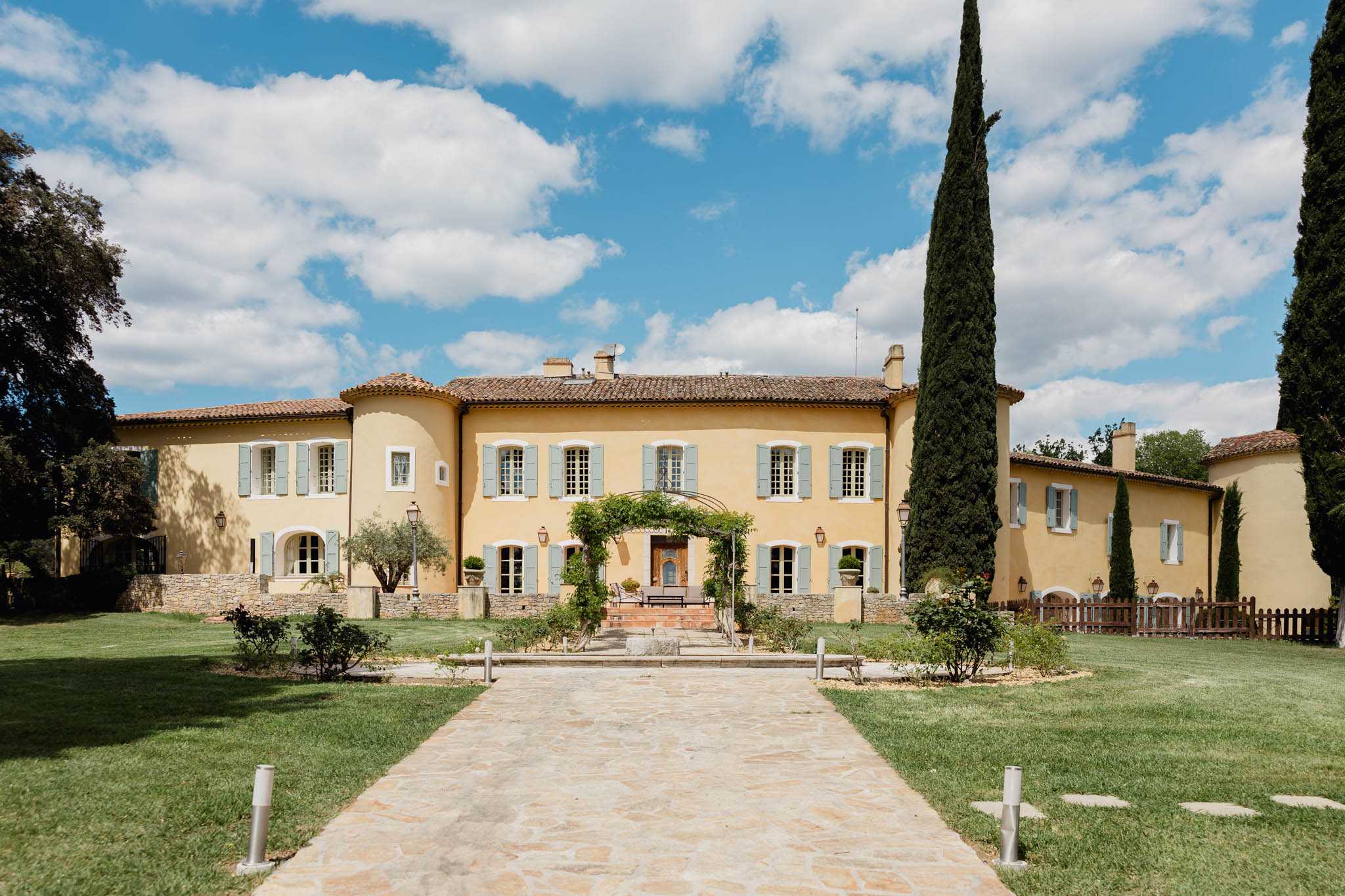
In France, only a civil ceremony at the local mairie (town hall) is legally binding. Any ceremony at the venue itself is symbolic. This distinction catches international couples who assume an outdoor ceremony under an olive tree is their legal wedding. It is not. The civil ceremony must take place in the commune where the venue is located, and mairies vary significantly in scheduling availability, with some requiring six months advance booking. Beyond the legal requirement, ceremony logistics at the venue itself involve questions about permitted locations, chapel status (consecrated versus deconsecrated), lighting orientation at your preferred ceremony time, and restrictions on confetti or candles at listed buildings. Across FWS-listed venues, 17% have on-site chapels, but chapel access does not automatically mean religious ceremonies are permitted. Clarifying these five questions before signing avoids the most common ceremony planning surprises.
- Does the venue permit symbolic ceremonies on site, and where? Most French venues allow symbolic ceremonies in their grounds, but confirm the specific locations offered: garden, terrace, chapel, courtyard, or interior salon. Check whether there is a fee for use of the ceremony space beyond the standard site rental.
- Where is the nearest mairie, and how far in advance must we book the civil ceremony? The civil ceremony must take place in the commune where the venue is located or where one partner has established residency. Mairies vary in availability. Some require booking six months in advance. Ask the venue for the specific commune mairie and its scheduling requirements.
- Does the venue have a chapel, and are religious ceremonies permitted? Across FWS-listed venues, 17% have on-site chapels. A chapel does not automatically mean religious ceremonies are permitted. Deconsecrated chapels allow any ceremony type. Consecrated chapels may require a Catholic service conducted by a priest. Confirm the chapel's status and any restrictions.
- Can the ceremony face a specific direction for light quality at our preferred time? An east-facing terrace is ideal for a morning ceremony but harsh and shadowed by late afternoon. A west-facing garden delivers golden light at 17:00 in July but is uncomfortably bright at 14:00. Confirm orientation and discuss timing with the venue.
- Are there restrictions on ceremony décor, confetti, or petals? Listed buildings (monuments historiques) often prohibit anything that could stain stone surfaces. Some venues ban confetti entirely. Others restrict the types of flowers or candle holders that may be placed on historic surfaces.
Accommodation
On-site accommodation is one of the defining advantages of a French destination wedding venue. The median across FWS-listed properties is 33 beds in 13 rooms, enough to house the core wedding party but rarely sufficient for all guests at a larger celebration. The standard of those rooms varies dramatically: "sleeps 30" can mean 15 well-appointed en-suite bedrooms or 10 rooms with shared facilities and extra mattresses in attic spaces. Some venues include all accommodation in the frais de location, while others charge per room per night, adding €3,000 to €8,000 for 30 guests over two nights. Mandatory full-property booking, air conditioning availability in southern France's 35-degree summers, and the quality and distance of overflow accommodation for larger guest lists are all questions that directly affect both budget and guest comfort. Browse venues with on-site accommodation to compare what is available.
- How many rooms and beds are available on site, and what is the standard? "Sleeps 30" can mean 15 well-appointed rooms with en-suite bathrooms, or it can mean 10 rooms with shared facilities and extra mattresses in attic spaces. Ask for the room-by-room breakdown, including which rooms have en-suite bathrooms, air conditioning, and heating.
- Is on-site accommodation included in the venue fee, or charged per room per night? Some venues include all accommodation in the frais de location. Others charge per room. At properties where rooms are charged separately, accommodation for 30 guests over two nights can add €3,000 to €8,000 to the total.
- Is booking all on-site accommodation mandatory? Some venues require the couple to book every room regardless of whether guests fill them. This prevents partial occupancy from affecting the venue's revenue, but it can add costs if your guest list is smaller than the venue's room inventory.
- What overflow accommodation exists nearby, and what is the transfer distance? For guest lists exceeding on-site capacity, confirm the nearest hotels, gîtes, or chambres d'hôtes. Rural châteaux may be 20 to 30 minutes from the nearest town. Shuttle logistics and costs increase with distance. The venue should be able to recommend specific overflow properties with which they have experience.
- Is there air conditioning in all guest rooms? Southern French venues in July and August experience temperatures above 35°C. Air conditioning in bedrooms is a comfort essential, not an optional extra. Confirm whether all rooms have it, or only some. Where AC is absent, ask about fan provision and ventilation.
Noise, Music, and Curfews
Noise regulations are the most misunderstood aspect of French venue selection. Every commune in France has the power to set local noise rules through arrêtés préfectoraux (prefectural decrees). These are not venue policies. They are local government regulations enforceable by the gendarmerie, and violating them can result in fines, confiscation of sound equipment, and in repeated cases, the venue losing its event licence. Across FWS-listed venues, only 13% are truly no-curfew properties. The majority impose outdoor music cutoffs between 22:00 and midnight, with indoor music permitted until 02:00 to 04:00. Many venues operate split rules: amplified music outdoors until a set hour, then a transition indoors for the late party. Understanding these thresholds before booking is essential, because a venue with no viable indoor dancing space alongside a 22:00 outdoor cutoff will end your party hours earlier than you planned.
- What are the commune's noise regulations (arrêtés préfectoraux) for this venue? Across FWS-listed venues, only 13% are truly no-curfew properties. The majority have outdoor music cutoffs between 22:00 and midnight, with indoor music permitted later, often until 02:00 to 04:00. Ask for the specific hours, not a vague "we're flexible." Request sight of the commune's arrêté if possible.
- What is the outdoor music cutoff, and what is the indoor cutoff? Many venues have split rules: outdoor amplified music until 22:00 or 23:00, then move indoors where music can continue until 02:00 or later. Confirm both thresholds and the transition plan. A venue that offers no viable indoor dancing space alongside a 22:00 outdoor cutoff is a problem for couples who want a late party.
- Has the venue ever received noise complaints, and what happened? This question reveals how the venue manages its relationship with the commune and neighbours. A venue that has navigated complaints and maintained its licence demonstrates competence. One that dismisses the question may be less transparent about actual constraints.
- Can we use a live band, or is only DJ/recorded music permitted? Some venues restrict live music due to volume levels, and a few prohibit amplified music entirely after a certain hour. Confirm before booking your band.
- Are there restrictions on fireworks, sparklers, or lanterns? Fire risk in southern France during summer is severe. Many communes issue summer fire bans (arrêtés sécheresse) that prohibit all pyrotechnics. Floating lanterns are banned in most of France due to fire and aviation safety regulations.
Weather and Plan B
France's climate is ideal for outdoor weddings from May to October, but rain, mistral winds, and extreme heat are all possibilities. Every venue on your shortlist must have a credible wet-weather alternative. "We move inside" is not a Plan B unless the venue can specify exactly where, for how many guests, with what lighting, and how the layout adapts. The most valuable assets a French venue can offer are covered outdoor spaces: terraces with permanent roofing, orangeries, glass-walled barns, and cloistered courtyards that provide weather protection without sacrificing the outdoor atmosphere. Summer heat creates different problems, with a 15:00 ceremony in July in Provence requiring shade from mature trees, a covered terrace, or a parasol structure. Electrical capacity is another practical concern, as rural properties frequently lack the power for full event lighting, sound, and catering equipment without a generator, which adds €800 to €2,000 per weekend.
- What is the Plan B for an outdoor ceremony if it rains? "We move inside" is not a Plan B. Ask: where exactly? How many guests does the indoor space hold? Is the ceremony layout the same? Does the lighting work for photography? A convincing Plan B is a specific room with tested capacity, not a vague assurance.
- What covered or enclosed outdoor spaces exist? Terraces with permanent cover, orangeries, glass-walled barns, and cloistered courtyards provide weather protection without losing the outdoor atmosphere. These spaces are the most valuable assets a French venue can offer, because they solve the weather problem without defaulting to a dark interior room.
- Is there heating available for autumn or winter weddings? Stone-walled châteaux and domaines can be cold even in September evenings. Confirm whether the venue provides heating in reception spaces. Industrial heaters for a barn or marquee are an additional hire cost of €500 to €1,500.
- Is there shade for summer ceremonies? A 15:00 ceremony in July in Provence requires shade. Mature trees, a covered terrace, or a parasol structure are essential. Ask the venue to describe the shade situation at your preferred ceremony time.
- Does the venue have a generator, and is it included? Rural properties frequently lack the electrical capacity for full event lighting, sound, and catering equipment. Generator hire runs €800 to €2,000 per weekend. Confirm whether the venue provides one or whether you must arrange it independently.
Contracts and Payments
French contract law differs from English common law in ways that directly affect your financial exposure. The two terms you must understand before signing any French venue contract are arrhes and acompte. They are not interchangeable, and the difference determines your cancellation rights. An arrhes is a reservation deposit that allows either party to withdraw: the couple loses the deposit, or the venue refunds double. An acompte is a binding part-payment that commits the couple to the full contract price regardless of cancellation. Beyond this critical distinction, the standard payment structure involves 30% to 50% at signing with the balance due one month before the event, plus a security deposit (caution) of €1,000 to €5,000 held against property damage. French-language contracts are the legal standard, and the French version prevails in any dispute, making professional translation essential for non-French-speaking couples. Event liability insurance (responsabilité civile) at €150 to €400 is required by virtually every venue.
- Is the deposit classified as arrhes or acompte? An arrhes is a reservation deposit that allows either party to withdraw. If the couple cancels, they lose the deposit. If the venue cancels, they must refund double the deposit. An acompte is a binding part-payment. Once paid, the couple owes the full contract price regardless of cancellation. Most French venue contracts specify which term applies. If the contract does not specify, French law defaults to arrhes. Always check this clause. For a full explanation of arrhes, acompte, and TVA in French vendor contracts, see our contracts guide.
- What is the full payment schedule? The standard structure is 30% to 50% at signing, with the balance due one month before the event. Some venues add a midpoint payment at six months. Confirm every payment date, amount, and method.
- What are the cancellation terms beyond the deposit? Understand what happens if you cancel three months out, one month out, or at the last minute. Some venues retain a sliding percentage of the total. Others enforce the full contract price under an acompte agreement.
- Is there a security deposit (caution), and how is it returned? A caution of €1,000 to €5,000 is standard. It is held against property damage and returned after a post-event inspection, typically within 30 days. Confirm the amount, the inspection process, and the return timeline in writing. Across FWS-listed venues, the typical security deposit is approximately €3,000.
- Is the contract in French only, or is an English version available? French-language contracts are the legal standard. Some venues provide English translations as a courtesy, but the French version prevails in any legal dispute. If the contract is French only and you do not read French fluently, invest in a professional translation. A traducteur assermenté (sworn translator) can provide a legally certified version.
- What insurance does the venue require us to hold? Virtually every French venue requires event liability insurance (responsabilité civile). This covers damage to the property and injury to guests during the event. The policy costs €150 to €400 and is non-negotiable. Some venues also require proof of wedding insurance covering cancellation.
Access, Logistics, and Setup
The practical details of getting people, equipment, and supplies to a rural French venue are where the gap between expectation and reality is widest. A château photographed from the air looks like a five-minute drive from civilisation. On the ground, it may be 40 minutes from the nearest town on a single-track road. A 7.5-tonne catering truck, a florist's van, and a furniture hire lorry all need adequate road width, turning space, and a firm surface to reach the property. Gravel tracks that turn to mud in rain present genuine logistical risks. Setup timing is equally important: a venue that allows Friday morning access for a Saturday wedding gives vendors adequate preparation time, while one that restricts access until Saturday morning creates pressure across every supplier. Parking capacity, vendor overnight accommodation at remote properties, and mobile phone signal strength for day-of coordination are all practical questions that affect the smooth running of your wedding more than any design decision.
- What is the access road like, and can a large catering truck reach the venue? Many rural châteaux and domaines are accessed via narrow country roads. A 7.5-tonne catering truck, a florist's van, and a furniture hire lorry all need adequate road width, turning space, and a firm surface. Gravel tracks that turn to mud in rain are a genuine logistical risk.
- When can vendors access the site for setup, and when must they clear by? Confirm the earliest setup time and the latest breakdown time. A venue that allows Friday morning setup for a Saturday wedding gives vendors adequate time. One that restricts access until Saturday morning creates pressure and increases the risk of things going wrong.
- How much parking is available, and where? Confirm the number of spaces for guest cars, vendor vehicles, and the couple's transport. Rural venues rarely have formal car parks. If parking is in a field, consider wet-weather conditions. Valet or shuttle services may be necessary for hilltop or coastal properties with limited access.
- Can vendors stay overnight? If the venue is remote and the wedding runs past midnight, your DJ, photographer, and other vendors may need accommodation. Some venues offer vendor rooms at reduced rates. Others expect all non-guests to leave the property after the event.
- Is there mobile phone signal and Wi-Fi? Rural France has patchy mobile coverage. Confirm signal strength on-site and whether Wi-Fi is available. This matters for vendor coordination on the day, guest communication, and live-streaming if planned.
Venue Management and Coordination
The level of on-site management a venue provides determines whether you need a separate wedding planner or coordinator, and this decision has significant budget implications. Some French venues provide a dedicated venue manager who is present throughout the event, handling supplier access, timeline adjustments, and guest logistics. Others provide only a caretaker who manages key handover and emergency contacts but plays no active role during the celebration. Understanding this distinction before signing the contract allows you to budget accurately for coordination support. Vendor lists, event frequency during peak season, turnaround times between bookings, and post-event cleaning expectations all fall under venue management. A property hosting back-to-back weddings every weekend in July and August has less setup flexibility than one hosting 15 events per year, and this directly affects the time available for your suppliers to prepare the space.
- Who is the day-of venue contact, and what is their role? Some venues provide a dedicated venue manager who is present throughout the event. Others provide a caretaker who handles key handover and emergency contacts but does not manage the day. Understand exactly what level of on-site support the venue provides, because this determines whether you need a separate wedding planner or coordinator.
- Does the venue provide a recommended vendor list, and how current is it? A curated list of traiteurs, photographers, florists, and planners who know the property saves significant research time. Ask when the list was last updated and how vendors are selected. Also ask the question from point 12: whether the venue receives commission from listed vendors.
- How many weddings does the venue host per week during peak season? A venue hosting back-to-back weddings every weekend has less setup flexibility than one hosting 15 per year. Confirm the turnaround time and whether another event will immediately follow yours.
- What condition should we leave the property in? Dry-hire venues expect the property returned to its pre-event state. Confirm whether professional cleaning is included in the fee or arranged separately. Damage deposit inspections typically happen the morning after the event.
The One Question Nobody Asks
After hundreds of venue profiles and thousands of couple enquiries processed through French Wedding Style, one question consistently separates well-prepared couples from those who encounter problems later. Every venue has experienced problems at previous weddings: storms that forced last-minute ceremony relocations, generator failures during dinner service, noise complaints from neighbours, catering issues that required improvisation. The question "What has gone wrong here before, and how did you handle it?" is not adversarial. It is the most revealing question you can ask, because the answer tells you how the venue team responds under pressure. A venue that gives a thoughtful, specific answer demonstrates experience and transparency. One that insists nothing has ever gone wrong is either new or not being honest. The follow-up question, "What do you wish couples knew before booking?" often surfaces practical information the venue does not volunteer in marketing materials.
- What has gone wrong at a previous wedding here, and how did you handle it? This question is not adversarial. It is the most revealing question you can ask. Every venue has experienced problems: a storm, a generator failure, a noise complaint, a catering issue. The answer tells you how the venue team responds under pressure. A venue that gives a thoughtful, specific answer demonstrates experience and transparency. One that insists nothing has ever gone wrong is either new or not being honest.
- What do you wish couples knew before they booked this venue? This open-ended question often surfaces information the venue does not volunteer: the fact that the nearest pharmacy is 45 minutes away, that the pool is unheated and unusable before June, that the mobile signal drops entirely in the east wing, or that the gravel driveway is impassable for guests in heels. Venue owners who answer this question honestly are the ones you want to work with.
French Terms Glossary
| French Term | Meaning |
|---|---|
| Frais de location | Site rental fee for exclusive use of the venue, typically covering the property for a two-to-three-night weekend. |
| Arrhes | A reservation deposit. Either party may cancel: the couple forfeits the deposit, or the venue refunds double. |
| Acompte | A binding part-payment. Once paid, the full contract price is owed regardless of cancellation. |
| Droit de bouchon | Corkage fee charged per bottle opened at the venue, typically €5 to €35 depending on the property. |
| Arrêtés préfectoraux | Local prefectural decrees governing noise limits, event hours, and fire regulations within a commune. |
| Traiteur | A professional caterer. In France, traiteurs operate as independent businesses, not venue employees. |
| Traducteur assermenté | A sworn translator authorised to produce legally certified translations of official documents. |
| Caution | Security deposit held against property damage, returned after a post-event inspection. |
| HT (hors taxes) | Price excluding tax. French TVA of 20% (goods) or 10% (services) is added on top. |
| TTC (toutes taxes comprises) | Price including all taxes. This is the final amount you pay. |
Related Articles
- French wedding venue types explained
- Visiting venues in France: what to look for
- How French wedding venue pricing works
- Hidden costs of a destination wedding in France
- Exclusive-use wedding venues in France
- All-inclusive wedding venues in France
Frequently Asked Questions
Should we ask all 50 questions at the venue visit?
No. Prioritise the questions about catering model, noise regulations, accommodation, and contract terms during the visit. Save the detailed financial and legal questions for a follow-up email, where you will have written responses on record. During the visit, focus on experiencing the property: walk the ceremony route, stand where your guests would sit for dinner, check the bathroom facilities, and assess the drive from the nearest town. The atmosphere and practical layout tell you things no questionnaire can capture.
What if the venue cannot answer a question about commune regulations?
A venue that does not know its own commune's noise regulations or fire restrictions is a concern. This information is fundamental to operating a legal event business. If the venue is unsure, ask for the name and contact details of the mairie so you can verify directly. You can also request the venue's operating licence or event permit, which will specify the hours and conditions under which events are authorised.
Is it normal for French venues not to have a formal contract?
No. Any professional French wedding venue will provide a written contract (contrat de location) specifying the rental period, price, inclusions, payment schedule, deposit terms, cancellation policy, and insurance requirements. If a venue proposes a verbal agreement or a single-page "confirmation," treat this as a significant red flag. French contract law protects both parties, but only when the terms are documented in writing and signed.
Can we negotiate on any of these points?
Certain points are negotiable, particularly outside peak season. Additional nights, early check-in, use of secondary spaces, waived corkage on independently sourced wine, and added vendor accommodation are all areas where venues have flexibility. The headline site fee is rarely negotiable during June to September, but shoulder-season and weekday bookings offer more room for discussion. Approach negotiation as a collaborative conversation about value, not a demand for discounts. For a full breakdown, see our guide to managing your French wedding budget.
Bring this list to your first site visit. Print it, share it with your partner, and use it as the framework for every venue conversation. The couples who avoid expensive surprises are the ones who asked the difficult questions before signing, not after. When you are ready to see venues in person, read our guide to visiting wedding venues in France, or return to our complete guide to finding your venue for the full chapter.
Explore Every Guide in This Chapter
Deep-dive into each topic covered above.