
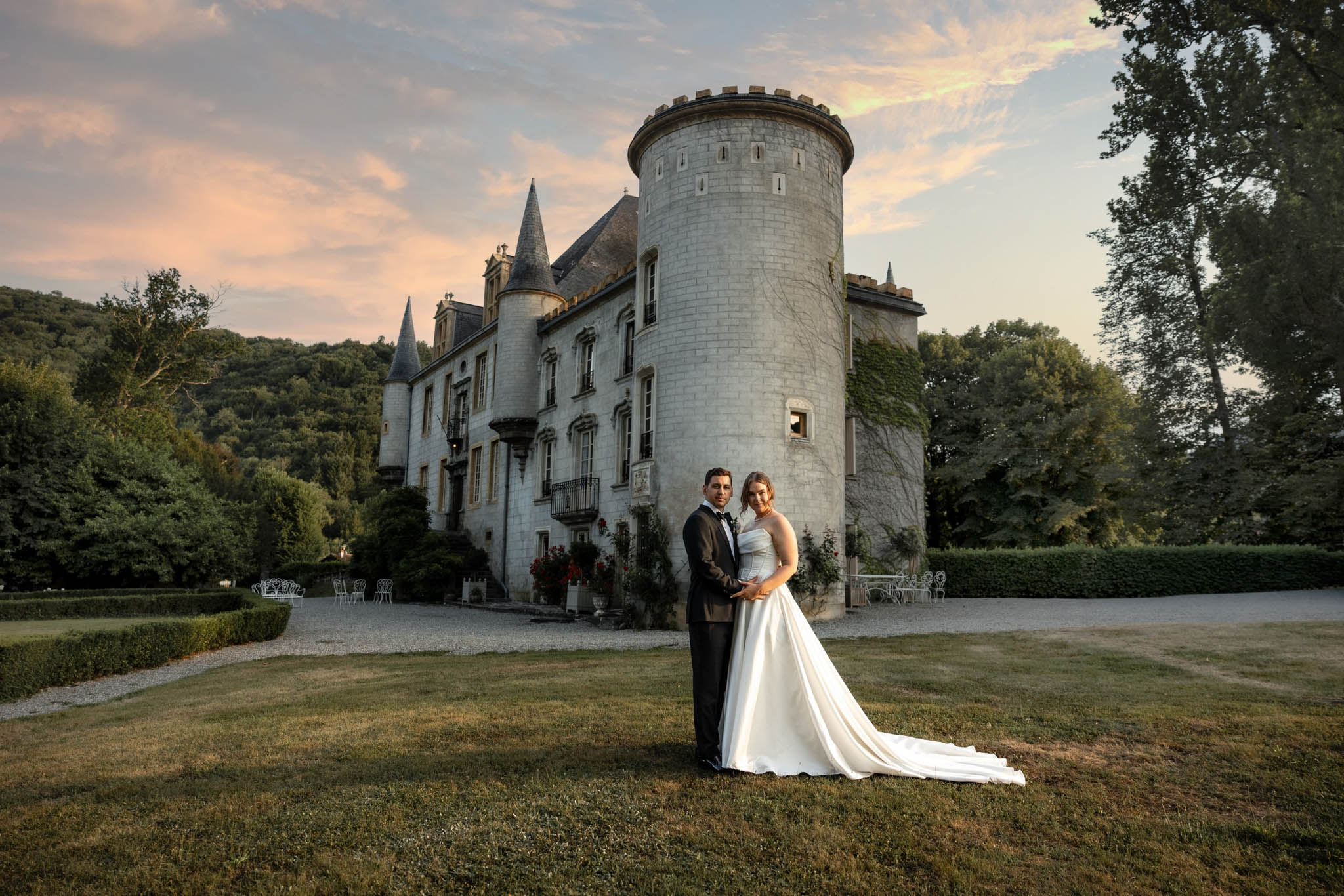
Finding a Wedding Photographer in France
Your photographer is the only vendor whose work you will live with every day after the wedding. The flowers die, the cake is eaten, and the venue returns to hosting someone else's celebration. The photographs stay.
Across the French Wedding Style vendor directory of 400+ wedding professionals, photography is the category where the gap between a good hire and a wrong one is widest and most permanent. Pricing tiers, portfolio evaluation criteria that go far beyond aesthetics, the second shooter question, the local versus fly-in decision, and the warning signs that predict a photographer who will not deliver. It connects to our broader guide to assembling your vendor team for a French wedding. For a broader view of every step involved, see our complete guide to planning a destination wedding in France.
Key Takeaways
- French wedding photography breaks into three pricing tiers: mid-market (€2,000 to €3,000), established (€3,000 to €5,500), and top-tier (€6,000 to €12,000+). Paris, Provence, and the Côte d'Azur sit at the top of each range. The South-West offers the best value.
- Evaluate portfolios on seven criteria: consistency across weddings, reception lighting quality, unguarded emotional moments, range of couple types, how unflattering moments are handled, transition coverage, and performance in poor conditions.
- A second shooter is worth the investment for weddings with 100 or more guests. Below that, a strong lead photographer working alone is standard practice in France.
- A strong local photographer is the better default. Flying one in adds €500 to €1,500 in travel costs and removes the advantage of knowing the light, the venues, and the vendor network.
- Book 18 months ahead for Provence and the Riviera in peak season. Other regions: 9 to 12 months.
How Much Does a Wedding Photographer Cost in France?
Wedding photography pricing in France in 2026 organises into three tiers, and the boundaries between them are reasonably consistent across regions. Mid-market photographers with solid technical skills and three to five years of experience charge €2,000 to €3,000 for full-day coverage of 8 to 10 hours. Established photographers with strong portfolios, editorial publication credits, and five to ten years of destination wedding experience charge €3,000 to €5,500. Top-tier photographers with international reputations and consistent magazine features charge €6,000 to €12,000 or more. These figures typically cover the photographer's fee, travel within mainland France, a set number of edited images (300 to 800 depending on the package), and an online gallery. Second shooter fees, engagement sessions, printed albums, and travel surcharges for remote or island venues are almost always charged separately. The table below breaks down what each tier includes and which couple profiles each best serves.
- Mid-market photographers with solid technical skills and three to five years of wedding experience charge €2,000 to €3,000 for full-day coverage (8 to 10 hours)
- Established photographers with strong portfolios, editorial publication credits, and five to ten years of destination wedding experience charge €3,000 to €5,500
- Top-tier photographers with international reputations, consistent magazine features, and 10+ years of high-profile wedding work charge €6,000 to €12,000 or more
Scroll →
| Tier | Price Range (2026) | What You Get | Best For |
|---|---|---|---|
| Mid-market | €2,000 to €3,000 | Full-day coverage, 400 to 600 edited images, online gallery, 4 to 8 week delivery | Couples who want strong documentation without editorial ambition |
| Established | €3,000 to €5,500 | Full-day + engagement session, 500 to 800 images, faster delivery, pre-wedding consultation, second shooter option | Couples who want a distinct visual style and proven destination experience |
| Top-tier | €6,000 to €12,000+ | Multi-day coverage, 800+ images, fine-art editing, album design, international travel included | Couples for whom photography is a top-three priority and budget is flexible |
Region affects pricing within each tier. Photographers based in Paris, Provence, and the Côte d'Azur charge 20 to 40% more than equally skilled photographers working in the South-West and Dordogne or Normandy.
The premium reflects higher demand, higher living costs, and the volume of international clients willing to pay more in those regions. From the photographers listed on French Wedding Style, couples on a tighter budget will find that choosing a venue in the South-West or Loire Valley opens access to strong photographers at the lower end of each tier. For how this fits within your total spending, see our full guide to French wedding venue pricing.
What Should You Look for Beyond a Portfolio of Pretty Photos?
Every working wedding photographer can produce a gallery of attractive images in good light. That is the minimum standard, not the differentiator. What separates a photographer who will deliver from one who will disappoint is visible only if you know what to look for. Evaluate every portfolio against these seven criteria. Consistency across multiple weddings. Ask to see three to five complete wedding galleries, not just the highlight reel. A portfolio page shows the 40 best images from 200 weddings. A full gallery shows how the photographer performs across an entire 12-hour day. Inconsistency between the portfolio page and the full gallery is the first warning sign. Reception lighting quality. The ceremony takes place in daylight at most French venues. The real test of a photographer's skill is the reception: indoor rooms lit by candlelight, dance floors with DJ lighting, late-night moments in low ambient light.
Unguarded emotional moments. Look for images where people are not posing or performing for the camera. A grandmother watching the first dance. Children asleep on chairs at midnight. Friends laughing during a speech with their mouths open and their eyes half-shut. These are the images that matter most five years later, and they require a photographer who can anticipate and capture moments rather than only directing them.
Range of couples. A photographer whose portfolio shows only one body type, one skin tone, or one age range has either limited experience or a limited ability to work with different people. Every couple deserves to look like themselves in their photos, and a strong photographer achieves that regardless of who is in front of the lens.
How unflattering moments are handled. French wedding days run 12 to 16 hours. Not every moment is photogenic. Double chins during dinner, sweaty foreheads during dancing, awkward postures during speeches. A skilled photographer either avoids these moments or captures them in a way that feels honest without being unkind. A weak photographer delivers them unedited and unselected.
Transition coverage. The spaces between the structured moments (walking to the ceremony, setting the table, guests arriving, the couple travelling between locations) are where a strong documentary photographer produces their best work. If the portfolio only shows ceremonies, first looks, and posed couples portraits, the photographer may not capture the connective tissue that tells the full story of the day.
Performance in poor conditions. Rain, overcast skies, harsh midday sun, and high-contrast indoor-outdoor transitions are standard conditions at French weddings between May and October. Ask to see a wedding shot in bad weather. If the photographer cannot produce compelling images when conditions are difficult, they are reliant on conditions being ideal.
Do You Need a Second Shooter at a French Wedding?
A second shooter is a second photographer working alongside the lead, covering different angles, different rooms, or different moments simultaneously. In France, using a second shooter is less common than in the UK or US, where it is nearly standard for weddings above 80 guests. French wedding photographers often work alone by preference and training, producing a cohesive visual narrative from a single perspective. The practical threshold is 100 guests. Below that number, a skilled lead photographer can cover the ceremony, cocktail hour, and reception without missing critical moments. Above 100, the mathematics of a single photographer become challenging: while they are shooting the couple's entrance, something is happening at a table across the room. While they are documenting the first dance, guests at the bar are having a moment that will not repeat.
If your venue has multiple spaces in use simultaneously (a ceremony garden, a cocktail terrace, and a dinner hall), a second shooter ensures coverage of all three transitions. If the couple is getting ready in different buildings and you want parallel coverage of both preparations, a second shooter is the only solution. The additional cost is typically €500 to €1,200 for the day, and most established photographers can bring a trusted colleague when requested.
Should You Hire a Local French Photographer or Fly One In?
A strong local photographer is the better default for three reasons. First, they know the light. A photographer who has shot 30 weddings in Provence knows exactly where the sun falls at 4pm in July, which wall catches the golden hour, and where the shadows will ruin a group shot. That knowledge cannot be replicated by a photographer visiting for the first time, regardless of their technical skill. Second, they know the venues. They have worked at the property before or at similar ones nearby. They know the angles, the problem spots, and the best locations for portraits. Third, they know the vendor network. They have working relationships with the planner, the florist, and the venue coordinator, which means smoother logistics on the day. Flying in a photographer from the UK, US, or another European country adds €500 to €1,500 in travel and accommodation costs and removes all three of those advantages.
Based on pricing data from the FWS vendor collection, the South-West and Dordogne offer the strongest value for photographers. Equally talented professionals charge 20 to 30% less than their counterparts in Provence or on the French Riviera, purely because demand is lower. Couples choosing a venue in these regions gain a cost advantage that extends across every vendor category, not just photography.
How Far in Advance Should You Book?
Booking timelines in France vary dramatically by region and season. Provence and the Côte d'Azur in peak season (June through September) require 18 months advance booking for the most sought-after photographers. Some are fully booked by January for the following summer. Paris operates on a 12-to-18-month timeline. Other regions, including Bordeaux, the Loire Valley, the Dordogne, and Normandy, typically work on 9 to 12 months. Shoulder season dates (April, May, October) in any region can often be booked 6 to 9 months ahead. The booking sequence matters. Secure your wedding planner first, then your venue, then your photographer. The planner helps choose the venue. The venue determines the region, which determines the photographer shortlist. Booking a photographer before confirming the venue risks paying a deposit to someone based three hours from where you ultimately celebrate.
What Are the Warning Signs of a Photographer Who Will Not Deliver?
Warning signs fall into four categories, and any single one should pause the booking conversation. Portfolio red flags. A portfolio that shows only the same three venues, suggesting limited experience. Images from styled shoots presented as real weddings (check by looking for genuine guest interactions versus arranged poses with models). A highlight gallery that looks dramatically different in style from the full wedding galleries. Inconsistent editing: warm tones in one wedding, cool tones in the next, with no coherent visual identity. Communication red flags. Slow response times during the enquiry phase. Vague answers to specific questions about pricing, deliverables, or timelines. Inability or unwillingness to share full wedding galleries when asked. Pressure to book immediately or lose the date without giving you time to consider. Contract red flags. No written contract at all. A contract that does not specify the number of hours, the number of delivered images, the delivery timeline, or the cancellation terms. Ownership clauses that prevent you from printing or sharing your own wedding photos without additional fees.
Experience red flags. A photographer who has never shot at your specific venue or region and shows no curiosity about scouting it beforehand. No backup equipment plan (cameras, lenses, memory cards, batteries all fail). No contingency plan for illness on the wedding day. Inability to name another photographer who could step in as emergency cover.
Common Planning Mistakes to Avoid When Booking a Photographer
Too many couples choose a photographer based on a single set of images rather than a body of work. One wedding shot at a photogenic venue in golden-hour light tells you nothing about what the photographer will do at your venue in your conditions. Request three full galleries from different venues, different seasons, and different weather conditions. The photographer's consistency across all three is a far better predictor than their single best set. Closely related is the assumption that all photographers offer the same deliverables. Some include engagement sessions. Some include albums. Some deliver 300 images and some deliver 800. Some have the gallery ready in three weeks and some take six months. Every element should be specified in the contract before you sign. Assumptions about what is "standard" in French wedding photography lead to disappointment, because the standard varies by photographer, not by market.
Underbudgeting compounds both problems. Couples who allocate €1,500 for photography and then search for a photographer in Provence will find options, but those options will be at the entry level of the market. Photography is the one vendor category where the results are permanent. Allocating 10 to 15% of your total wedding budget to photography is a reasonable starting point. For an 80-guest wedding costing €60,000 total, that means €6,000 to €9,000, which places you firmly in the established-to-top-tier range where consistency is reliable.
Related Articles
- Building your vendor team for a French destination wedding
- How to choose a wedding planner in France: costs, types, and what to ask
- Choosing a traiteur for your French wedding: the catering system explained
- How venue pricing works in France: site fees, packages, and what they cost
Frequently Asked Questions
What is included in a typical French wedding photography package?
A standard package includes full-day coverage (8 to 12 hours), an online gallery of 400 to 800 edited images, and digital download rights. Most photographers also include a pre-wedding consultation or planning call. Engagement sessions, albums, prints, and second shooters are typically offered as add-ons. Delivery timelines range from 3 to 12 weeks depending on the photographer. Confirm every element in the contract before signing.
Do French photographers charge for travel?
Photographers based in your venue's region typically include travel within their fee for distances up to 60 to 90 minutes. Beyond that, expect a travel surcharge of €0.50 to €0.80 per kilometre plus accommodation if an overnight stay is required. Photographers travelling from another region or country charge €500 to €1,500 for flights, transfers, and accommodation. Always confirm travel terms in writing before booking.
How long does it take to receive the photos?
Delivery timelines in France range from 3 weeks for a small selection of highlights to 12 weeks for a full edited gallery during peak season when photographers are processing multiple weddings consecutively. The average is 6 to 8 weeks. If receiving images quickly is important to you, ask the photographer for their current turnaround time and get the commitment written into the contract. A preview of 50 to 100 highlights within 5 to 10 days is standard among established photographers.
Can I hire a videographer from the same studio as my photographer?
Some French studios offer both photography and videography as a combined package, typically at a 10 to 20% discount versus booking separately. The advantage is guaranteed coordination between the two on the day. The disadvantage is that you may prefer one studio's photography but another's video style. If visual consistency matters more than price, book the combined package. If you want the best in each category independently, book separately and ensure both teams communicate before the wedding day.
Before you book, request a full wedding gallery, not just the highlight reel. The images from a complete reception through to midnight tell you more than any polished portfolio page. Browse our directory of wedding photographers across France to begin comparing portfolios and pricing by region.
Explore Every Guide in This Chapter
Deep-dive into each topic covered above.