
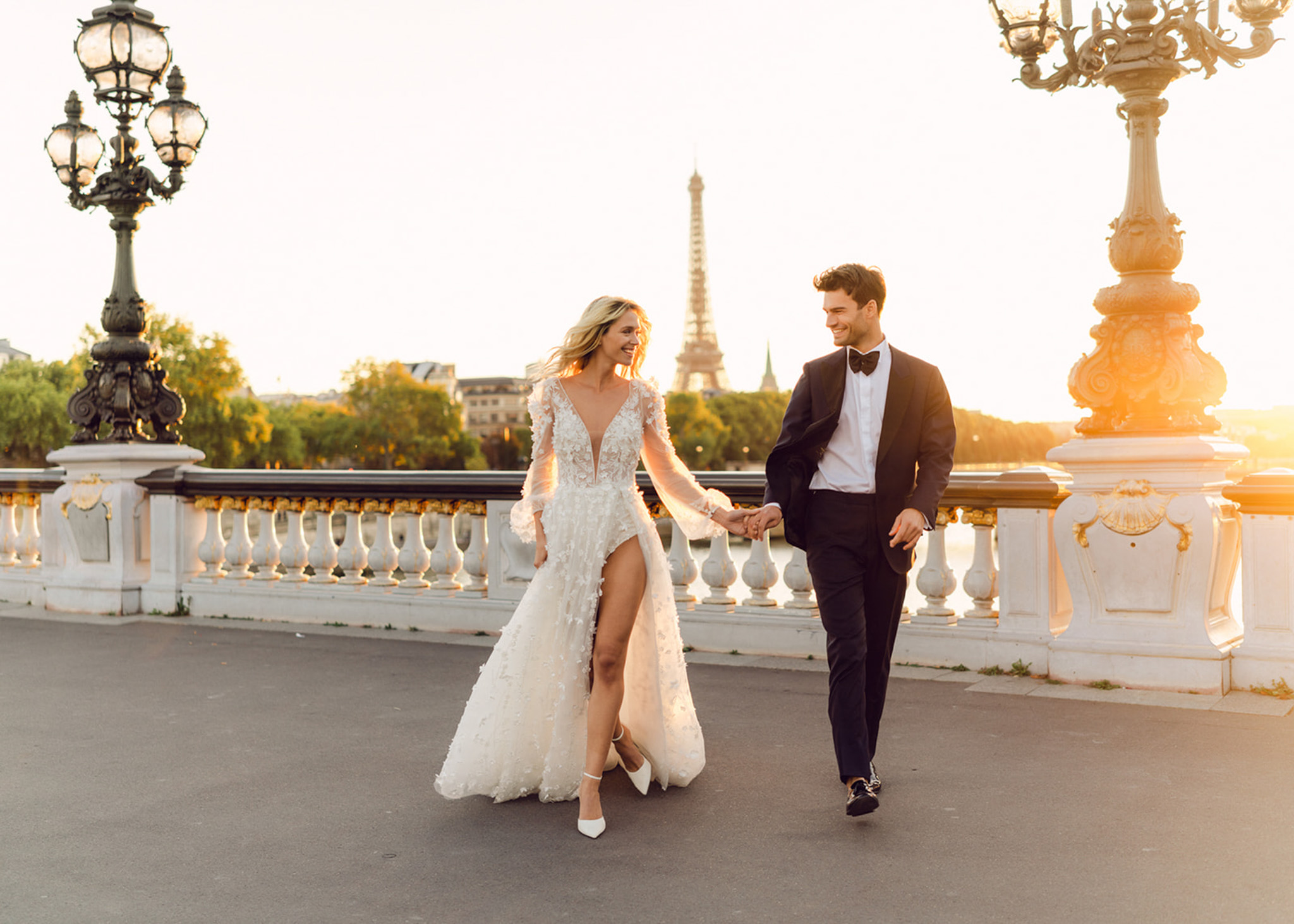
Normandy's dramatic coastline runs from the chalk cliffs of Etretat to the tidal wonder of Mont-Saint-Michel, through a landscape that inspired the Impressionists (Monet painted his water lilies at Giverny, just across the Seine). Brittany carries a distinct Celtic identity: the standing stones of Carnac predate Stonehenge, the Breton language is still spoken in the west, and the granite coastline of Finistère is among the most striking in Europe. Together, these regions sit closer to the UK than any other French wedding destination, and for couples who want France without the long flight, that proximity reshapes the entire planning equation.
Channel ferry ports at Caen, Saint-Malo, Cherbourg, and Roscoff mean some guests can drive to the wedding with their outfits hanging in the car. Venue hire runs 40 to 50% less than comparable properties in Provence, date availability is broader, and the vendor market carries fewer restrictions. The trade-off is a maritime climate where rain is possible even in July, average summer temperatures sit 10 to 15 degrees below the south, and outdoor plans require a genuine indoor backup at every stage. Both regions as wedding destinations, cost by cost and month by month, as part of our complete guide to choosing your wedding region in France. For a broader view of every step involved, see the complete French destination wedding planning resource.
Key Takeaways
- A mid-range wedding for 80 guests in Normandy or Brittany costs €35,000 to €75,000 all-in as of 2026, compared with €83,000 to €144,000 for a comparable Provence celebration.
- Normandy has one of France's richest stocks of manoirs (manor houses) and colombage (half-timbered) properties. Brittany adds granite manor houses and dramatic coastal venues.
- Channel ferry crossings from Portsmouth, Poole, Plymouth, and Dover give UK guests a drive-on option that eliminates flights, airport transfers, and car hire entirely.
- Maritime climate means July averages of 16 to 20°C in Brittany and 18 to 22°C inland in Normandy. Plan B is not optional. It is the starting point for every outdoor element.
- Lower international demand translates to more venue availability, greater negotiation flexibility, and fewer compulsory vendor lists than in southern France.
What Makes Normandy and Brittany Different from Southern France?
The two regions occupy France's northern Atlantic coast, stretching from the D-Day beaches and Mont-Saint-Michel through to the granite headlands of Finistère. The landscape is green, rain-fed, and shaped by the sea rather than the sun. Apple orchards replace olive groves. Cidre (French cider) and calvados (an apple brandy aged in oak barrels) replace rosé. The architecture draws from a different tradition entirely: Normandy's colombage farmhouses (colombage refers to the half-timbered construction of exposed oak frames filled with plaster or brick) and pale stone manoirs have more in common with the English countryside than with the limestone bastides of Provence. A manoir is a manor house, a private country estate with formal grounds and reception spaces. Brittany's granite manor houses, slate roofs, and rugged coastal settings carry a Celtic character that is distinct even within France. These regions deliver something the south cannot: softer light, a slower pace, and a wedding market that is not yet saturated by international demand.
Historically, Normandy shaped European history from William the Conqueror's invasion of England in 1066 through to the Allied landings of June 1944. Brittany maintained its own language, laws, and cultural identity well into the modern era. That heritage runs through the venues, the food, and the local character in ways that give a northern French wedding a sense of place you will not find in the more internationally oriented south.
Couples who choose these regions are not settling for a compromise. They are choosing a distinct version of France, one built on maritime tradition, orchard country, and architecture that predates the Renaissance châteaux of the Loire. Browse countryside wedding venues in France to see properties that reflect this character.
How Much Does a Wedding in Normandy or Brittany Cost?
Normandy and Brittany are among the best-value wedding regions in France as of 2026. A complete wedding for 80 guests costs between €35,000 and €75,000 depending on venue tier, vendor selection, and the scope of the weekend programme. Weekend château or manoir hire runs €6,000 to €25,000, catering sits at €100 to €180 per head before drinks, and a full-service planner costs €3,500 to €10,000. Compare this directly to Provence, where the mid-range bracket for 80 guests runs €83,000 to €144,000 and venue hire alone consumes €15,000 to €45,000. The saving is not marginal. It is structural, driven by lower venue hire fees, reduced demand from the international wedding circuit, and a local vendor market where prices reflect the regional economy rather than the destination wedding premium that inflates costs across the south of France. The quality of properties, food, and scenery is comparable; the pricing is fundamentally different.
- A complete wedding for 80 guests costs between €35,000 and €75,000 depending on venue tier, vendor selection, and the scope of the weekend programme
- Weekend château or manoir hire runs €6,000 to €25,000, catering sits at €100 to €180 per head before drinks, and a full-service planner costs €3,500 to €10,000
- Compare this directly to Provence, where the mid-range bracket for 80 guests runs €83,000 to €144,000 and venue hire alone consumes €15,000 to €45,000
- The saving is not marginal
- It is structural, driven by lower venue hire fees, reduced demand from the international wedding circuit, and a local vendor market where prices reflect the regional economy rather than the destination wedding premium that inflates costs across the south of France
Scroll →
| Budget Tier | Venue Type | Total Cost (80 Guests) | Key Characteristics |
|---|---|---|---|
| Budget-friendly | Colombage farmhouse / small manoir | €35,000 to €50,000 | Dry-hire, limited on-site rooms, local caterer, bring own vendors |
| Mid-range | Private manoir or château with grounds | €50,000 to €75,000 | On-site accommodation for 20 to 50 guests, gardens, some vendor flexibility |
| Prestige | Grand château or coastal estate | €75,000 to €110,000+ | Full estate access, extensive grounds, event coordination, premium catering |
Château hire for a weekend in Normandy costs €15,000 to €25,000 for properties that would run €25,000 to €45,000 in Provence. Catering sits at €100 to €180 per head before drinks, below the Provence range of €150 to €280. Accommodation is often generous: Normandy manoirs frequently sleep 30 to 60 guests across the main house, converted stables, and outbuildings, reducing the overflow hotel costs that inflate southern budgets. For the full national picture, see our guide to regional price differences across France. For couples working within tighter margins, read our guide to planning a budget wedding in France.
How Reliable Is the Weather for Summer Weddings?
Honest answer: not reliable in the way Provence is reliable. Normandy and Brittany have a maritime climate where rain is possible in every month of the year, including July and August. Brittany averages 10 to 13 rainy days per summer month, compared to 3 to 4 in Provence. Average July temperatures run 16 to 20°C on the Brittany coast and 18 to 22°C inland in Normandy. These are not the 30 to 38°C highs of the Mediterranean south. Guests will not swelter, but they will need a layer for the evening, and outdoor dining without cover is a gamble at any point in the season. Every outdoor element, ceremony, cocktail hour, dinner, and dancing, needs a confirmed indoor alternative that works at full guest capacity. The best Normandy and Brittany venues have this built into their layout, with vaulted reception halls, covered courtyards, or permanent marquee structures.
That said, when summer delivers in Normandy, the light is extraordinary. It carries a soft, golden quality that is very different from the harsh midday glare of Provence. Photographers working in northern France describe it as naturally flattering, with gentle contrasts and extended golden hours that stretch past 10 pm in late June. The landscape in good weather is vivid green, the air carries the scent of cut grass and apple blossom, and the long northern evenings create an atmosphere that the south, for all its sunshine, cannot replicate.
Ask your venue what happens if it rains at 3 pm on ceremony day. If the answer requires improvisation, keep looking. The best northern French properties resolve this structurally: a covered orangerie, a tented courtyard, or a vaulted stone hall within a two-minute walk of the ceremony lawn. That adjacency matters more than the size of the garden. For detailed seasonal data across all regions, consult our seasonal climate guide for French weddings.
Can UK Guests Drive to the Wedding via Ferry?
This is the single logistical advantage that no other French wedding region can match. Four major ferry routes connect the UK directly to Normandy and Brittany: Portsmouth to Caen (6 hours, operated by Brittany Ferries), Poole to Cherbourg (4.5 hours), Plymouth to Roscoff (6 hours), and Dover to Calais followed by a 3 to 4 hour drive west. Guests board the ferry with their car, their wedding outfits on hangers, gifts in the boot, and children settled in a cabin. They arrive in France without a single airport queue, baggage carousel, or car hire desk. Many venues sit within 30 to 60 minutes of a ferry port, making the total door-to-venue journey time 5 to 7 hours from southern England. The practical result is higher attendance rates and lower friction for the guest list. Older relatives who find airports stressful can drive on and off the ferry at their own pace. Families with young children avoid the overhead of airport logistics.
Guests who want to extend the trip can drive through Normandy or Brittany at leisure before or after the wedding. Car hire is unnecessary because everyone arrives with their own vehicle. When your venue is 30 minutes from the Caen ferry terminal, the barrier to attendance drops to roughly the same level as a domestic UK wedding in the West Country. Book early for peak summer sailings, as July and August ferry crossings fill months in advance.
Build the ferry option into your save-the-date communications. Include route options, approximate drive times from the port to the venue, and booking links for Brittany Ferries and Condor. Guests who prefer to fly can still use Paris CDG (2 to 3 hours by train or car to Normandy) or regional airports like Dinard, Rennes, or Deauville.
But the ferry route is the differentiator. It is the reason UK couples choose Normandy or Brittany over regions that may be more photogenic on paper but require every guest to book a flight. For couples also considering closer-to-home options, compare with Paris and Île-de-France weddings where Eurostar access serves a similar role.
What Venue Types Define the Region?
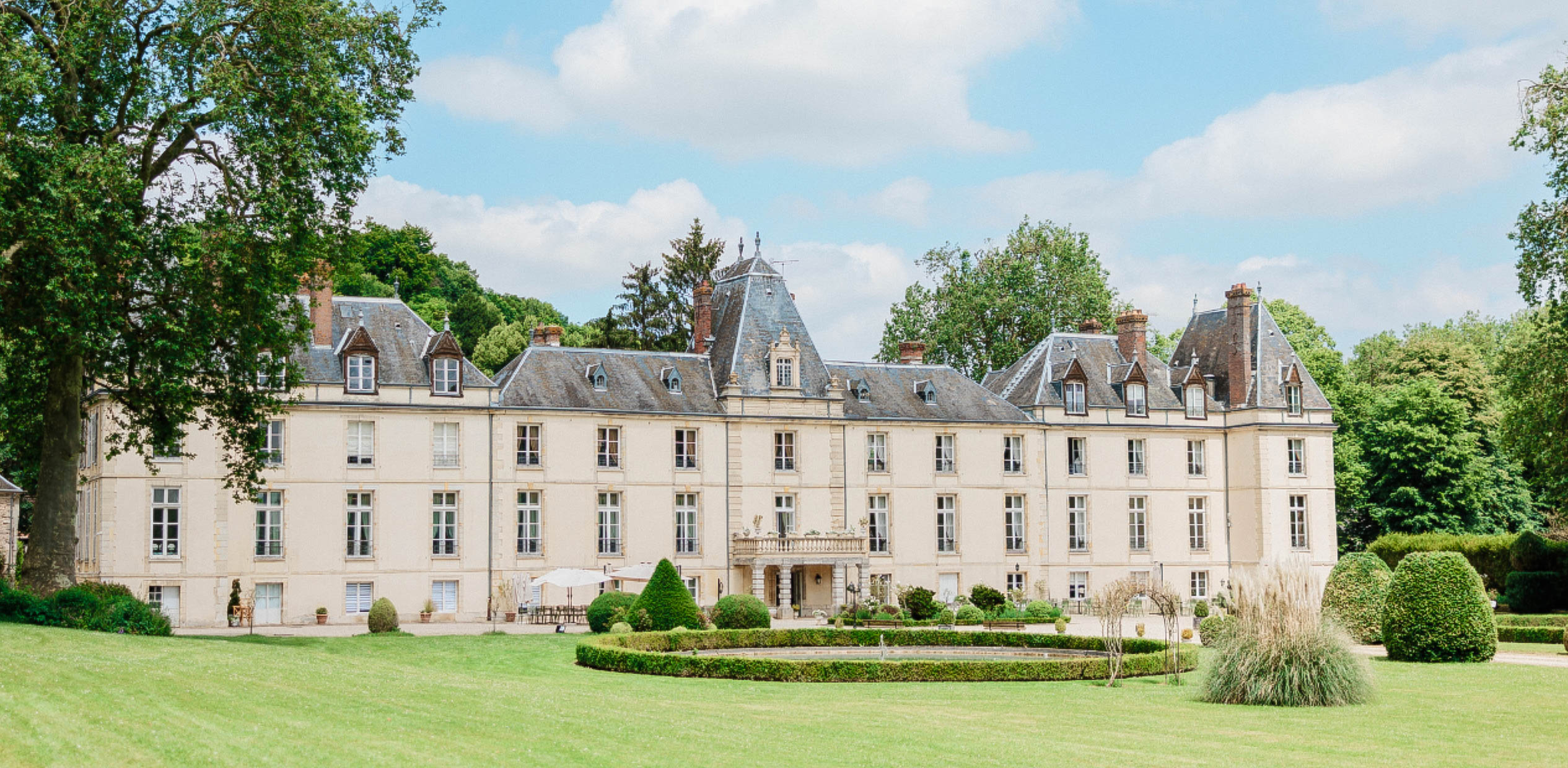
Normandy holds one of France's richest collections of private manor houses and half-timbered properties. The colombage farmhouse is the signature architectural form of the Pays d'Auge and the Calvados countryside. These properties range from compact converted farmsteads sleeping 15 guests to grand colombage manoirs with formal gardens, orchards, and reception barns that seat 150. The character is warm, textured, and rooted in the agricultural landscape. Many qualify as rustic wedding venues in the truest sense: working farmland converted for celebrations without losing the original fabric. Stone manoirs in the Cotentin peninsula and the Suisse Normande offer a different register, closer to the solid, understated architecture of northern France. Weekend hire for a colombage manoir runs €8,000 to €18,000, while Normandy châteaux range from €15,000 to €25,000. Brittany adds granite manor houses at €6,000 to €15,000 and dramatic coastal estates with sea views at €12,000 to €25,000.
Scroll →
| Venue Type | Region | Character | Typical Weekend Hire |
|---|---|---|---|
| Colombage manoir | Normandy (Pays d'Auge) | Half-timbered, orchard setting, rustic warmth | €8,000 to €18,000 |
| Stone manoir | Normandy (Cotentin, Suisse Normande) | Solid limestone or granite, formal grounds | €10,000 to €22,000 |
| Normandy château | Normandy (various) | Classical French château, formal gardens, slate roofs | €15,000 to €25,000 |
| Granite manor | Brittany (interior) | Grey granite, Celtic character, woodland or farmland | €6,000 to €15,000 |
| Coastal estate | Brittany (coast) | Sea views, dramatic clifftop or harbour settings | €12,000 to €25,000 |
Brittany's venue stock carries a distinct identity. Granite is the dominant material, giving properties a solid, weathered quality that suits the coastal climate. The interior of Brittany, from the forests of Brocéliande to the farmland around Josselin and Pontivy, offers granite manors surrounded by mature gardens and private woodland.
Coastal Brittany delivers something no inland region can: clifftop ceremonies, harbour-town receptions, and views across the Atlantic that shift with the tide and the weather. These venues are not as widely marketed to the international wedding circuit as their southern equivalents, which means availability is broader and pricing reflects genuine value rather than destination demand. Explore château wedding venues across France for a broader comparison.
What Defines Norman and Breton Food Culture at a Wedding?
Normandy and Brittany build wedding menus from ingredients the south does not have, and the regional food identity is one of the strongest reasons to choose these regions. In Normandy, the dairy tradition dominates: Camembert, Pont-l'Évêque, and Livarot cheeses anchor the cheese course, while Isigny cream and butter run through every hot dish. Calvados serves as the trou normand digestif between courses, a tradition your traiteur (caterer) should preserve. Cidre, both dry and demi-sec, replaces wine as the apéritif and pairs with the starter course. Seafood plateaux loaded with oysters, langoustines, and crab are standard for welcome dinners along the coast. In Brittany, Cancale oysters harvested from the bay near Saint-Malo are among the finest in France. Catering costs sit at €100 to €180 per head before drinks, lower than Provence's €150 to €280 range, and the quality of local produce rivals any region in France. Tarte Tatin closes a Normandy meal with caramelised apples from the surrounding orchards.
Brittany brings its own identity to the table. Cancale oysters, harvested from the bay near Saint-Malo, are among the finest in France and make a natural apéritif course. Galettes de sarrasin (buckwheat crepes) work as a late-night food station that guests gravitate toward after midnight. Kouign-amann, the caramelised butter pastry from Douarnenez, and salted butter caramel are Breton signatures worth building into the dessert offering.
Cider culture is shared across both regions but runs deeper in Brittany, where artisanal producers offer bottles that rival good wine for complexity. These ingredients shape a wedding menu that is fundamentally different from anything served in the south. Where Provence leans on olive oil, herbs, and rosé, the north draws from butter, orchard fruit, and the sea. Discuss this regional identity with your traiteur early and let the local produce guide the menu rather than importing a southern French template.
What Every Couple Wishes They Had Known About Northern France
Normandy and Brittany are not a budget fallback. Couples who arrive expecting discount Provence will be disappointed by the weather and confused by the landscape. Couples who choose the north for what it offers, maritime light, green countryside, ferry access, half-timbered architecture, cider and calvados culture, and genuine value, find a wedding experience with a character the south cannot provide. The framing matters. This is not France minus the sunshine. It is a different France entirely, one with its own food traditions (Camembert, Isigny butter, Cancale oysters, buckwheat galettes), its own architectural language (colombage manoirs in Normandy, granite manor houses in Brittany), and its own rhythm. The wedding market here is less saturated, vendors are less stretched, and the pace of planning is noticeably unhurried. Couples who visit expecting a compromise leave having discovered a destination. See how Casey and Laura brought this to life at their Normandy château.
Rain needs to be part of the plan, not a surprise. In Provence, rain on a summer wedding day is a genuine surprise. In Normandy and Brittany, it is a standard scenario that your timeline must accommodate without panic. Every transition between spaces needs to work in rain. Every outdoor moment needs a covered alternative within a two-minute walk. Florists, photographers, and caterers who work regularly in the north build this flexibility into their process. We cover this in our guide to muted colour palettes that suit Normandy and Brittany wedding settings. Vendors imported from southern France may not. Hire locally wherever possible.
Ferry access and lower prices create an illusion of simplicity, but the logistics remain distinctly French. Vendor conversations happen in French, agreements follow French contract norms, and coordination across a multi-day weekend at a private property requires local expertise. Our guide to manor house and countryside venue options in northern France explains the specifics.
From the hundreds of real weddings featured on French Wedding Style, the northern France celebrations that run most smoothly are those with a local planner steering the process. A planner in Normandy or Brittany costs €3,500 to €10,000 as of 2026, less than in the south, and the return on that investment is proportionally higher because fewer international planners cover these regions. Find a recommended wedding planner with specific experience in northern France. For couples still weighing regions, compare with the Dordogne for destination weddings or getting married in Provence to understand the trade-offs clearly.
Related Articles
- Choosing your wedding region in France: the complete guide
- Getting married in Provence
- Planning a wedding in Paris and Île-de-France
- Dordogne and south-west France weddings
- Regional price differences across France
- Seasonal climate guide for French weddings
Frequently Asked Questions
How much does a wedding in Normandy or Brittany cost for 80 guests?
A mid-range wedding for 80 guests costs €35,000 to €75,000 all-in. This includes venue hire, catering at €100 to €180 per head, a full vendor team, guest accommodation, and a contingency buffer. Prestige properties with full estate access run €75,000 to €110,000 or more. These figures sit 40 to 50% below comparable Provence pricing, making Normandy and Brittany among the best-value regions in France for destination weddings.
Can UK guests take a ferry to a Normandy or Brittany wedding?
Four major ferry routes connect the UK directly to the region: Portsmouth to Caen, Poole to Cherbourg, Plymouth to Roscoff, and Dover to Calais with a drive west. Crossings take 4.5 to 6 hours. Guests arrive with their own car, wedding outfits, and luggage, eliminating flights, airport transfers, and car hire. Many venues are within 30 to 60 minutes of a ferry port, making attendance as straightforward as a domestic UK wedding.
What is the weather like for a summer wedding in Normandy or Brittany?
Maritime climate with July averages of 16 to 20°C in Brittany and 18 to 22°C inland in Normandy. Rain is possible in every summer month. The guaranteed sunshine of southern France does not apply here. Every outdoor element needs a confirmed indoor alternative. When the weather cooperates, the soft golden light and green landscape create conditions that photographers describe as naturally flattering. Include a note in your guest communications recommending a light jacket or wrap for evening, and consider providing pashminas or blankets at the venue.
What types of venues are available in Normandy and Brittany?
Normandy offers colombage (half-timbered) manoirs, stone manor houses, and classical châteaux. Brittany adds granite manor houses and coastal estates with sea views. Weekend hire ranges from €6,000 to €25,000 depending on property size and location. Most properties include on-site accommodation for 20 to 60 guests. The architectural character differs from southern France, with exposed timber frames, slate roofs, and orchard settings replacing the stone bastides and olive groves of Provence.
Is Normandy or Brittany better for a wedding?
Normandy suits couples drawn to half-timbered architecture, apple orchard settings, and closer proximity to Paris (2 to 2.5 hours by car). Brittany suits couples who want coastal drama, granite character, and direct ferry access via Roscoff or Saint-Malo. Normandy has a slightly deeper venue stock for château-style weddings. Brittany offers more clifftop and harbour-town settings. Both regions share similar pricing and climate profiles. Your choice depends on the atmosphere and landscape you want. Some couples combine both in a multi-day programme: a Normandy château wedding followed by a coastal brunch near Saint-Malo.
How do Normandy and Brittany compare to Provence for a destination wedding?
Normandy and Brittany cost 40 to 50% less than Provence for comparable properties. Ferry access from the UK simplifies guest logistics for British couples. The climate is cooler, wetter, and less predictable. The architectural style favours half-timbered manoirs and granite manors over Mediterranean bastides. Couples who prioritise value, UK accessibility, and green countryside choose the north. Couples who want guaranteed sunshine and outdoor-focused celebrations choose Provence.
Do I need a wedding planner for a Normandy or Brittany wedding?
International couples benefit significantly from hiring a local planner in this region. Vendor communication happens in French, contract terms follow the French legal framework, and managing a multi-day celebration at a private property requires someone with on-the-ground knowledge. A full-service planner in Normandy or Brittany costs €3,500 to €10,000. Fewer international planners cover these regions compared to Provence, so local expertise is particularly valuable for sourcing reliable vendors, managing weather contingencies, and knowing which indoor spaces genuinely work as reception alternatives on rainy days.
Start with the ferry schedule. Once you know whether your guests will cross from Portsmouth, Poole, or Plymouth, the venue shortlist narrows to properties within an hour of that port. That single logistics decision simplifies everything else. Browse countryside wedding venues in France to find properties close to the right ferry route for your guest list.
Explore Every Guide in This Chapter
Deep-dive into each topic covered above.