
Multi-Day Wedding Weekends
The French destination wedding is not a single day. It is a weekend. Friday arrival and welcome dinner, Saturday ceremony and reception, Sunday brunch and departure. Three fixed points, everything else optional. This structure is the standard at the 400+ venues featured on French Wedding Style, and the couples who execute it well share one principle: anchor the key moments, then let the rest breathe.
Over-programming kills the atmosphere faster than bad weather. Under-planning leaves guests stranded with nothing to do in a region they do not know. The balance between structure and freedom is what separates a good wedding weekend from one guests talk about for years. Below is the full framework, the financial responsibilities, and the pacing mistakes that even experienced planners make. For the complete chapter, see our guest experience guide. For a broader view of every step involved, see our step-by-step destination wedding planning guide for France.
Key Takeaways
- The standard French destination wedding weekend runs Friday evening to Sunday midday: welcome dinner (Friday), ceremony and reception (Saturday), farewell brunch (Sunday). Three anchor events, with free time between them.
- The couple pays for the three anchor events. Optional activities (wine tastings, group lunches, pool access) are either offered as a courtesy, split among attendees, or left to guests to organise independently.
- Two nights is the minimum for a destination wedding. Three nights (Thursday to Sunday) works for weddings where the majority of guests are travelling from outside Europe and need time to adjust.
- The mistake that planners flag in the first meeting is programming every hour. Guests at a destination wedding want downtime: time to explore, swim, read, nap, and recover between events. Provide information and options, not a mandatory itinerary.
- Communicate the weekend schedule on the wedding website 3 to 4 months before the wedding. Include event times, dress codes, transport arrangements, and what is and is not provided.
What Does a French Wedding Weekend Look Like?
The three-day framework below is the most common structure at French destination weddings. Venues, planners, and caterers across every region default to this pattern because it works. It gives guests enough time to settle in, celebrates the wedding at its centre, and provides a gracious conclusion on Sunday morning. Friday. Guests arrive throughout the afternoon and settle into their accommodation (on-site rooms, nearby gîtes, local hotels). The first anchor event is the welcome dinner, held at 7:30 to 8pm either at the venue or at a nearby restaurant. The tone is casual and convivial. No speeches beyond a brief welcome. Wine flows. Introductions happen naturally. The evening wraps by 10:30 to 11pm. Early arrivals who land before 3pm might explore the nearest town, sit by the pool, or walk the venue grounds. Do not programme this time. Let people decompress.
Saturday. This is the main event, and its timeline depends on the ceremony format and season. A typical summer Saturday: bridal party preparation from 8am, ceremony at 4 to 5pm, apéritif in the grounds from 5:30 to 7:30pm, seated dinner from 8pm, pièce montée at midnight, dancing until 3am or later.
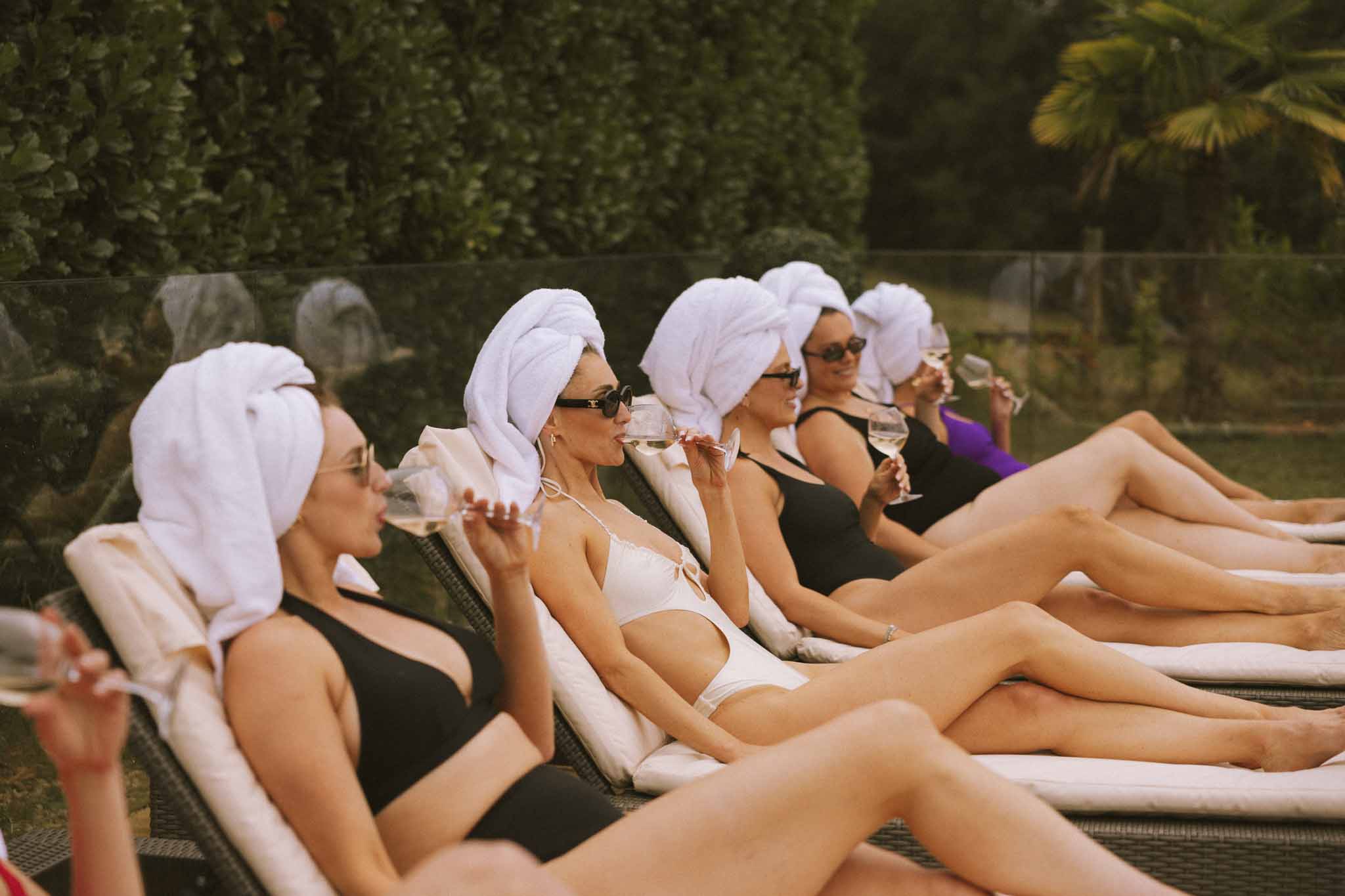
The morning before the ceremony is free time for guests: a late breakfast, a swim, a walk to the village. Some couples arrange an optional group lunch (a shared table at a local restaurant), but this is not obligatory and should be clearly marked as optional. Guests who need the morning to recover from Friday evening will thank you for the flexibility.
Sunday. The farewell brunch is the third anchor event, held at the venue from 10am to 12pm. Keep it simple: coffee, pastries, fresh fruit, eggs, and champagne for those who want it. The brunch serves as a collective goodbye, a chance to recap the highlights, and a buffer before the logistics of departure begin. Check-out from on-site accommodation is typically by midday. Shuttles to airports and TGV stations depart after the brunch.
How Do You Pace Activities Without Exhausting Guests?
The principle is simple: anchor, do not programme. Set the three fixed points (Friday dinner, Saturday wedding, Sunday brunch) and leave the gaps between them unstructured. Provide options and information, but do not create a minute-by-minute schedule that guests feel obligated to follow. Free time is not wasted time. It is the space where the best memories form. The conversation by the pool at 11am on Saturday. The spontaneous walk to a village bakery. The quiet hour reading on a terrace before getting ready. These moments are part of the experience. Couples who fill every slot with organised activities (Thursday wine tour, Friday morning yoga, Friday afternoon cooking class, Friday evening dinner, Saturday morning group hike) find that their guests are tired, irritable, and socially depleted by the time the ceremony begins. The rule of thumb: one structured event per day, with one optional activity offered for guests who want it. Friday has the welcome dinner (structured) and afternoon free time. Saturday has the wedding (structured) with an optional morning activity.
Who Pays for What Across the Weekend?
Financial responsibilities at a multi-day wedding weekend follow a clear convention, though it varies slightly by culture. The framework below reflects the standard at French destination weddings attended by a mix of British, American, Australian, and European guests. The couple covers the venue hire for the full weekend, the welcome dinner on Friday evening including transport, all food and drink on the wedding day itself, the Sunday brunch, and any shuttle services between accommodation and the venue. Guests pay for their own flights, their own accommodation (whether on-site rooms, nearby hotels, or gites), and any personal activities during the daytime hours. The grey areas that cause confusion are typically the post-midnight bar tab, activities organised for the wedding weekend (such as a group wine tasting or a welcome dinner at a restaurant), and gratuities. Establishing clear expectations on the wedding website at least three months before the celebration prevents awkward conversations on the day.
| Item | Who Pays | Notes |
|---|---|---|
| Venue hire (Friday to Sunday) | Couple | Most venues quote a weekend rate covering Friday PM to Sunday midday |
| Welcome dinner (Friday) | Couple | Food, drink, and transport to/from the dinner |
| Wedding day (Saturday) | Couple | Ceremony, apéritif, dinner, entertainment, transport |
| Sunday brunch | Couple | Simpler format, lower per-head cost |
| Flights and travel | Guests | Guests book and pay for their own travel |
| Off-site accommodation | Guests | Couple provides recommendations; guests book directly |
| On-site accommodation | Couple (included in venue hire) | Allocated to family and bridal party |
| Optional activities | Split or guest-funded | Wine tastings, group lunches, excursions: guests pay their share |
| Guest shuttles (main windows) | Couple | Airport/station transfers for arrival and departure |
The couple's financial responsibility covers the three anchor events, venue hire, and group transport. Everything else (guest travel, guest accommodation, optional activities, individual meals outside the scheduled events) sits with the guests. This is understood and accepted at destination weddings. Guests who have agreed to attend a wedding in France have budgeted for the trip. Do not feel guilty about not covering every expense. For a detailed look at the full cost structure, see our wedding budget guide.
Is Two Nights or Three the Right Length?
Two nights (Friday to Sunday) is the standard and works for the majority of weddings. Three nights (Thursday to Sunday) is appropriate when the guest list is predominantly long-haul (US, Australia, Asia) and guests need a day to recover from jet lag before the social programme begins. Adding a Thursday night increases costs. The venue may charge an additional night's hire (€1,000 to €5,000 depending on the property). You will need to provide or recommend dinner for early arrivals. Accommodation for a third night is an extra cost for guests. And if only a fraction of the guest list arrives on Thursday, the evening can feel sparse rather than festive. The decision hinges on your guest list composition. If 70 percent or more of your guests are flying from the same continent (UK, for example), two nights is sufficient.
What Mistakes Do Couples Make with Multi-Day Weddings?
Over-programming is the most common. Every hour scheduled, every activity mandatory. By Saturday afternoon, guests are running on fumes. They have socialised non-stop for 36 hours, attended three organised events, and had no time to themselves. The ceremony feels like one more item on a packed itinerary rather than the centrepiece of the weekend. Scale back. Three anchor events. One or two optional activities. Everything else is free time. Inconsistent communication causes logistics chaos. The wedding website says one thing, the WhatsApp group says another, and the printed schedule in the room says a third. Centralise all information on the wedding website and print a summary card for each guest room. Do not use WhatsApp groups to relay schedule changes. Update the website, then direct guests to it. Neglecting the Sunday brunch is a missed opportunity. Couples who pour everything into Friday and Saturday sometimes leave Sunday as an afterthought: a few croissants on a table, no set time, guests drifting off without a proper goodbye.
Failing to account for different energy levels across the guest list is the final trap. Guests in their twenties want to stay out until 3am on Friday and do it again on Saturday. Guests in their sixties want to be in bed by 11pm and have a quiet morning. Parents with young children need nap windows. A well-paced weekend accommodates all of these without forcing anyone to keep up or feel left out. Communicate clearly which events are "everyone" and which are optional. See how this couple brought this to life at Château de Varennes in Burgundy.
Related Articles
- Guest experience at a French wedding: the complete guide
- Planning the welcome dinner
- Guest activities between events
- Guest accommodation options
- Guest travel logistics
- The vin d'honneur and soirée
- Wedding budget guide for France
- Exclusive-use wedding venues in France
- Destination wedding venues in France
- Browse all wedding venues in France
Frequently Asked Questions
Do we need to entertain guests for the entire weekend?
No. Your responsibility is the three anchor events: welcome dinner, wedding day, and farewell brunch. Between these, guests are adults who can entertain themselves. Provide a list of local suggestions (restaurants, markets, swimming spots, villages to explore) and leave the rest to them. Over-entertainment leads to over-tired guests.
What if some guests can only come for Saturday?
Welcome them warmly and do not make them feel like they missed the "real" weekend. Provide the Saturday schedule separately if needed. For transport, include them in the Saturday shuttle plan. Not every guest can take three days off work for a wedding, and the invitation to the ceremony and reception is the core commitment.
How do we handle the Sunday brunch if guests are checking out at different times?
Set the brunch for 10am to 12pm and let guests come and go. Some will eat quickly and head to the airport. Others will linger until noon. The format should be a standing buffet, not a sit-down meal, so there is no awkwardness about empty seats as people leave. Provide a goodbye card or small favour at the brunch table as a closing gesture.
Explore Every Guide in This Chapter
Deep-dive into each topic covered above.