
Lighting Guide: Fairy Lights, Candles, Lanterns
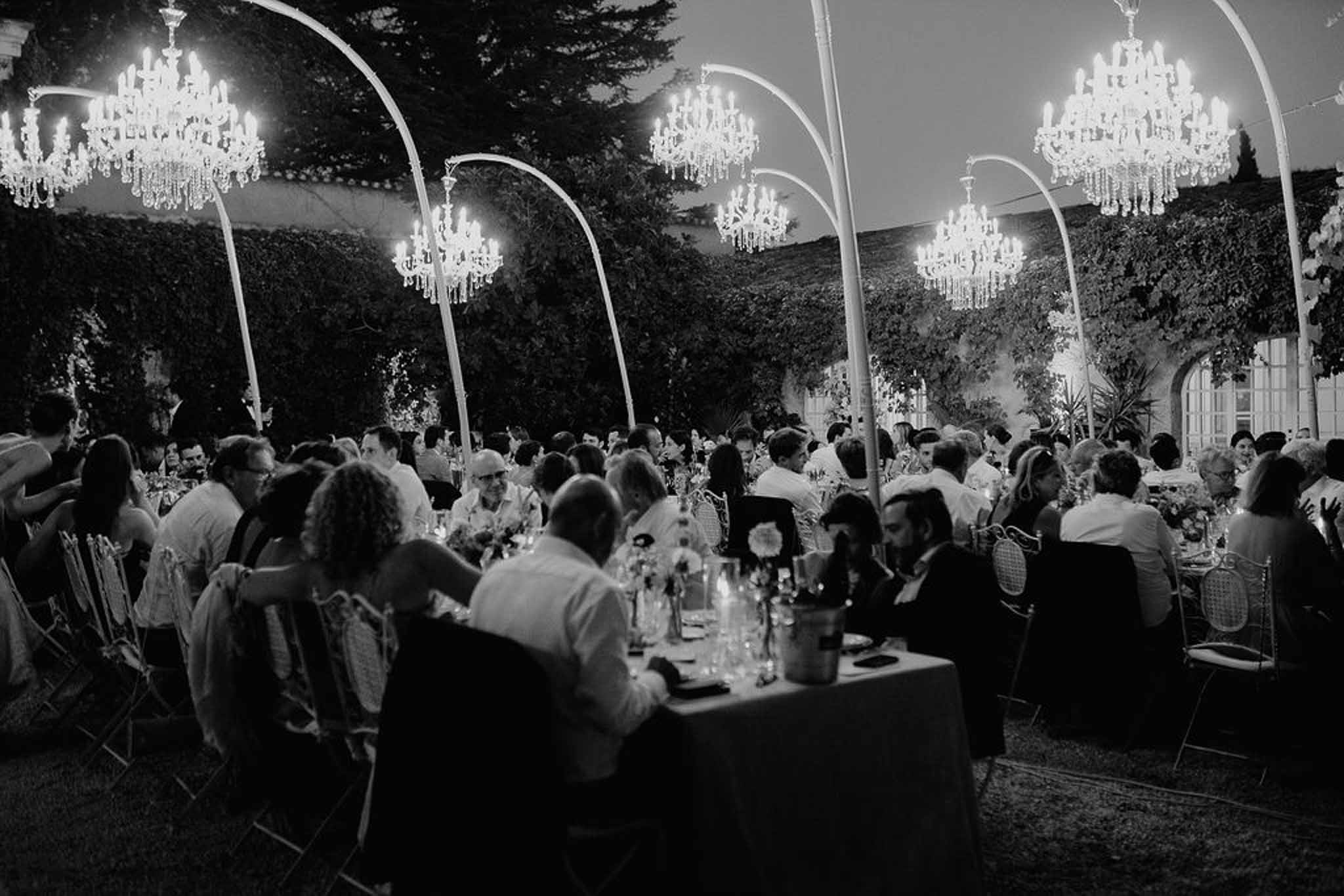
The single biggest visual transformation at a French wedding happens after dark. A courtyard that looked pleasant at 4pm becomes something entirely different at 10pm under the right lighting. Fairy lights strung between plane trees turn a gravel terrace into a room without walls. Festoon bulbs hung across a barn create warmth where there was industrial space.
Candles along a stone ledge give a 17th-century corridor the atmosphere it was designed for, before electricity existed. Lighting is the element that changes how a venue feels more dramatically than flowers, linen, or any other design decision. It is also the element most governed by regulation. French fire safety rules at historic properties dictate what you can light, where you can light it, and how. What works, what is permitted, and what it costs, as part of our complete styling and design chapter. For a broader view of every step involved, see the full planning guide for destination weddings in France.
Key Takeaways
- Evening lighting is the highest-impact design element at a French wedding. It transforms the venue more than flowers, more than linen, more than any other single category of décor.
- Festoon lights (large exposed bulbs on a cable) and fairy lights (small LEDs on a thin wire) are different products with different effects. Festoon creates structure and defines space. Fairy lights create atmosphere and softness.
- ERP (Établissement Recevant du Public) fire safety regulations restrict open flames at classified historic properties. Real candles may require venue approval, a written risk assessment, or LED alternatives depending on the property's classification.
- Professional wedding lighting installation in France costs €800 to €3,500 depending on scope. DIY festoon and fairy light installation is possible at some venues but requires advance planning and power supply access.
How Does Lighting Transform a French Wedding Venue After Dark?
During the day, the venue does the work. The stone, the gardens, the sky, and the natural light create the atmosphere. After sunset, all of that disappears. The stone walls become dark shapes. The garden becomes a void beyond the terrace. The sky provides nothing. What remains is whatever light you have placed. That light becomes the architecture of the evening. This is why lighting matters more at a French wedding than at most other wedding formats. French weddings run late. Dinner begins at 8pm or 9pm in summer, well after sunset. Dancing continues until 2am, 4am, sometimes later. The majority of the evening, and the majority of the photographs your guests will take on their phones, happen in artificial light. Your photographer's evening coverage (the party, the dancing, the late-night portraits) depends entirely on the ambient light you have provided.
The most common lighting configurations at French weddings fall into four categories, and most celebrations use a combination of two or three.
What Are the Options: Festoon, Fairy Lights, Candles, Lanterns?
Festoon lights. A heavy-gauge cable strung with large exposed bulbs (typically warm white, 2700K, either incandescent or LED) spaced 30 to 50cm apart. Festoon lights create structure. They define the boundaries of an outdoor space, turning an open courtyard into a canopy or marking the edges of a dance floor. They provide functional light: bright enough to see faces, read a menu, navigate a step. The visual effect is warm and celebratory. They photograph as distinct points of light with a golden glow. In France, festoon is the standard outdoor wedding lighting. A strand of festoon above a courtyard dining table is as traditional as the Champagne on it. Fairy lights (guirlandes lumineuses). A thin wire with tiny LED bulbs spaced every few centimetres. Fairy lights create atmosphere rather than structure. Wrapped around tree trunks, woven through olive branches, cascaded from a beam, or draped as a curtain behind a head table, they produce a soft, diffused glow rather than defined points of light. They do not provide functional illumination.
They provide mood. The visual effect is softer and more romantic than festoon. In photographs, fairy lights read as a wash of warm sparkle rather than individual bulbs. They work best in combination with another light source (candles, festoon, or venue uplighting) rather than alone.
Candles. Tapers on candelabra, pillar candles in glass hurricanes, votives scattered across tables and ledges. Candlelight provides the warmest, most flattering light available. It is also the most regulated at French historic properties (see ERP section below). The visual effect is intimate and low.
Candlelight works at face level and below, creating pools of warm light on the table surface while leaving the upper walls and ceiling in shadow. For couple portraits, a corridor lit only by candle creates the kind of imagery that defines a gallery. The limitation: functional visibility. Guests cannot read a menu by candlelight alone. A combination of candle and festoon provides both atmosphere and function.
Lanterns. Metal or glass lanterns housing candles or LED lights, placed on tables, along pathways, on stone ledges, and at the entrance to reception spaces. Lanterns serve a dual purpose: decorative and directional. A line of lanterns along a garden path guides guests from the cocktail terrace to the dining area while creating a visual rhythm. Paper lanterns (boules japonaises) suspended from branches or beams offer a lighter, more playful effect than metal lanterns but are more fragile outdoors. Both real-flame and LED versions are widely available through French event rental companies.
Scroll →
| Lighting Type | Effect | Best For | Cost Range (installed) |
|---|---|---|---|
| Festoon | Warm, structured, functional | Courtyards, terraces, open-air dining | €400 to €1,200 |
| Fairy lights | Soft, atmospheric, diffused | Tree wrapping, beam draping, curtain backdrops | €300 to €800 |
| Candles (real or LED) | Intimate, warm, low-level | Table centrepieces, corridor ambiance, ledge placement | €200 to €600 |
| Lanterns | Directional, decorative, portable | Pathways, entrance markers, table accents | €150 to €500 (rental) |
| Professional uplighting | Dramatic, architectural, colour-wash | Façade illumination, reception room washes | €500 to €2,000 |
The combination that produces the most consistently photographed results at French weddings: festoon above the outdoor dining space for functional light and structure, fairy lights wrapped through nearby trees for depth, votives on every table for warmth at face level, and lanterns along the path between spaces. This four-layer approach creates a complete lighting environment that works from wide-angle photographs (festoon defines the space) to close-up portraits (candle and fairy light provide the warmth).
What Fire Safety Rules Apply at Historic French Properties?
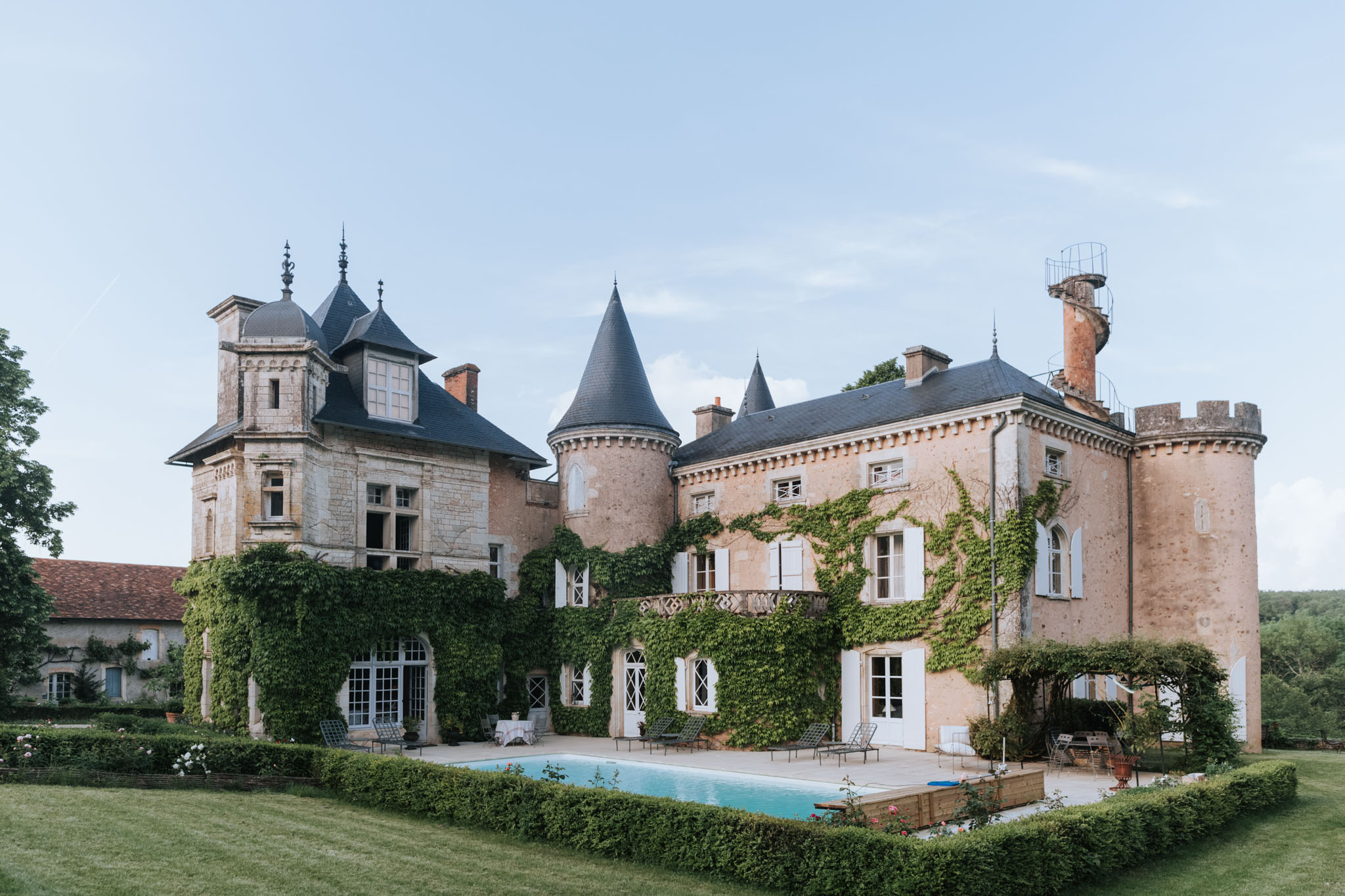
ERP (Établissement Recevant du Public) regulations govern fire safety at any French property that receives the public, including wedding venues. For couples planning celebrations at historic properties, these rules directly affect candle use, lantern placement, and any open flame. The regulations are not uniform. They vary by the venue's classification, its size, its conservation status, and the local préfecture's interpretation. However, the common restrictions across most historic wedding venues in France include the following. Open flames near protected surfaces. Classified monuments (monuments historiques) and properties with protected interiors (painted ceilings, tapestries, wooden panelling, original parquet) typically restrict open flames within a defined distance of these surfaces. The distance varies but 1 to 2 metres is standard. This means candles on a dining table positioned beneath a painted ceiling may not be permitted, while the same candles on a courtyard table are fine.
Candle containment. Where candles are permitted, they must be contained: in glass votives, hurricane lanterns, or on candelabra with drip trays. Freestanding tapers on bare surfaces are rarely permitted. The containment rule is practical: a knocked-over votive extinguishes in its glass container, while a knocked-over taper rolls and ignites whatever it touches.
Flame proximity to fabric and dried material. Candles cannot be placed within 30cm of tablecloths, napkins, dried flower arrangements, or fabric draping. This affects centrepiece design directly: a candle surrounded by dried flowers and trailing fabric is a combination that no ERP-compliant venue will allow, regardless of how it looks on Pinterest.
Fire detection and extinguisher requirements. Venues hosting events above a certain guest count must have functioning fire detection and portable extinguishers accessible in every reception room. Your venue handles this. It is not your responsibility, but it is worth confirming during the planning stage.
The practical approach: ask your venue coordinator during the initial planning meeting whether open flames are permitted, and if so, under what conditions. A venue that has hosted 200 weddings knows exactly what is and is not allowed. They will not be surprised by the question. Most château wedding venues in France have a standard fire safety briefing that they provide to planners and couples. Request it in writing and share it with your florist, stylist, and anyone responsible for placing candles or lanterns.
How Much Does Wedding Lighting Cost in France?
Lighting costs divide into two categories: installation by a professional lighting company and DIY or venue-provided options. Professional installation. A specialist wedding lighting company (entreprise d'éclairage événementiel) provides the lights, installs them before the wedding, and removes them after. DIY festoon. Purchasing or renting festoon and hanging it yourself is feasible at some venues. A 50-metre string of warm white festoon lights costs €60 to €120 to purchase and €30 to €60 per day to rent from a French event supply company. You will need anchor points (trees, posts, building fixtures), cable, and access to an outdoor power supply. Simple installations (one strand between two trees above a table) are manageable. Complex installations (a canopy across a courtyard requiring multiple anchor points at height) typically need professional help unless someone in the wedding party has genuine rigging experience.
- Prices for a mid-range installation (courtyard festoon canopy, tree fairy lights, pathway lanterns, and basic uplighting on the venue façade) run €1,500 to €3,500 depending on the venue's size, access difficulty, and the amount of cable and hardware required
- A simple festoon canopy over a single courtyard costs €800 to €1,200
- A complex multi-zone installation with indoor and outdoor elements, suspended fairy light canopies, and programmable uplighting starts at €3,000 and can reach €5,000 for large properties
Venue-provided lighting. Some venues include basic festoon lighting as part of their hire package, already installed and tested. This is worth asking about specifically because it can save €800 to €1,500. If the venue has permanent festoon installed, check the bulb type (warm white vs cool white) and the coverage area. Permanent installations do not always cover the specific zone you want to use for dinner or dancing.
- Candle and votive costs are straightforward: €1 to €3 per votive from a French event supplier (Truffaut, Point Virgule, or specialist event companies), €5 to €15 per glass hurricane lantern (rental), and €30 to €80 per candelabra (rental)
- For a 100-guest wedding with 12 tables, expect to spend €200 to €500 on table-level candle elements
- Budget LED candles (Uyuni, Luminara) cost €8 to €15 each and can be reused or sold after the wedding
What Lighting Mistakes Do Couples Make at French Venues?
Cool white bulbs. The most common and most easily avoided mistake. Cool white LEDs (4000K to 6500K) emit a blue-tinged light that makes skin tones grey, food unappealing, and stone walls cold. Warm white (2200K to 2700K) is the only acceptable colour temperature for wedding lighting. Every festoon string, every fairy light, every LED candle, and every uplighter should be warm white. If a rental company offers "white" LEDs without specifying colour temperature, ask. The price difference is zero. The visual difference is enormous. Over-lighting. Flooding the space with too much light removes the intimacy that evening creates. A courtyard lit as brightly as a car park loses the atmosphere that darkness provides. The goal is pools of warm light with soft shadows between them. Guests' faces should be lit. The corners of the garden do not need to be. Reduce the number of festoon strings by one from your initial plan. The result will feel warmer.
No pathway lighting. Guests need to navigate between spaces: cocktail terrace to dining room, dining room to dance floor, main building to guest accommodation. Without pathway lighting (lanterns, low garden lights, or marked LED strips), guests stumble on gravel, miss steps, and cluster near the lit areas rather than spreading across the property. Pathway lighting is functional, not decorative. Budget for it separately.
Ignoring the DJ or band's lighting. Professional DJs and bands bring their own lighting equipment. Some of it is tasteful (warm wash lights, subtle colour accents). Some of it is not (strobing LEDs, colour-cycling spotlights, moving heads).
If you have invested in a carefully designed warm lighting scheme, a DJ who sets up cool-blue moving heads will override your entire atmosphere. Discuss lighting with your entertainment in advance. Most professional wedding DJs in France will adapt their setup to match the couple's lighting design if asked. The conversation needs to happen before the day, not at 11pm when the dance floor opens.
The evening transformation is the reward for all the design work that precedes it. The flowers, the table settings, the stone walls, and the garden backdrop all reach their peak under warm light after dark. See how this couple brought this to life at Château Marcellus in South-West France.
The couples who invest in lighting as a deliberate design element, rather than an afterthought, produce the reception photographs that stop people scrolling. For a complete picture of evening design including colour choices and table styling, see our guides to colour palettes for French stone types and château table décor. Couples looking for inspiration across the full range of French venue settings can browse our destination wedding venues across France.
Related Articles
- Styling and design for a French wedding: the complete guide
- French wedding aesthetics: what makes them different
- Colour palettes for French wedding venues
- Château table décor ideas for French wedding dining rooms
- Wedding arch and ceremony backdrops at French venues
- Music and entertainment for your French wedding
- How French venue pricing works
- Hidden costs of a destination wedding in France
- Château wedding venues across France
- Destination wedding venues across France
Frequently Asked Questions
Can we use real candles at every French wedding venue?
Not at every venue. Properties classified as monuments historiques or those with protected interiors (painted ceilings, tapestries, original wooden panelling) may restrict or prohibit open flames indoors. Many châteaux allow contained candles (votives in glass, candelabra with drip trays) with prior approval. Some prohibit all open flames inside the building while permitting them outdoors. Ask your venue coordinator at the planning stage and request the policy in writing. LED candles are always an acceptable alternative and photograph convincingly in evening light.
What is the difference between festoon lights and fairy lights?
Festoon lights use a heavy cable with large, spaced bulbs (typically 4 to 8cm diameter). They produce strong, defined points of light and provide functional illumination. Fairy lights use a thin wire with tiny LED bulbs (2 to 4mm) spaced every few centimetres. They produce a soft, diffused glow and provide atmospheric rather than functional light. Festoon defines and structures a space. Fairy lights add warmth and texture. Most French wedding lighting designs use both.
Should we hire a lighting company or do it ourselves?
For a simple setup (one festoon strand above a table, pathway lanterns), DIY is feasible with the right anchor points and power supply. For anything involving height installation (rigging across a courtyard, wrapping trees above arm's reach, suspended canopies), professional installation is safer and produces a better result. A lighting company also handles removal the day after, which is valuable when the couple and wedding party are recovering. The cost difference between basic DIY and professional installation for a single courtyard space is typically €500 to €800.
How do we power outdoor lighting at a rural French venue?
Most French wedding venues provide outdoor power points (prises extérieures) at the main reception areas. Ask the venue specifically: where are the outdoor power points, what amperage do they support, and how far are they from the area you want to light? Professional lighting companies bring their own cabling and distribution boards. For DIY installations, you will need outdoor-rated extension cables and a residual current device (RCD) for safety. Generators are an option at very remote properties but add noise and cost (€200 to €500 per evening for a quiet-running unit).
Does lighting affect photography quality?
Significantly. Warm, ambient lighting produces the most flattering evening photographs. Cool light, mixed colour temperatures, and harsh directional light create problems that even professional editing cannot fully correct. Overwhelmingly the most important impactful thing you can do for your evening photography is ensure all lighting (festoon, fairy lights, candles, uplighting, DJ lights) shares the same warm colour temperature. Ask your photographer what lighting conditions they prefer and share that guidance with your lighting provider, DJ, and venue coordinator. A 60-second conversation between your photographer and your DJ about lighting can prevent an hour of post-processing problems.
Explore Every Guide in This Chapter
Deep-dive into each topic covered above.