
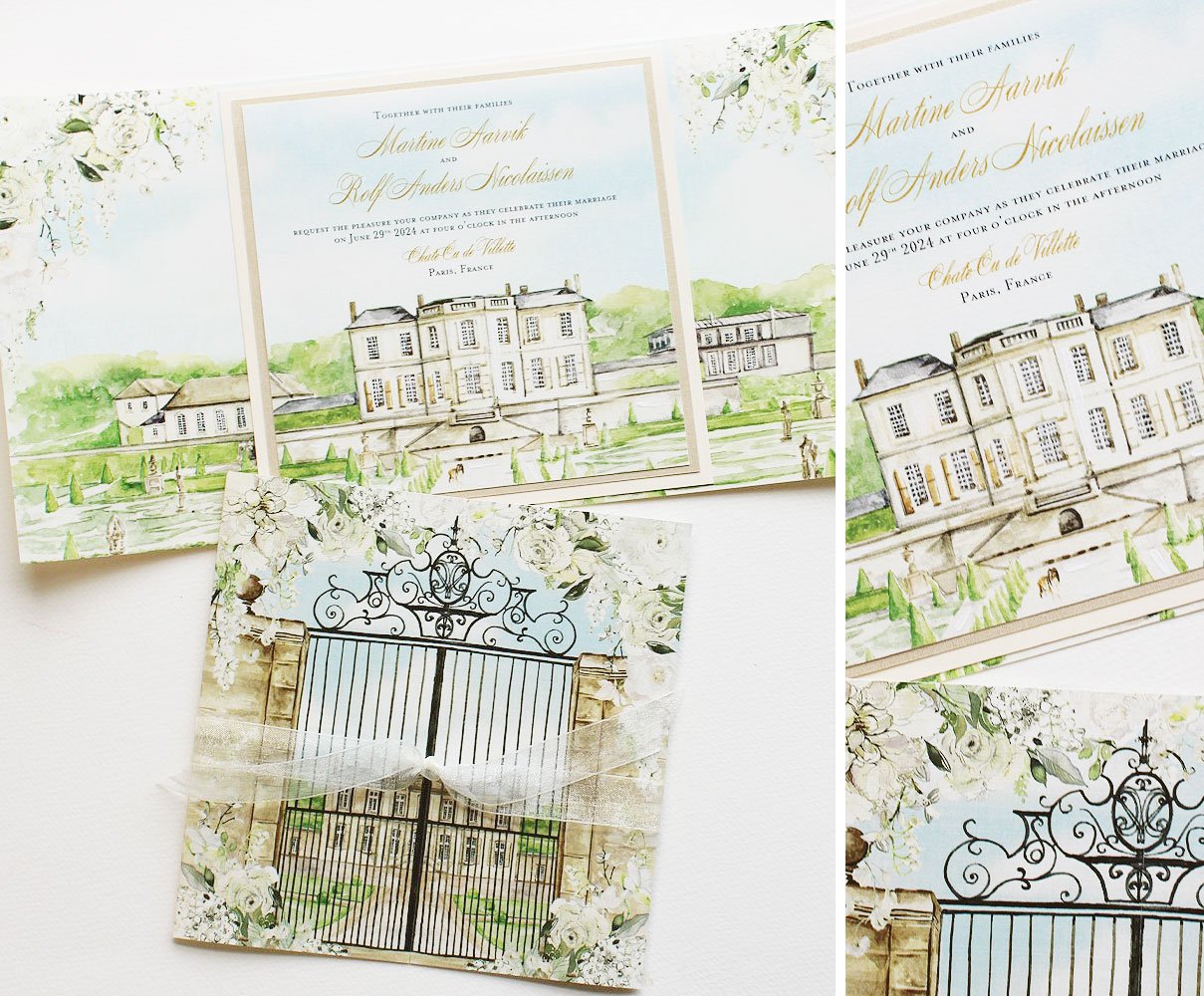
Invitations and Stationery for a French Wedding
French wedding stationery follows a system that international couples rarely encounter before they begin planning. The faire-part, a tiered invitation suite that separates guests by which parts of the celebration they are attending, is the foundation. Save-the-dates carry a heavier logistical burden when guests are booking international flights. The wedding website replaces the 47 WhatsApp messages your guests would otherwise send. And the day-of stationery, from bilingual menus to the plan de table at the dining room entrance, bridges the cultural gap between French and international conventions across every printed detail your guests hold and photograph. This chapter covers all four stages of the stationery journey. It is part of our complete guide to planning a wedding in France.
How French Wedding Stationery Works Differently
The defining difference is structure. A British or American wedding sends one invitation covering the whole day. A French wedding sends a faire-part: a set of nested cards where each card corresponds to a different part of the celebration. The outermost card covers the ceremony. The second covers the vin d'honneur (cocktail reception). The innermost covers dinner. Guests receive only the cards matching the events they are invited to. This tiered system is practical, not exclusionary: French weddings routinely have 150 guests at the vin d'honneur and 80 at dinner, and the stationery manages this gracefully. For international couples, the challenge is adapting this system for guests who have never seen it, while respecting the convention for French guests who expect it. The solution sits across four interconnected decisions: how you word and format the invitation itself, when and how you announce the date, what your wedding website covers, and what printed pieces your guests encounter on the day. Each decision feeds the next.
The Four Stationery Decisions Every Couple Faces
Stationery for a French destination wedding unfolds in a clear sequence, and each stage carries decisions that affect the next. The save-the-date goes out first (9 to 12 months ahead) and must include enough logistical detail for guests to book flights and accommodation early, when prices are lowest. The wedding website goes live before or alongside the save-the-date and serves as the central information hub for travel, dress code, accommodation blocks, and RSVP management. The formal invitation follows (4 to 6 months ahead) and needs to communicate the weekend structure, ceremony type, and any bilingual elements clearly. The day-of stationery, including the order of ceremony, table plan, and menus, is designed last but printed first in terms of lead time. Getting the sequence right prevents the most common problems: guests who do not have enough notice, invitations that confuse rather than clarify, and a wedding day where international guests cannot follow the programme because the stationery assumed they understood French conventions.
Scroll →
| Stationery Stage | When | Key Decision | Guide |
|---|---|---|---|
| Save-the-date | 9 to 12 months before | Digital, printed, or hybrid; include region and travel hint | Save-the-date timeline guide |
| Wedding website | Live before save-the-dates | Travel, accommodation, RSVP, FAQ, dietary form | Wedding website guide |
| Formal invitation | 4 to 6 months before | Faire-part tiers, bilingual wording, logistics insert | Invitation wording guide |
| Day-of stationery | Designed 3 months before, printed 4 to 6 weeks before | Bilingual menus, programs, plan de table, place cards | Day-of stationery guide |
The Four Guides in This Chapter
How the French faire-part system works, bilingual wording rules, and the invitation mistakes international couples make
The foundational guide for this chapter. How French wedding invitations differ from British and American ones. The tiered faire-part structure explained card by card. Traditional versus modern wording. How to format bilingual invitations without mixing languages or registers. The six essential elements a destination wedding invitation must include beyond the standard who, when, and where. And the common wording mistakes that confuse French guests, embarrass the couple, or leave international guests without the logistics they need to attend.
When to send save-the-dates for a destination wedding in France, what to include, and the timing that costs your guests money
Nine to twelve months is the baseline. The reasoning rests on flight pricing data and accommodation booking patterns that make a clear case. Digital versus printed: which works for international guest lists, which carries more weight, and why the hybrid approach serves most couples. What to include (date, region, website URL, multi-day note) and what to leave for the formal invitation. The timing mistakes that force guests into expensive last-minute bookings and reduce attendance at destination wedding venues across France.
What your destination wedding website must include: the seven pages, the three most-forgotten, and the platforms that handle it
The wedding website is the logistics hub of a destination celebration. Seven core pages cover the essentials: travel (airports, transfers, GPS coordinates), accommodation (venue rooms, nearby hotels, booking codes), weekend schedule, RSVP form with dietary collection, FAQ, local guide, and your story. The three pages couples most commonly forget: dietary requirements form, local restaurant recommendations, and a weather and terrain note that prevents guest complaints. Platform comparison for 2026: Zola, Squarespace, WithJoy, and Minted, assessed on RSVP tracking, multilingual support, and password protection.
Bilingual menus, the plan de table, marque-places, and the stationery your guests hold on the day
The four standard day-of pieces at a French wedding: printed menus, ceremony programs, place cards (marque-places), and the plan de table seating display. How bilingual menus work (French course name first, English description below). The plan de table: French seating chart conventions, display formats from mirror calligraphy to illustrated boards, and why readability from two metres matters more than aesthetics. French place card etiquette: when to use first name only versus full name, placement above the plate, and why the card never goes inside a wine glass. Cost comparisons for each format and the DIY options that work.
Design your stationery suite as a system, not a series of separate purchases. Choose one typeface, one paper stock, and one colour palette that runs from the save-the-date through the last place card. French guests notice consistency across the suite. It signals intention and care. A mismatched welcome board next to a carefully designed plan de table undermines both.
Related Chapters
- Planning a Destination Wedding in France: The Complete Guide (pillar page)
- Styling and Design: Colour palettes, table decor, and the visual language that your stationery should echo
- French Wedding Traditions and Culture: The customs behind the faire-part, the vin d'honneur tiers, and the dinner conventions your stationery explains
- Building Your Vendor Team: How to find and brief a bilingual stationer who understands both French convention and international expectations
- Food, Drink and Catering: The menu your day-of stationery will present, from the apéritif dinatoire through the piece montee
Frequently Asked Questions
What is the French faire-part system for wedding invitations?
The faire-part is a tiered invitation suite where nested cards separate guests by which parts of the day they attend: ceremony only, vin d'honneur (cocktail reception), or the full dinner and evening party. Each guest receives only the cards matching their tier. This is the standard at French weddings and manages the common format where a wider circle attends the cocktail hour and a smaller group stays for the seated dinner.
How early should save-the-dates go out for a destination wedding in France?
Nine to twelve months before the wedding. International guests need time to book affordable flights to regional French airports, secure accommodation near rural venues that fills quickly in summer, and coordinate annual leave. For peak-season weddings (June through September), lean toward twelve months. Formal invitations then follow four to six months before the date.
Do we need a wedding website for a French destination wedding?
Yes. The wedding website is where guests find travel details (airports, transfer times), accommodation options with booking codes, the weekend schedule, the RSVP form, and a dietary requirements form that feeds directly to your traiteur. Build at least the travel and accommodation pages before save-the-dates go out. Guests visit the URL within hours of receiving the announcement.
What day-of stationery is standard at a French wedding?
Four items appear at virtually every French wedding reception: printed menus (one per guest or one per two), an order of ceremony program, place cards (marque-places) at each setting, and a plan de table (seating display) at the entrance to the dining room. For bilingual celebrations, menus list the French course name first with the English description below.
Should French wedding invitations be bilingual?
If your guest list includes both French and English speakers, yes. Keep the languages separate: French on one side, English on the other, or French on the front face and English on the inner face. The French text should be reviewed by a native speaker. Wedding French uses formal register and specific conventions that general language skills may miss. The invitation wording guide covers the format options and the pitfalls to avoid.
Stationery at a French wedding is not just paper. It is the communication layer that carries your guests from the first announcement through the last course of the dinner. The faire-part tells them which parts of the day are theirs. The save-the-date gives them time to plan. The website answers every logistics question. The printed menu, the ceremony program, and the place card at their seat make them feel expected, welcomed, and guided through a celebration that may follow conventions they have never encountered before. Browse château wedding venues in France for properties that inspire the stationery tone, explore destination wedding venues where these logistics decisions matter most, or continue to the next chapter: food, drink, and catering.
Explore Every Guide in This Chapter
Deep-dive into each topic covered above.