
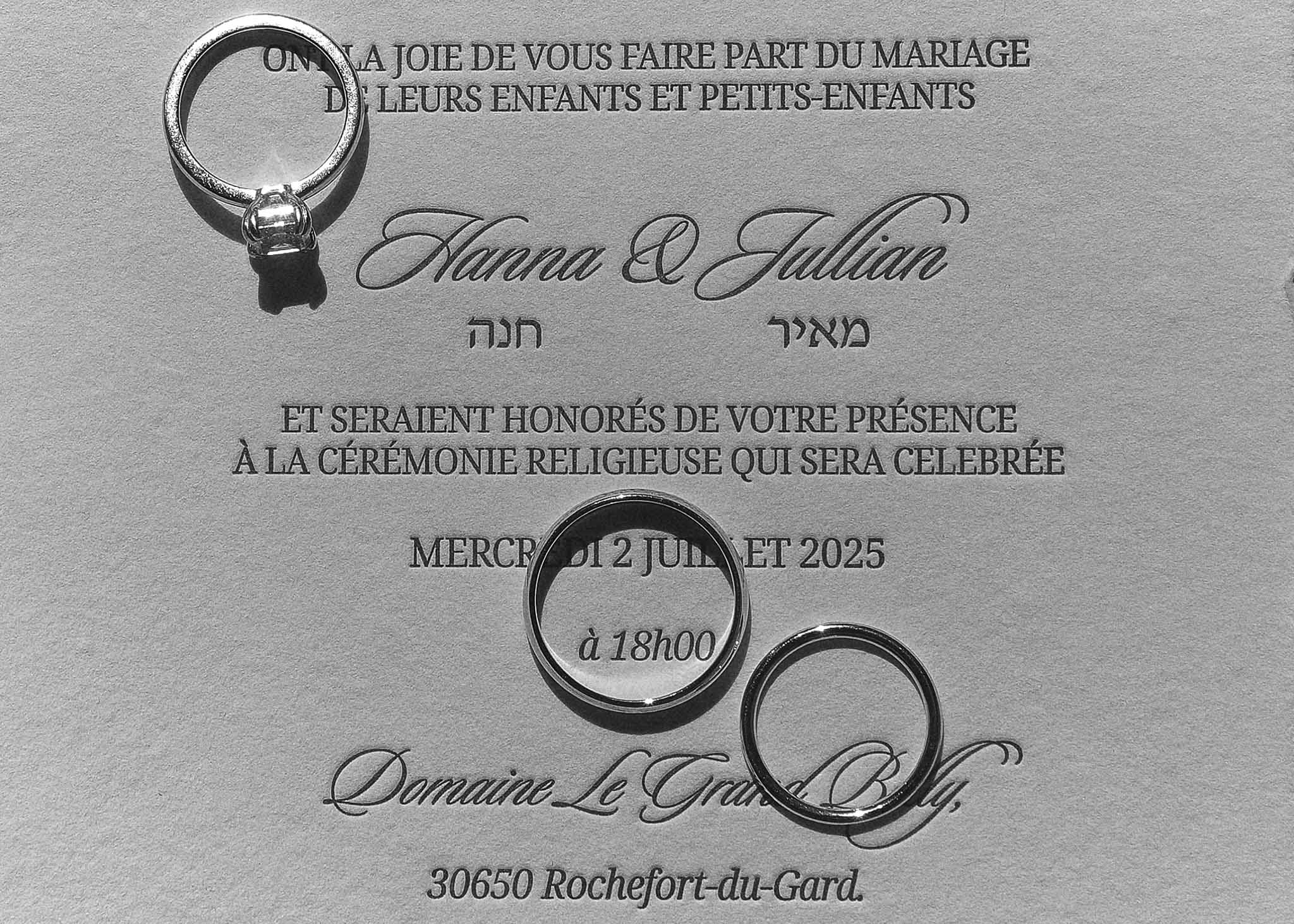
Destination Wedding Invitation Wording & Etiquette
French wedding invitations follow a completely different system from British or American ones. There is no single card that says "you are invited to our wedding." Instead, there is the faire-part: a layered, tiered set of enclosures that tells each guest exactly which parts of the day they are attending. Get the wording wrong, and you confuse your French guests.
Get the format wrong, and your international guests miss critical logistics. This guide breaks down the faire-part structure, bilingual wording etiquette, and the specific information a destination wedding invitation must include. For the full chapter on paper, digital, and day-of stationery, see our complete invitations and stationery guide. For a broader view of every step involved, see the full planning guide for destination weddings in France.
Key Takeaways
- French wedding invitations use the faire-part system: a set of nested cards that separate guests into tiers (ceremony only, vin d'honneur, and dinner). Each guest receives only the cards matching the events they are invited to.
- Bilingual invitations place French on one side and English on the other, or use a single language with a translation card enclosed. Never mix languages within the same paragraph.
- Destination wedding invitations must include travel logistics (nearest airports, transfer options, accommodation blocks) that traditional French invitations do not cover.
- The error international couples make most often international couples make is sending a single all-inclusive invitation that confuses French guests accustomed to the tiered system.
- Traditional French wording places the parents' names first, not the couple's. Modern bilingual invitations increasingly lead with the couple, but understanding the convention matters for French family expectations.
How Does French Wedding Invitation Wording Differ from English?
French wedding invitations are issued by the parents, not the couple. The traditional wording opens with the names of the bride's parents on the left and the groom's parents on the right, followed by a formal announcement that their children will be married. The couple's names appear below the parents' names. This is not a stylistic choice. It reflects the French legal and cultural tradition that marriage is a union of two families, formally announced by those families. Across the 400+ venues listed on French Wedding Style, this convention remains the standard at traditional French celebrations. The tone is formal. French wedding language uses the conditional tense ("ont l'honneur de vous faire part du mariage de...") rather than the direct "request the pleasure of your company." There is no RSVP in the English sense. Instead, a response card (carton-réponse) is enclosed with a stamped return envelope. The French tradition assumes attendance unless the guest sends regrets. This is the inverse of the Anglo convention, where non-response typically means "no."
Modern French couples, particularly those marrying internationally, increasingly issue invitations in their own names. But even these updated versions tend to acknowledge parents in a secondary line ("avec la bénédiction de leurs parents" or simply listing parent names below). Understanding both the traditional and modern formats lets you choose a wording that respects French convention while feeling authentic to your relationship.
What Is the French Faire-Part System?
A faire-part is the French wedding announcement and invitation combined into a single stationery suite. Unlike the British or American model, where one invitation covers the entire wedding day, the faire-part uses a tiered system of nested cards. Each card corresponds to a specific part of the celebration. Guests receive only the cards matching the events they are invited to attend. This is the defining feature of French wedding stationery and the element that confuses international couples most. The three tiers work as follows. The outermost card announces the marriage and invites the guest to the ceremony (église or mairie). Every guest on the list receives this card. The second enclosure invites the guest to the vin d'honneur, the cocktail reception that follows the ceremony. A vin d'honneur is the celebratory drinks and canapé hour held immediately after the ceremony, typically lasting 1.5 to 3 hours, and many French weddings invite a wider circle to this portion. The innermost card, the smallest, invites the guest to dinner and the soirée.
This system is practical, not exclusionary. French weddings routinely have 150 guests at the vin d'honneur and 80 at dinner. The tiered invitation manages this gracefully. For international couples blending French and Anglo traditions, the challenge is adapting this system for guests who have never encountered it. A brief explanatory note ("In the French tradition, each card indicates which parts of the celebration you are invited to attend") resolves most confusion.
Scroll →
| Tier | Card | Who Receives It | What It Covers |
|---|---|---|---|
| 1 (outermost) | Faire-part / ceremony card | All guests | Announcement of marriage, ceremony location and time |
| 2 | vin d’honneur card | Ceremony + cocktail guests | Post-ceremony reception, venue, approximate duration |
| 3 (innermost) | Dinner card | Close family and friends only | Seated dinner and evening party, dress code, end time |
How Do You Word Bilingual Invitations?
Bilingual wedding invitations in France follow one clear rule: keep the languages separate. French text on one side, English on the other. Or French on the front face of a folded card, English on the inner face. Never alternate paragraphs or mix languages within a single block. Based on destination weddings we have featured over 15 years, the side-by-side format on a single sheet (French left, English right) is the most popular choice for couples with guests from both language groups. The French text should be written or at least reviewed by a native speaker. Wedding French is formal, and small errors in tense, register, or phrasing are immediately obvious to French guests. Common pitfalls include using "tu" forms in what should be "vous" language, translating English idioms literally ("we request the pleasure" does not translate word-for-word), and misspelling French place names or venue names. A professional stationer with experience in bilingual suites will catch these. A general graphic designer may not.
For the English text, match the formality level of the French side. If the French wording is traditional and parent-led, the English version should mirror that structure, not suddenly switch to casual "Hey, we're getting married!" language. Consistency of register signals intentionality. The stationery should feel like one cohesive suite that happens to serve two languages, not two competing invitations stapled together.
Practical wording for the English side should include elements that French invitations omit: a clear RSVP deadline with instructions, a wedding website URL for travel and accommodation details, and any dress code guidance beyond "tenue de soirée" that international guests may need explained. The wedding website is where you bridge the information gap without overloading the printed invitation.
What Information Must a Destination Wedding Invitation Include?
A destination wedding invitation carries a heavier logistical burden than a local one. Your guests are booking flights, taking time off work, arranging childcare, and budgeting for travel. The invitation must give them enough information to commit, while directing them to your wedding website for the full details. As of 2026, the standard for international destination weddings in France includes six essential elements beyond the basic who, when, and where. Nearest airports and travel time. Name the two closest airports and approximate transfer times. "Toulouse-Blagnac Airport (45 minutes by car)" is more useful than just a venue address. Couples marrying in regions like the Dordogne or Normandy where the nearest airport is not obvious must make this clear. Accommodation. State whether the venue has on-site rooms and whether you have blocked rooms at nearby hotels. Include the booking deadline. "We have reserved 20 rooms at Hôtel des Vignes. Please book by 1 March using code SMITHWEDDING" gives guests immediate actionable information.
Weekend structure. French destination weddings often span a full weekend. If there is a welcome dinner on Friday and a brunch on Sunday, say so. Guests need to know whether they are booking one night or three. For guidance on structuring a multi-day celebration, see our guide to the vin d'honneur and French wedding day timeline.
Dress code. "Tenue de soirée" means formal evening wear in French, but international guests may not know the term. Be explicit: "Black tie" or "Formal evening dress; the ceremony is outdoors on grass, so flat shoes recommended."
RSVP deadline and method. Set the deadline at least eight weeks before the wedding. Provide both a physical response card and an online option (website RSVP form). International post is unreliable for tight deadlines. See how this couple brought this to life at Château Gassies in Bordeaux.
Wedding website URL. This is where the full travel guide, accommodation options, local restaurant recommendations, and day-by-day schedule live. The invitation points to it. The website carries the detail. Couples building their site should read our guide on what a destination wedding website must include.
What Are the Common Wording Mistakes International Couples Make?
Ignoring the faire-part system entirely and sending a single Anglo-style invitation to a mixed guest list is the mistake we see most often. French guests receiving a card that says "join us for our wedding celebration" without tiered enclosures do not know whether they are invited to the whole day or just the ceremony. They may assume the vin d'honneur only and leave before dinner. This causes confusion, awkward phone calls to the couple's parents, and empty seats at the dinner table. Over-translating runs a close second. Phrases like "the honour of your presence" translate poorly into French. The French equivalent is not a literal translation but a different construction entirely ("ont l'honneur de vous faire part du mariage de leur fille..."). For a deeper look, see our guide to French regional terms and etiquette to reference in your wedding invitations. Couples who run their English wording through Google Translate and print the result embarrass themselves with every native speaker who reads it. Invest in a bilingual stationer or a native-speaking friend who understands formal register.
Omitting logistics is equally damaging. A French couple marrying locally can send a card with a venue name and everyone knows where it is. An international couple asking guests to fly to Provence with nothing but "Château de Something, 84000 Apt" is asking them to do too much research. The invitation should include enough information to commit (airport, accommodation, dates needed) and a clear pointer to the wedding website for the rest.
Sending invitations too late is a mistake specific to destination weddings. For a wedding in France with international guests, save-the-dates should go out 9 to 12 months ahead, with formal invitations following 4 to 6 months before the wedding. Sending invitations 8 weeks out, the UK standard, does not give international guests enough time to book affordable flights and accommodation.
Finally, some couples attempt to blend the two systems by adding an explanatory paragraph to a traditional faire-part. This clutters the stationery and undermines the design. The cleaner approach is a dedicated "About the Day" insert card (in both languages) that explains the tiered system to international guests and provides the key logistics. The faire-part itself stays clean and traditional. The insert card bridges the cultural gap. This approach works well at château wedding venues where the stationery sets the tone for the entire celebration.
Related Articles
- Invitations and stationery for a French wedding: the complete guide
- Save-the-date timeline for a destination wedding in France
- What your destination wedding website must include
- Day-of stationery: menus, programs, and place cards
- Blending French and international wedding traditions
- The vin d'honneur and French wedding day structure
- Choosing a wedding planner in France
- Browse all wedding venues in France
Frequently Asked Questions
Should both sets of parents be named on the invitation?
In traditional French wording, yes. The bride's parents appear on the left, the groom's parents on the right, and both families formally announce the marriage. Modern bilingual invitations sometimes name only the couple and add "with the blessing of their families" as a secondary line. If one partner's family is French and expects the traditional format, naming both sets of parents is the diplomatic choice. If both families are international and relaxed, the couple-led format works well.
What does RSVP mean in the French context?
RSVP stands for "Répondez s'il vous plaît" and is originally French, but the practice differs. In France, receiving a faire-part traditionally implies you will attend unless you send regrets. There is no expectation of a "yes" confirmation the way Anglo weddings require. For a mixed guest list, include a response card with both "accepts with pleasure" and "regretfully declines" options, plus a clear deadline. This satisfies both cultural expectations.
Can we send digital invitations for a French wedding?
For the save-the-date, digital is increasingly accepted and practical for international guest lists. For the formal invitation, French etiquette still favours printed stationery. A physical faire-part carries weight and formality that a digital version does not replicate. For destination weddings with guests across multiple countries, a hybrid approach works: printed invitations for close family and VIP guests, digital for the broader list, all pointing to the same wedding website.
How do we handle guests who are invited to the vin d'honneur but not dinner?
This is standard in France and carries no social stigma. Those guests receive the ceremony card and the vin d'honneur card but not the dinner card. The vin d'honneur is substantial (1.5 to 3 hours of canapés, champagne, and conversation) and is considered a full celebration in itself. Do not apologise for the distinction. It is expected. International guests unfamiliar with the system may need a gentle explanation, ideally via the wedding website rather than on the invitation itself.
What paper stock and printing method is standard for French invitations?
French faire-part traditionally use heavyweight cotton or laid paper (vergé) in off-white, cream, or pale grey. Letterpress and engraving are the traditional printing methods for formal invitations. Thermography is acceptable for semi-formal suites. Digital printing works for modern, design-forward invitations. The paper weight should be 300gsm or heavier for the main card. Enclosure cards can be lighter (200 to 250gsm). French stationers tend to favour tactile, textured stocks over glossy or coated finishes.
Do we need to include a map with the invitation?
For a destination wedding in a rural area, a map insert or a clear link to a digital map is essential. French rural addresses can be confusing (lieu-dit names, departmental roads without clear numbers). A simple illustrated map showing the venue in relation to the nearest town and airport, plus a "Full directions on our website" note, bridges the gap between the printed suite and the detailed travel information online.
Is calligraphy expected on French wedding invitations?
Hand calligraphy for envelope addressing is a premium touch, not an expectation. French stationery tradition values clean typography (serif fonts in the Didot or Garamond family) over decorative calligraphy. If your budget allows calligraphy for the outer envelopes and response card addressing, it adds a layer of craft. But a well-printed address in a classic typeface is entirely appropriate and more common in France than calligraphy.
Explore Every Guide in This Chapter
Deep-dive into each topic covered above.