

Hidden Costs of a Destination Wedding in France
Every destination wedding in France carries costs that never appear on the initial venue quote, the vendor proposal, or the planning spreadsheet. These are not optional upgrades or premium additions.
They are structural costs of getting married in a foreign country, and they catch international couples with budgets of €30,000 to €150,000 with equal reliability. Across the hundreds of destination weddings featured on French Wedding Style over the past 15 years, the gap between the initial budget and the final invoice averages 15 to 25%. This guide lists every hidden cost so you can budget for them from the start as part of your complete French wedding cost planning. For a broader view of every step involved, see our step-by-step destination wedding planning guide for France.
Key Takeaways
Every destination wedding in France carries costs that never appear on the initial venue quote or vendor proposal, and across the hundreds of weddings featured on French Wedding Style over 15 years, the gap between the initial budget and the final invoice averages 15 to 25%. Three costs surprise virtually every international couple: responsabilite civile event liability insurance at €150 to €400 required by every venue, the taxe de sejour nightly tourist tax per person per night, and French VAT at 20% on goods and 10% on services applied on top of quoted prices. Venue-related extras at dry-hire properties add €5,000 to €15,000, legal paperwork runs €500 to €1,500 depending on nationality, and international bank transfer fees through traditional banks cost €1,500 to €2,500 across 15 to 20 vendor payments. Budget a minimum contingency of 10% and increase to 15 to 20% for dry-hire venues and outdoor ceremonies.
- The three costs that surprise virtually every international couple: responsabilité civile insurance (€150 to €400), taxe de séjour tourist tax (per person per night), and French VAT (20% on goods, 10% on services) applied on top of quoted prices.
- Venue-related extras (generator, portable toilets, waste removal, furniture hire, overtime) can add €5,000 to €15,000 to a dry-hire budget.
- Legal paperwork costs (sworn translations, apostilles, self-attestation) total €500 to €1,500 for UK couples and €550 to €1,100 for US couples.
- International bank transfer fees and exchange rate markups cost €1,500 to €2,500 across 15 to 20 vendor payments if using a traditional bank.
- Budget a contingency of 10% minimum. Increase to 15 to 20% for dry-hire venues, rural locations, outdoor ceremonies, and shoulder season weddings.
Which Hidden Costs Surprise Every International Couple?
Three costs appear on virtually every destination wedding invoice in France and are almost never anticipated by British, American, or Australian couples during initial budgeting: responsabilité civile event liability insurance at €150 to €400 required by virtually every venue, the taxe de séjour nightly tourist tax of €1 to €5 per person per night that adds €80 to €400 across 40 guests over two nights, and French VAT (TVA) charged at 20% on goods and 10% on services but frequently excluded from vendor quotes. A traiteur quoting €15,000 HT (hors taxes) will invoice €16,500 TTC (toutes taxes comprises) once the 10% service TVA is applied, and across a full wedding budget with 10 to 15 separate vendor invoices, failing to confirm HT versus TTC on every quote results in cumulative surprises of €3,000 to €5,000. The single question that prevents this entirely is "Est-ce TTC ou HT?" asked consistently to every supplier from the first conversation.
What Venue-Related Costs Are Not Included in the Site Fee?
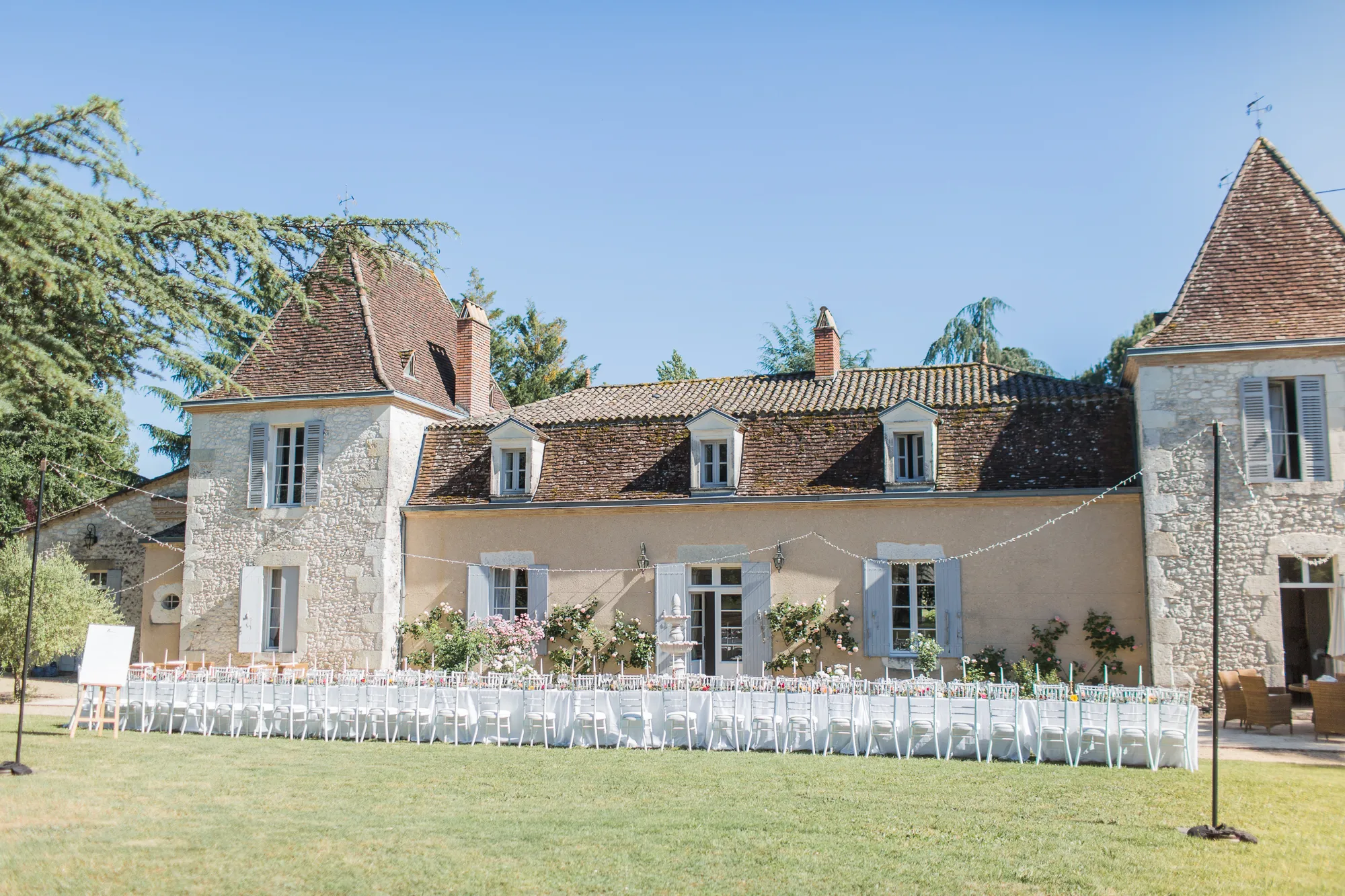
The venue site fee (frais de location) covers the property, grounds, accommodation, and basic infrastructure, but a significant category of costs sits outside it, particularly at dry-hire and rural properties where the extras compound rapidly to €5,000 to €12,000 before any catering or entertainment. Generator hire for châteaux without sufficient electrical capacity runs €800 to €2,000 for a weekend, premium portable toilet facilities for 80 or more guests cost €1,500 to €3,000, and professional post-event cleaning adds €500 to €1,500. Furniture rental for 100 chairs, banquet tables, and quality linens adds €2,000 to €5,000, with only half of FWS-listed venues including tables and chairs in the site fee and 74% not providing a sound system. Some premium Paris venues charge up to €4,000 for electricity as a separate line item. At all-inclusive venues, many of these costs are absorbed into the package price. For a full breakdown, see our guide to how French venue pricing works.
What Are the Hidden Costs of French Vendor Contracts?
French vendor contracts contain cost structures that differ from UK and US norms, and the differences catch international couples in three consistent ways. Overtime charges are the most common surprise. Every French supplier contract specifies a service window with a defined end time. A photographer booked for ten hours, a DJ contracted until 1am, a traiteur whose team clears by midnight.
Beyond that window, overtime is billed in hourly or half-hourly increments at rates agreed in the contract but rarely highlighted during the initial sales conversation. At a French wedding where dinner runs to midnight and dancing continues past 3am, overtime charges across photographer, DJ, and catering staff can add €1,000 to €3,000 to the final bill. Vendor travel and accommodation surcharges apply when suppliers travel one to three hours to reach rural venues. Ask every vendor in the first conversation whether travel and accommodation are included in their quote or charged separately, and get the answer in writing before signing. Supplier meal costs are a smaller but consistent addition: French venues and traiteurs typically charge €20 to €40 per head for vendor meals during the event.
How Much Does the Legal Paperwork Actually Cost?
Couples who marry legally in France rather than holding a symbolic ceremony after marrying at home face paperwork costs that are never bundled together in any official guide, making the total a consistent surprise. Sworn translations by a traducteur assermenté cost €30 to €60 per page, with a typical dossier requiring 6 to 10 pages for a total of €180 to €600. UK couples need an FCDO apostille at £75 plus a Certificate of No Impediment (CNI) with a 28-day notice period. US couples must navigate a self-attestation process because the US Embassy in Paris cannot issue a certificat de coutume. Some mairies require Embassy notarization at $50 per seal. In total, the legal paperwork runs €500 to €1,500 for UK couples and €550 to €1,100 for US couples, excluding the time cost of additional trips to France for the mairie appointment and the civil ceremony itself.
What Financial Costs Do Couples Overlook?
International bank transfer fees are the largest consistently overlooked financial cost of a destination wedding, with traditional banks adding a hidden markup of 3 to 4% to the exchange rate on every transfer from GBP or USD to EUR. Across 15 to 20 vendor payments totalling €50,000 over 12 to 18 months, this markup costs €1,500 to €2,000 in exchange rate loss alone. Add explicit per-transfer fees of £15 to £40 per transaction, and the total cost of moving money through a traditional bank reaches €1,800 to €2,500. Specialist transfer services such as Wise charge 0.33 to 0.7% per transfer using the mid-market rate, reducing the total cost to €165 to €350 on the same budget. For a detailed comparison and strategy, see our guide to paying French wedding vendors and managing currency exchange.
Wine sourcing is another area where hidden costs accumulate or, conversely, where informed couples save significantly. Of the 438 venues in the FWS collection, 105 allow couples to bring their own wine, and 78 of those charge zero corkage.
- Where corkage (droit de bouchon) applies, the typical fee is €5 to €12 per bottle
- Couples who buy direct from a local domaine at €8 to €15 per bottle instead of paying venue-supplied wine at €25 to €40 per bottle can save €1,500 to €3,000 on a 200-bottle order
- Always ask the venue about their wine policy before signing
Exchange rate movement over the 12-to-18-month planning period is a separate risk.
- A 5% adverse rate swing on a €50,000 budget adds €2,500 to the cost in the couple's home currency
- A 10% swing, which has occurred between GBP and EUR multiple times since 2016, adds €5,000
- Neither insurance nor contingency budgets cover this
- The only protection is a deliberate currency conversion strategy: converting in planned tranches rather than reactively with each invoice

What Guest-Related Hidden Costs Should You Budget For?
Guest logistics at a destination wedding generate costs that couples with domestic wedding experience do not anticipate, with the total cost of pre and post-wedding events reaching €5,000 to €15,000 on top of the main wedding day budget at many French celebrations. Guest shuttle transport between accommodation and venue, essential at most rural French properties where public transport does not exist, costs €500 to €1,500 for a coach or minibus running a fixed loop through the evening. Welcome dinner catering for 30 to 80 guests the night before the wedding runs €50 to €130 per head depending on format, adding €1,500 to €10,000 that is rarely included in the initial budget. Farewell brunch on the Sunday morning adds another €500 to €2,000. For couples hosting the multi-day celebration that is standard at French destination weddings, these figures should be ring-fenced from the start alongside the main wedding day costs.
How Much Contingency Should You Budget?
A contingency reserve of 10% of your total budget is the non-negotiable minimum for any destination wedding in France, representing €5,000 on a €50,000 budget held in reserve and not allocated to any vendor or expense until a genuine need arises. Increase the contingency to 15 to 20% in four specific scenarios: dry-hire venues where logistics costs are harder to predict, rural or remote locations where supplier travel complications and limited backup options create exposure, outdoor ceremonies with no permanent indoor alternative where weather is the most unpredictable cost, and shoulder season weddings in May or October where conditions are less reliable. The most common contingency triggers are guest list growth adding €5,000 to €10,000 in late catering costs, weather events requiring emergency marquee hire, and a key supplier cancelling within three months forcing replacement at premium rates.
- Dry-hire venues where logistics costs are harder to predict
- Rural or remote locations where supplier travel complications and limited backup options create exposure
- Outdoor ceremonies with no permanent indoor alternative where weather is the most unpredictable cost
- Shoulder season weddings (May, October) where conditions are less reliable

“I recommend 15 to 20% contingency, not the 10% that many UK guides suggest. The three costs that surprise virtually every international couple are equipment rentals, staffing and cleaning, and administrative fees. Not creating a detailed budget of all additional costs from the very start is the most significant mistake.”
The most common contingency triggers are guest list growth (adding ten guests late in planning adds €5,000 to €10,000 in catering alone), weather events requiring emergency marquee or heating hire, and a key supplier cancelling within three months of the wedding, which forces emergency replacement at premium rates.
The Assumptions That Derail Hidden Cost Planning
What goes wrong most often is treating the venue fee and vendor quotes as the complete budget, when in reality they are only the starting framework with costs totalling 15 to 25% of the headline figure sitting between them. Infrastructure costs add €5,000 to €12,000 at dry-hire venues, tax surprises account for €2,000 to €5,000 in VAT alone, international bank transfer fees through traditional banks cost €1,500 to €2,500, legal expenses run €500 to €2,000 depending on nationality, and guest logistics for shuttles, welcome dinner, and farewell brunch add €2,500 to €13,000. A couple who budgets €50,000 based on venue and vendor quotes alone will realistically spend €57,000 to €62,000 once all hidden costs are included. Understanding this gap from the start prevents the financial stress that derails planning in the final months. The breakdown of these costs is as follows.
- Infrastructure costs: €5,000 to €12,000 at dry-hire venues
- Taxes: €2,000 to €5,000 in VAT surprises alone
- Transfer fees: €1,500 to €2,500 through traditional banks
- Legal expenses: €500 to €1,500 depending on nationality
- Guest logistics: €2,500 to €13,000 for shuttles, welcome dinner, and farewell brunch
- Contingency reserve on top
A couple who budgets €50,000 based on venue and vendor quotes alone will realistically spend €57,000 to €62,000 once all hidden costs are included. Understanding this gap from the start is not pessimistic. It is accurate, and it prevents the financial stress that derails the planning process in the final months.
The mistake that costs couples most is not confirming VAT treatment on every invoice. French vendors quote in either HT (hors taxes, excluding VAT) or TTC (toutes taxes comprises, including VAT), and the convention varies by vendor category and region. Assuming every quote is TTC when several are HT creates a cumulative shortfall of €3,000 to €5,000 across a full wedding budget. One question, asked consistently to every supplier, eliminates this risk entirely. For a full explanation of the legal difference between arrhes and acompte in French vendor contracts, and how TVA applies to each vendor category, see our contracts guide.
What makes this worse is cutting the contingency to make the budget balance. A budget that works only if nothing unexpected happens is not a budget. It is a wish. The contingency is the difference between absorbing a problem and being financially derailed by one. Protect it from the first spreadsheet to the final invoice.
The Complete Hidden Cost Checklist
| Category | Hidden Cost | Typical Range |
|---|---|---|
| Venue extras | Generator hire | €800 to €2,000 |
| Venue extras | Portable toilets | €1,500 to €3,000 |
| Venue extras | Waste removal and cleanup | €500 to €1,500 |
| Venue extras | Furniture rental (if not included) | €2,000 to €5,000 |
| Venue extras | Electricity surcharge (some venues) | €500 to €4,000 |
| Venue extras | Security deposit (caution, refundable) | €1,000 to €5,000 |
| Taxes and insurance | Responsabilité civile (event liability) | €150 to €400 |
| Taxes and insurance | Taxe de séjour (tourist tax) | €80 to €400 (group total) |
| Taxes and insurance | French VAT gap (HT vs TTC surprise) | €2,000 to €5,000 |
| Vendor contract extras | Overtime charges (photographer, DJ, traiteur) | €500 to €3,000 |
| Vendor contract extras | Vendor travel and accommodation | €500 to €1,500 |
| Vendor contract extras | Supplier meals | €200 to €600 |
| Legal and paperwork | Sworn translations + apostilles (UK) | €500 to €1,500 |
| Legal and paperwork | Self-attestation + translations (US) | €550 to €1,100 |
| Financial | Bank transfer fees and exchange markup | €1,500 to €2,500 |
| Financial | Exchange rate movement (unhedged) | €1,000 to €5,000 |
| Guest logistics | Shuttle transport | €500 to €1,500 |
| Guest logistics | Welcome dinner | €1,500 to €10,000 |
| Guest logistics | Farewell brunch | €500 to €2,000 |
| Contingency | 10 to 20% of total budget | €5,000 to €20,000 |
Related Articles
These four guides expand on the hidden cost categories covered above. The venue pricing guide explains how French site fees work and what is typically included versus excluded at each property type. The wedding insurance guide covers which policies protect against the specific risks of a French destination wedding, from supplier cancellation to weather events. The currency exchange guide provides a step-by-step strategy for avoiding the 3 to 4% bank markup that costs international couples €1,500 to €2,500 across a typical wedding budget. The all-inclusive versus dry-hire comparison shows how venue model choice directly determines which hidden costs apply and which are absorbed into a package price.
- How venue pricing works in France: site fees, packages, and hidden costs
- Wedding insurance for a destination wedding in France
- Currency exchange and paying French wedding vendors
- All-inclusive versus dry-hire venue costs in France
Frequently Asked Questions
What are the biggest hidden costs of a French destination wedding?
The three costs that surprise virtually every international couple are responsabilité civile insurance (€150 to €400, required by every venue), taxe de séjour tourist tax (€80 to €400 for a group), and French VAT applied on top of quoted prices (20% on goods, 10% on services). Together with venue extras, vendor overtime, legal fees, and bank transfer costs, hidden expenses typically add 15 to 25% to the initial budget.
How much should I add to my budget for hidden costs?
Allocate a separate hidden costs line of €3,000 to €5,000 for a mid-range wedding or €5,000 to €10,000 for a premium celebration. This is in addition to a 10 to 15% contingency reserve. The hidden costs line covers predictable extras (taxes, transfer fees, legal paperwork, guest logistics). The contingency covers genuine surprises (weather events, supplier cancellations, guest list changes).
Do I have to pay French VAT on my wedding?
French VAT (TVA) applies to all goods and services purchased in France: 20% on goods (rentals, flowers, stationery) and 10% on services (catering, photography, planning). Always ask whether a vendor's quote is HT (excluding VAT) or TTC (including VAT). A quote of €15,000 HT becomes €16,500 TTC for services or €18,000 TTC for goods. This distinction across 10 to 15 vendor invoices can add €3,000 to €5,000 to the total budget.
What is taxe de séjour and how much does it cost?
A taxe de séjour is a nightly tourist tax charged per person per night at accommodation in France. The rate is set by each municipality and ranges from €1 to €5 per person per night depending on the accommodation classification. For 40 guests staying two nights at a château, the total taxe de séjour is €80 to €400. The venue collects it and passes it to the local commune. It appears on the final invoice as a separate line item.
Are private weddings in France subject to SACEM music licensing fees?
Private weddings are not subject to SACEM (Société des Auteurs, Compositeurs et Éditeurs de Musique) licensing fees. SACEM licensing applies to public events where music is performed for a general audience. A wedding is a private celebration among invited family and friends and does not qualify as a public event. Couples are not liable for any music licensing fees for their private wedding reception.
How much do sworn translations cost for a French wedding?
A traducteur assermenté (sworn translator) charges €30 to €60 per page for official document translation required by the French mairie. A typical marriage dossier requires 6 to 10 translated pages, totalling €180 to €600. UK couples also need an FCDO apostille (£75). US couples must navigate a self-attestation process (free in most cases, or $50 if Embassy notarization required). Total legal paperwork costs: €500 to €1,500 for UK couples, €550 to €1,100 for US couples.
Start planning your budget with our complete guide to French wedding costs, or browse all wedding venues in France to begin your venue search. To protect your investment, read our guide to wedding insurance for a destination wedding in France.
Explore Every Guide in This Chapter
Deep-dive into each topic covered above.