
What to Wear as a Guest
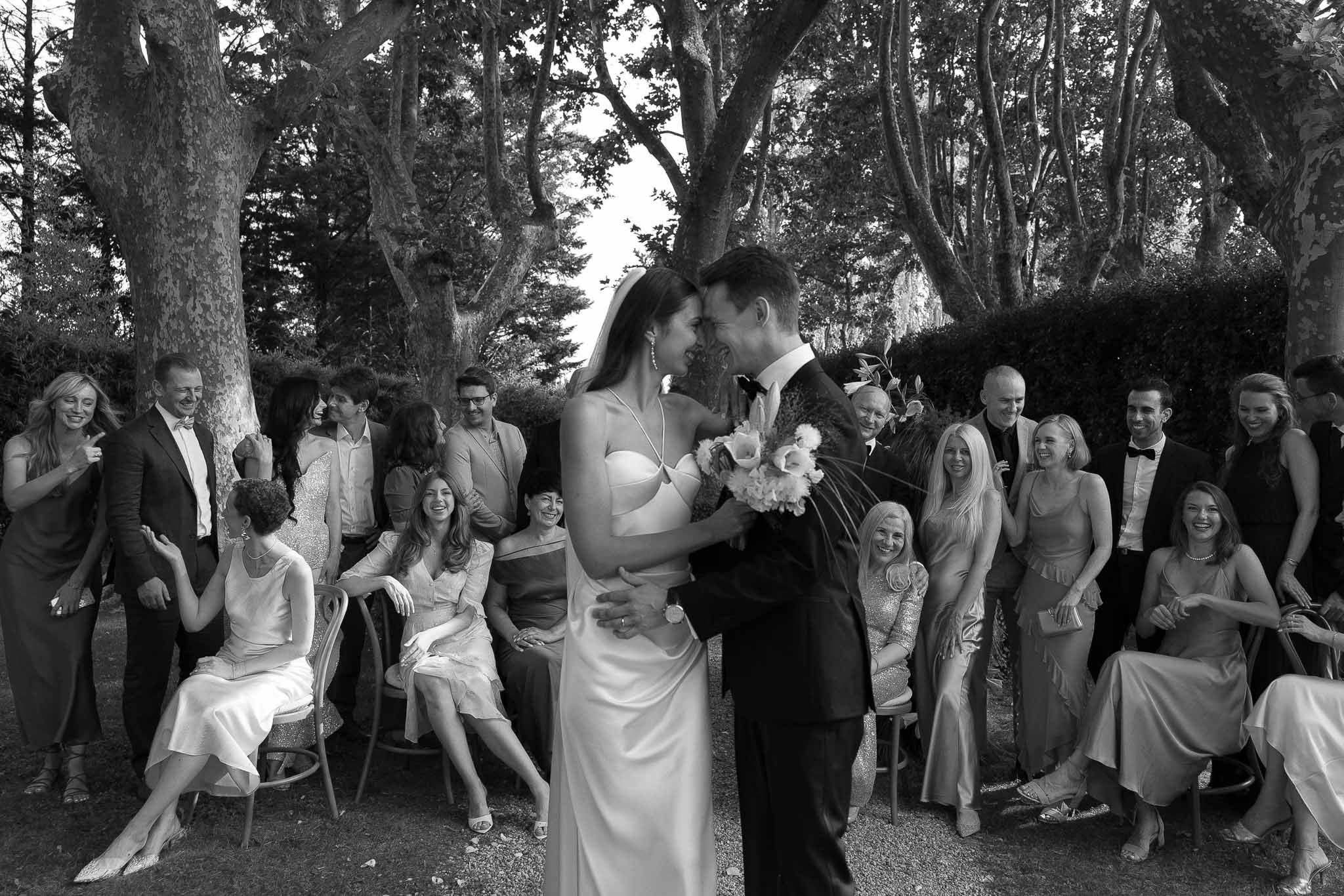
The dress code at a French wedding is more formal than most international guests expect. A garden party in the Cotswolds and a ceremony in the grounds of a Provençal château may look similar in photographs, but the sartorial expectations are different. French weddings lean toward structured formality: men in suits (not separates), women in dresses or tailored outfits (not jumpsuits or cocktail separates).
The outdoor setting adds complications that indoor weddings do not face: gravel that destroys stilettos, heat that wilts structured fabrics, and evening temperatures that drop sharply once the sun sets. What follows are the cultural expectations, the practical considerations, and the outfit strategy that lets guests look right and feel comfortable from ceremony through to 3am. This forms part of our complete guide to planning a destination wedding in France. For the full chapter, see our complete guest experience guide.
Key Takeaways
- French wedding guest dress code runs one notch more formal than equivalent British or American events. When in doubt, dress up rather than down. A well-cut suit for men and a below-the-knee dress for women is the safe default.
- Block heels or flat dress shoes are essential for outdoor ceremonies on gravel, grass, or cobblestone. Stilettos will sink, catch, and cause twisted ankles. This is by far the most common mistake international guests make at French venue weddings.
- Natural fabrics (linen, cotton, silk) are the right choice for summer in the south. Synthetic fabrics trap heat and become visibly uncomfortable during a 2-hour outdoor ceremony in 30 to 35 degree temperatures.
- Bring a light wrap, pashmina, or blazer for the evening. Temperatures in southern France can drop 10 to 15 degrees after sunset, and the dinner may last until midnight outdoors.
- If the couple specifies a dress code on the invitation, follow it precisely. "Black tie" at a French wedding means black tie, not "smart with a dark jacket."
How Does French Wedding Dress Code Differ?
The French approach to wedding guest attire is rooted in the formality of the occasion. A wedding in France is a significant social event, and dressing well for it is a mark of respect to the couple, the families, and the venue. This is not pretension. It is cultural expectation. For men, the default is a full suit in a medium to dark tone (navy, charcoal, midnight blue). A jacket with mismatched trousers reads as underdressed at most French weddings. Ties are expected at formal weddings (château, city, winter) and optional at more relaxed summer celebrations (domaine, mas, garden). Open-neck shirts without a jacket are too casual for any French wedding, even in July heat. French male guests will almost universally wear a suit. International male guests who arrive in chinos and a blazer will stand out.
For women, a knee-length or midi dress in a structured fabric is the standard. Maxi dresses work at garden and countryside venues. Shorter cocktail dresses are appropriate at city and evening celebrations. Colour choices are broad: jewel tones, pastels, prints, and bold colours are all welcome. White, cream, and ivory are traditionally avoided (reserved for the couple). Black is acceptable in Paris and at city weddings, but at traditional countryside celebrations, particularly with French family guests, it can be read as mourning wear. If in doubt, add a colourful accessory. If the invitation says "tenue de soirée" (evening dress), interpret this as cocktail to formal: a structured dress or gown, not casual eveningwear.
Children, if attending, are expected to be well-dressed too. Boys in tailored shorts or trousers with a collared shirt. Girls in a clean dress. This is one area where French expectations align closely with British ones.
What Should Guests Wear to an Outdoor Château Wedding?
An outdoor ceremony at a French château is the most common scenario, and it presents a specific set of challenges. The setting is formal (historic architecture, manicured gardens, stone terraces) but the environment is outdoors (sun, wind, gravel, grass, temperature shifts). The outfit needs to work for both. For women, choose a midi or knee-length dress in a fabric that moves with you and does not crease badly (silk, cotton-linen blend, crepe). Avoid heavily structured pieces that rely on air conditioning to remain comfortable. A hat or fascinator is not expected at French weddings (unlike British events) but a pair of good sunglasses is essential for a 4pm ceremony in July. Footwear is the critical decision. Block heels, wedges, or flat dress shoes (polished loafers, pointed flats, embellished sandals) are the right choice. Stiletto heels will sink into gravel, catch between cobblestones, and become painful on uneven terrain within 30 minutes. Some venues provide heel protectors (clear plastic caps that distribute weight on soft ground), but do not rely on this.
For men, a lightweight wool or cotton-blend suit in a summer-appropriate colour (light grey, mid-blue, stone) works for daytime ceremonies. Switch to darker tones (navy, charcoal) for evening-only celebrations. Suede loafers or leather derby shoes are practical on outdoor terrain. Patent or high-shine leather shoes look out of place on gravel.
What About Heat, Gravel, and Evening Chill?
Heat. Summer weddings in the south of France regularly hit 30 to 35 degrees Celsius. At an outdoor ceremony starting at 4pm, the sun is still strong and shade may be limited. Natural fabrics (linen, cotton, light wool, silk) breathe and wick moisture. Synthetic fabrics (polyester, nylon, acrylic) trap heat against the skin and become visibly uncomfortable. For women, a lightweight dress with some movement in the skirt allows air circulation. For men, a linen-blend suit with an unlined jacket is the most comfortable option. Undershirts are advisable to prevent visible perspiration on shirt fabric. Gravel and terrain. Nearly every French château, domaine, and bastide has gravel paths, cobblestone courtyards, or uneven garden surfaces. The walk from the car park to the ceremony, from the ceremony to the apéritif, and from the apéritif to the dinner table may cover 200 to 500 metres across mixed surfaces.
Plan footwear for this, not for a smooth hotel ballroom floor. Women should pack a pair of flat evening shoes for dancing later in the evening, even if they wear low heels for the ceremony. Men in leather-soled shoes should be aware that leather on gravel is slippery when polished.
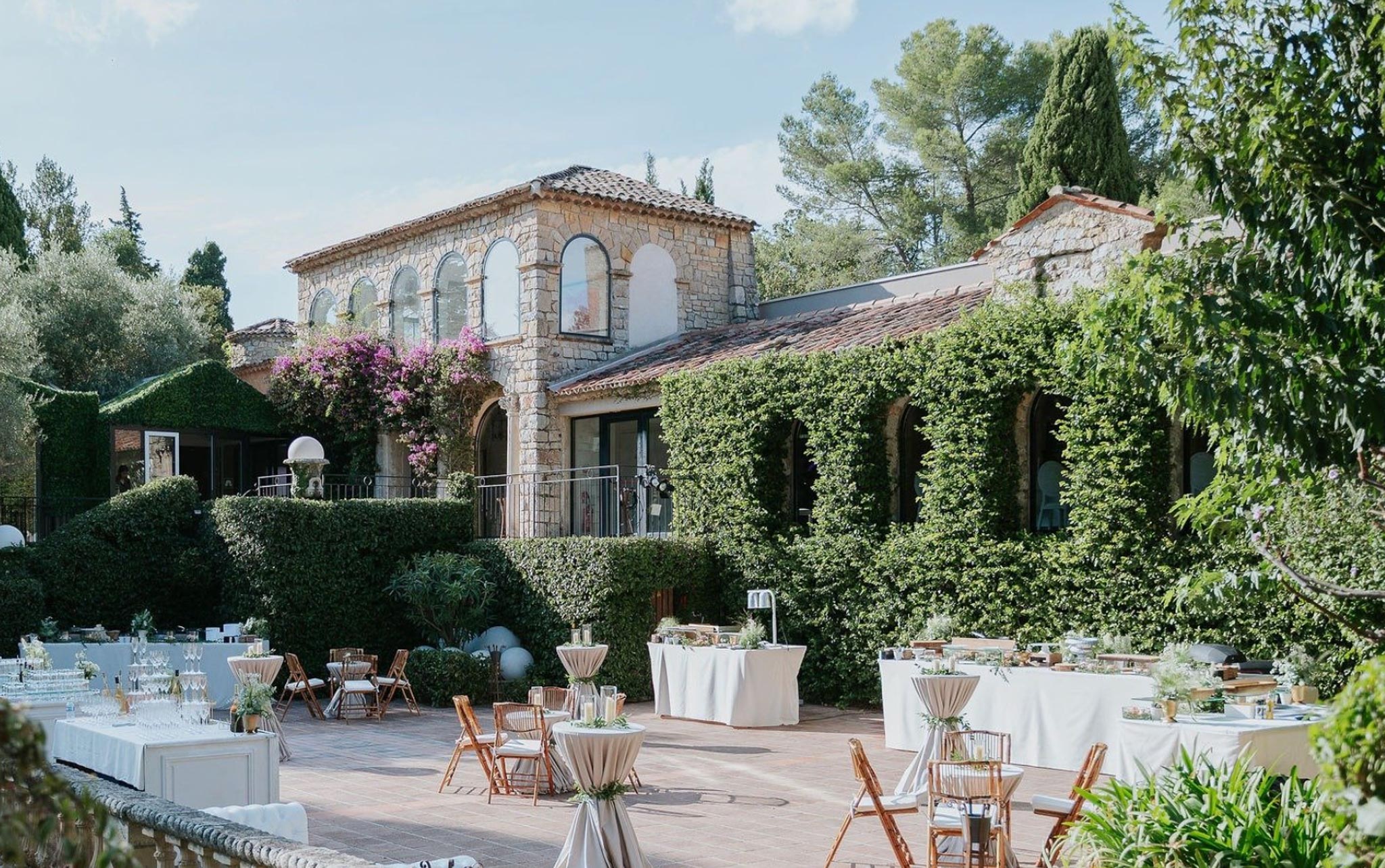
Evening chill. Temperatures in southern France drop significantly after sunset, particularly between September and May. Even in July and August, evenings can cool by 10 to 15 degrees once the sun goes down. A light wrap, pashmina, or linen blazer takes up minimal luggage space and makes the difference between enjoying the outdoor dinner and shivering through the cheese course. For women, a wrap that complements the dress colour doubles as a style element. For men, keeping the jacket on (rather than draping it over a chair after the apéritif) solves the problem. See how this couple brought this to life at Château de Robernier in Provence.
The couple can help by providing light throws or blankets on dinner chairs. Some venues stock these. Others provide them as an add-on. A basket of pashminas in a neutral colour costs €200 to €400 for 30 to 50 and makes a practical favour that guests genuinely use. For broader packing advice, see our guide to what guests should pack for a French destination wedding.

Related Articles
- Guest experience at a French wedding: the complete guide
- What guests should pack for a French wedding
- Choosing a wedding dress for your French venue type
- French wedding style and aesthetic guide
- Seasonal weather and climate guide for French weddings
- Structuring a multi-day wedding weekend
- Outdoor wedding venues in France
- Château wedding venues in France
- Browse all wedding venues in France
Frequently Asked Questions
Can guests wear white to a French wedding?
No. The convention against wearing white, cream, or ivory applies in France just as it does in the UK and US. This extends to predominantly white prints and very pale pastels that read as white in photographs. Choose a colour that is clearly not in the bridal palette.
What does "tenue de soirée" mean on a French wedding invitation?
Tenue de soirée translates as "evening dress" and indicates a formal dress code. For women: a cocktail or full-length gown. For men: a dark suit or dinner jacket (tuxedo). It is the French equivalent of "black tie" in Anglo terminology, though a well-cut dark suit is increasingly accepted alongside a dinner jacket. If unsure, ask the couple for clarification. Under-dressing for a tenue de soirée wedding is more noticeable than over-dressing.
Are hats or fascinators expected at French weddings?
No. Unlike British weddings, hats and fascinators are not a customary part of French wedding guest attire. Some guests may wear one, but it is not an expectation. Sunglasses and a light scarf are more practical accessories for an outdoor French wedding in summer.
Explore Every Guide in This Chapter
Deep-dive into each topic covered above.