

The French Riviera & Côte d'Azur
The French Riviera is one of the most desired wedding destinations in Europe, and one of the most misunderstood. The fantasy of white linen, bougainvillea, and azure water holds up. The logistics of delivering that fantasy do not always match the Instagram version. The real choices, costs, and trade-offs involved in planning a Riviera wedding, whether you choose the coast or the hills above it. It forms part of our guide to choosing your wedding region in France.
Key Takeaways
The French Riviera splits into two distinct wedding markets that differ in price by 20 to 40%: the coastal strip running from Nice through Cannes to Saint-Tropez, and the arriere-pays hill towns sitting just 20 minutes inland around Grasse, Mougins, and Vence. A coastal wedding for 80 guests costs €100,000 to €200,000 or more in 2026, while a comparable celebration in the hinterland runs €60,000 to €150,000. Most private villas on the coast were built as residences rather than event spaces, requiring temporary kitchens, generators, and shuttle transport that add €8,000 to €20,000 in infrastructure costs. Sound curfews along the coast are strictly enforced between 22:00 and 23:00, and Monaco requires 30-day residency for legal marriage. Understanding these five realities before you begin contacting venues will shape every subsequent planning decision.
- The Riviera splits into two distinct wedding markets: the coastal strip (Nice, Cannes, Saint-Tropez, Cap Ferrat) and the arrière-pays hill towns (Grasse, Mougins, Vence). Coast weddings cost 20 to 40% more.
- Most private villas on the Riviera were built as residences, not event spaces. No professional kitchen, no dedicated power supply, no guest parking. Everything must be brought in from scratch.
- Sound curfews are strictly enforced along the coast and carry real consequences. Plan entertainment around them or risk having your reception shut down.
- Monaco works best for a ceremony or pre-wedding dinner. Private venues at scale do not exist, and legal marriage requires 30-day residency.
- The arrière-pays above Nice and Cannes offers some of the most underused wedding settings on the Riviera: lower prices, fewer restrictions, and a landscape closer to Provence than to international resort polish.
What Does a French Riviera Wedding Actually Look Like?
A Riviera wedding looks like superyachts in the harbour, Champagne on a clifftop terrace, and a Slim Aarons colour palette of turquoise water and white stone. That core aesthetic is real. It exists in the grand Belle Époque hotels of Nice and Cannes, in the legendary villas of Cap Ferrat, and along the harbours of Villefranche-sur-Mer and Saint-Jean-Cap-Ferrat. What couples often do not account for is how much infrastructure is required to produce that scene.
July and August roads around Nice, Cannes, and Saint-Tropez are genuinely gridlocked. Neighbour noise complaints are common. Sound curfews are strict. Parking for 80 to 100 guests at a private villa may simply not exist. As of 2026, the Riviera remains one of Europe's most visually rewarding wedding locations, but it demands more logistical planning per euro spent than almost any other region in France.
The aesthetic itself is specific. A coastal Riviera wedding does not feel particularly French or Provençal. It feels international, Mediterranean, and cinematic. Couples who want lavender fields and stone farmhouses are looking for getting married in Provence, not the Côte d'Azur. Couples who want sea views, harbour lights, and a sense of occasion that carries a distinct cosmopolitan edge are in the right place. That distinction matters when setting expectations for your guests and your photographer alike. For help finding the right photographer at every budget level, see our guide to wedding photography in France.
How Does the Coast Compare to the Arrière-Pays for Weddings?
The decisive useful distinction in Riviera wedding planning is the split between the coastal strip and the arrière-pays. The arrière-pays is the hinterland of medieval hill towns sitting just 20 minutes inland from Nice or Cannes, around Grasse, Mougins, Vence, Saint-Paul-de-Vence, and Tourrettes-sur-Loup. The two zones offer fundamentally different wedding experiences at meaningfully different prices. A coastal wedding for 80 guests runs €100,000 to €200,000 or more.
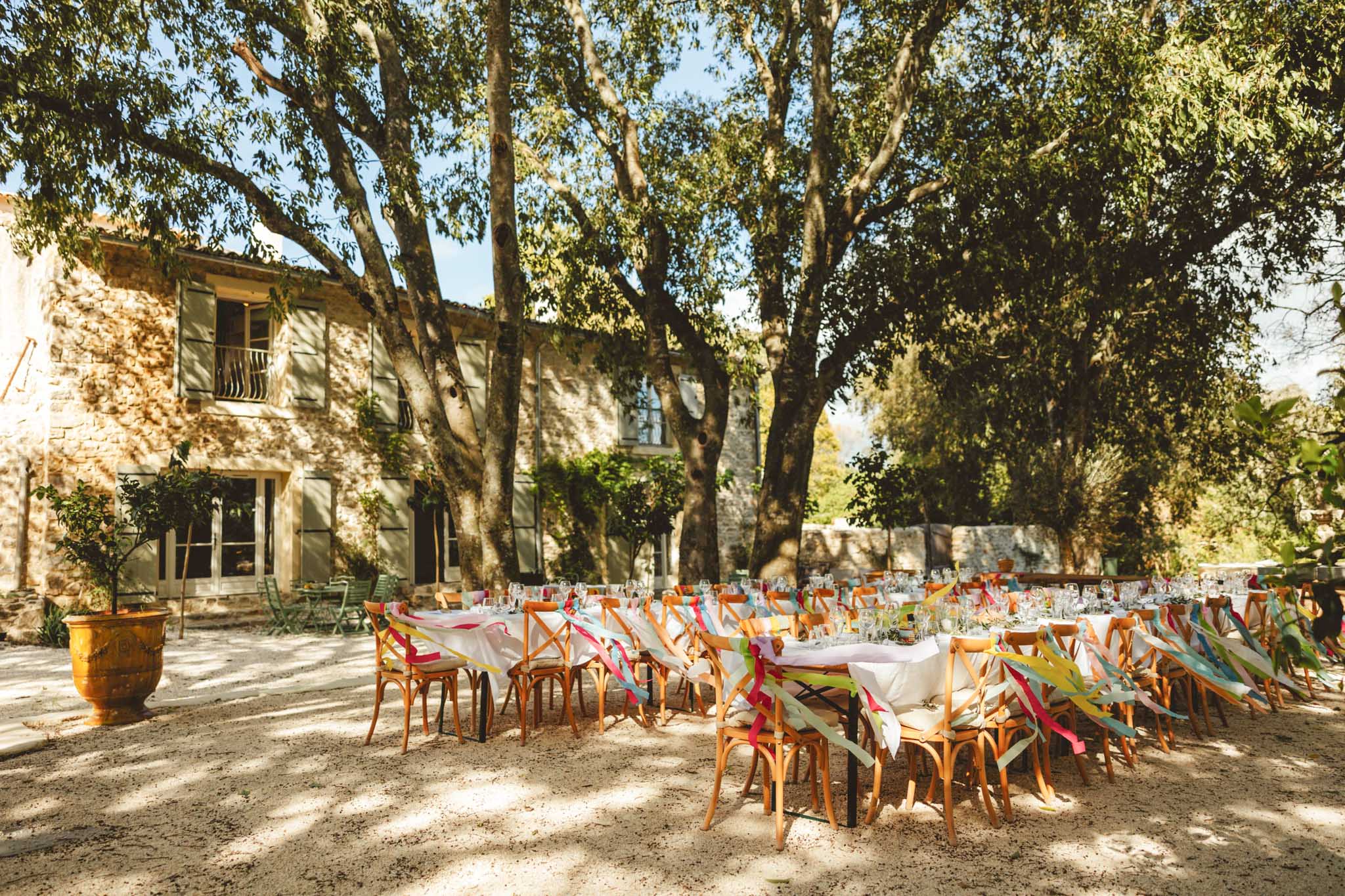
A comparable celebration in the arrière-pays costs €60,000 to €150,000. The coastal strip delivers sea views, harbour allure, and Belle Époque architecture, but comes with strict sound curfews (outdoor music typically ends at 22:00 to 23:00), constant summer traffic, and parking challenges at private villas. The arrière-pays offers terraced olive groves, jasmine-scented gardens, medieval stone villages, and significantly more privacy with fewer restrictions. French Wedding Style has tracked pricing across both zones for over a decade, and the gap is consistent.
| Factor | Coast (Nice, Cannes, Cap Ferrat, Saint-Tropez) | Arrière-Pays (Grasse, Mougins, Vence) |
|---|---|---|
| Venue fee (weekend) | €20,000 to €60,000+ | €10,000 to €25,000 |
| Realistic total (80 guests) | €100,000 to €300,000+ | €60,000 to €150,000 |
| Landscape | Sea views, harbour settings, Belle Époque architecture | Terraced olive groves, medieval perched villages, jasmine and herbs |
| Aesthetic | International style, cinematic, resort atmosphere | Closer to Provence: fragrant, green, genuinely quiet |
| Traffic | Constant in summer, gridlocked July/August | Light, manageable year-round |
| Sound curfews | Strictly enforced, neighbours proactive | Less aggressively enforced in rural hill communes |
| Parking | Problematic at most private venues | Generally adequate, more space available |
| Privacy | Limited at hotel and harbour venues | High, especially at domaine and villa properties |
| Airport proximity | 10 to 40 minutes from Nice | 20 to 50 minutes from Nice |
The honest steer is straightforward. If you need the sea in every photograph and want the full Riviera allure, commit to the coast and budget accordingly. If you prioritise beauty, privacy, and a relaxed atmosphere at a lower price point, the arrière-pays delivers all three. The Grasse perfume region, where jasmine and roses grow on terraced hillsides above the Mediterranean, contains some of the most underused wedding settings in the entire south of France. Browse destination wedding venues on the Riviera and southern France to see properties across both zones.
How Much Does a Riviera Wedding Cost?
The French Riviera is the most expensive wedding region in France, running 10 to 25% more than inland Provence for comparable celebrations as of 2026. A mid-range 80-guest wedding on the coastal strip between Nice and Saint-Tropez costs €100,000 to €200,000 all-in, while the same celebration in the arrière-pays around Grasse, Mougins, or Vence comes in at €60,000 to €150,000. Coastal venue hire runs €20,000 to €60,000 or more for a weekend, catering €280 to €500 per head, and a full-service planner €10,000 to €20,000. Cap Ferrat operates in its own pricing tier, where villa hire alone can exceed €50,000 for a weekend. These figures include venue fees, catering, full vendor teams, and multi-day guest logistics but exclude guest accommodation, which on the coast adds €200 to €600 per room per night in peak season. For couples willing to reduce the guest list to 60 at a hinterland property, the total drops to €50,000 to €90,000.
Across the 14 Riviera venues listed on French Wedding Style, the average maximum capacity is 236 guests, the highest of any region. Villas average just 22 sleeping guests, confirming that on-site accommodation for large celebrations requires significant overflow planning. The cost differential against other French regions is substantial.
A couple spending €80,000 in the Riviera hinterland achieves a celebration that would cost €50,000 to €60,000 in the Dordogne for a comparable property and vendor quality. That premium reflects the climate, the Mediterranean light, the airport accessibility, and the sheer desirability of the postcode. For a full breakdown of how regional price differences across France shape your options, compare the Riviera against Provence, Bordeaux, and the south-west.
| Budget Category | Coast Range (80 Guests) | Hinterland Range (80 Guests) |
|---|---|---|
| Venue fee (weekend) | €20,000 to €60,000+ | €10,000 to €25,000 |
| Catering per head | €280 to €500 | €200 to €350 |
| Wedding planner (full) | €10,000 to €20,000 | €7,000 to €14,000 |
| Photographer | €4,000 to €12,000 | €3,000 to €7,000 |
| Florist and styling | €5,000 to €18,000 | €3,000 to €10,000 |
| Entertainment | €5,000 to €15,000 | €3,000 to €8,000 |
For a broader view of venue pricing explained for French weddings, including how site fees, packages, and hidden costs work across the country, read our full cost breakdown.
What Should Couples Know About Villa Weddings on the Riviera?
Villa weddings are the signature Riviera format, and they carry hidden complexity that couples frequently underestimate because most of the photogenic villas along the coast were built as private residences, not event spaces. A private villa typically has no professional kitchen, meaning your caterer must bring a temporary setup at a cost of €3,000 to €8,000. Residential electrical systems cannot support simultaneous catering equipment, lighting rigs, and sound, so generator rental at €1,500 to €4,000 becomes standard. Guest parking rarely exists at hillside properties, making shuttle services mandatory at €1,500 to €4,000. Event insurance must be arranged separately at €1,000 to €3,000. These infrastructure costs can add €8,000 to €20,000 on top of the villa rental fee. Neighbour relations require active management on the coast, where properties sit close together and noise violations are reported without hesitation. The specific challenges break down as follows.
- Your caterer (traiteur) must bring a temporary kitchen, which means renting equipment, running gas lines, and setting up a prep area that meets French food safety regulations, at a cost of €3,000 to €8,000
- Residential electrical systems cannot support catering equipment, lighting rigs, and a sound system simultaneously
- Generators are standard, and they need placement far enough from guest areas to avoid noise while remaining accessible for the catering team
- Generator rental adds €1,500 to €4,000
- A villa designed for one family does not have space for 30 to 50 guest vehicles
- Shuttle services from nearby hotels or car parks become mandatory, adding €1,500 to €4,000 to the budget
- Event insurance, typically €1,000 to €3,000, must be arranged separately, as the owner's policy rarely covers large gatherings
- These infrastructure costs can add €8,000 to €20,000 on top of the villa rental fee
Neighbour relations require active management: on the Riviera coast, properties sit close together, and neighbours who are accustomed to quiet residential streets will report noise violations without hesitation. The distinction between a residence and an event space creates a chain of logistical requirements that significantly increases both cost and planning effort. For couples exploring the villa route, consider villa wedding venues in France where the properties have been specifically set up for events with infrastructure already in place.
How Do Sound Curfews Affect Riviera Wedding Planning?
Sound curfews are one of the most disruptive practical realities of a coastal Riviera wedding, and the most common source of day-of stress for couples who did not plan around them. Along the coast from Nice to Saint-Tropez, most communes enforce outdoor music cutoffs between 22:00 and 23:00. Some locations require all outdoor amplified sound to stop at 22:00, with indoor continuation permitted at reduced volume until midnight or 01:00. Enforcement is not theoretical.
Neighbours in residential coastal areas know the local rules and will call the police. In some communes, a single complaint triggers an automatic response. A noise violation during your reception can result in the music being shut down mid-event, fines of €500 to €1,500, and, in some cases, the venue losing its event permissions for future seasons. The practical response is to build the entire timeline around the local curfew: start the ceremony at 16:00, serve the apéritif immediately, begin dinner by 19:30, and transition indoors for the party before the cutoff. This gives you a full evening outdoors with music before the rules take effect.
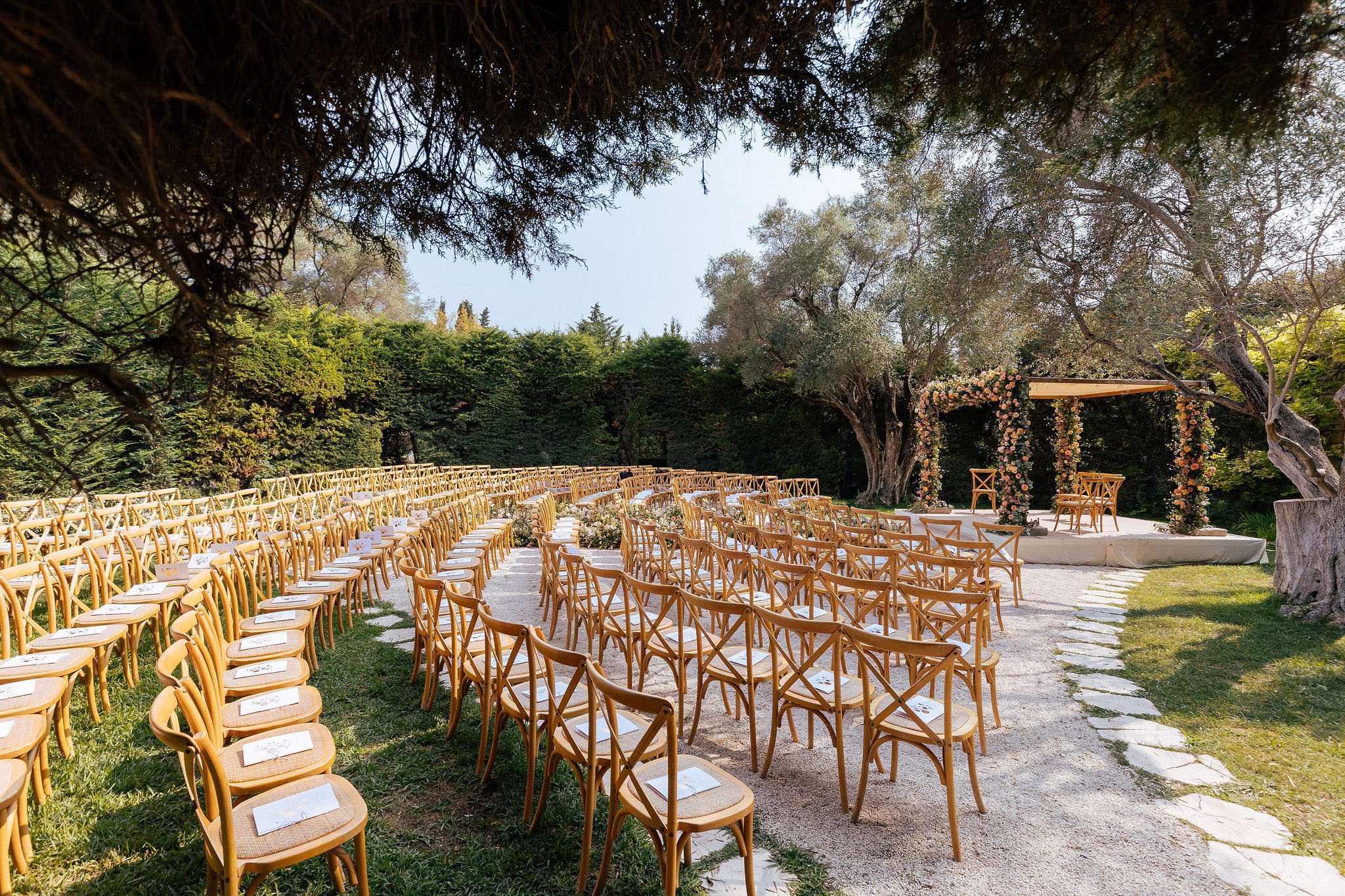
The arriere-pays is more forgiving. Rural hill communes above the coast tend to enforce curfews less aggressively, particularly for properties set in agricultural land with significant distance between neighbours. This does not mean curfews do not exist in the hinterland. It means the practical risk of enforcement is lower when the nearest neighbour is 500 metres away rather than 50. A good Riviera planner builds the entire timeline around the local curfew. Ask about this in your first conversation with any venue or planner. Find a recommended wedding planner in France who knows Riviera-specific regulations.
Can You Get Married in Monaco?
Monaco occupies just two square kilometres between Nice and the Italian border, making it the second-smallest sovereign state in the world. It offers some of the most recognisable hotel venues in Europe: the Hôtel de Paris, the Hermitage, and the Monte-Carlo Beach.
For couples drawn to Monaco, the practical realities require careful consideration. Private venues at scale do not exist in the principality. The grand hotels are the primary event spaces for weddings of 50 guests or more, and space constraints mean large outdoor receptions require hotel terraces or rooftop areas with strict capacity limits. For legal marriage in Monaco, both partners must complete a 30-day residency requirement, with all documents accompanied by sworn translations into French. The administrative process is more involved than a French civil ceremony and requires advance coordination with Monaco's civil registry office, the Direction des Services Judiciaires.
Monaco works best as a component of a Riviera wedding rather than the entire event. A pre-wedding dinner at a Monaco hotel, a ceremony at the Mairie, or a morning-after brunch with harbour views all leverage Monaco's visual appeal without requiring the full event infrastructure. Many couples hold the main reception at a villa or venue along the coast between Nice and Monaco, then use Monaco for one element of a multi-day celebration. For the full legal process of getting married in France or Monaco, read our Planning a Destination Wedding in France pillar guide.
Which Riviera Towns Are Underrated for Weddings?
The most underrated wedding locations on the Riviera sit in the arrière-pays, where medieval villages, terraced gardens, and Provençal farmhouses offer a different register of Mediterranean beauty at lower prices and with fewer restrictions. Grasse, the world capital of perfume, sits at 350 metres above sea level surrounded by fields of jasmine, rose, and tuberose, with domaine venues available at €10,000 to €20,000 for a weekend. Mougins, a fortified hilltop village 15 minutes from Cannes, has attracted renowned chefs for decades, which means the local catering infrastructure is excellent.
Vence and Saint-Paul-de-Vence, 20 minutes from Nice, offer medieval architecture associated with Chagall and Matisse. Tourrettes-sur-Loup, known as the "village of violets," is genuinely off the international wedding radar, keeping pricing accessible and restrictions relaxed. These hill towns offer privacy and smaller-scale celebrations that suit couples searching for intimate wedding venues in France. All four sit within 20 to 50 minutes of Nice airport, offering the Mediterranean climate and proximity of the coast without the congestion, noise complaints, or premium pricing.
Grasse
The world capital of perfume. Grasse sits at 350 metres above sea level, surrounded by fields of jasmine, rose, and tuberose grown for the fragrance industry. The town and its surrounding hills contain domaines and bastides with terraced gardens, swimming pools, and panoramic views of the coast below. Venue prices sit in the hinterland range (€10,000 to €20,000 for a weekend), and the setting has a character that no coastal hotel can replicate. The scent of the landscape itself becomes part of the wedding atmosphere.
Mougins
A fortified hilltop village 15 minutes from Cannes with a strong gastronomic reputation. Mougins has attracted restaurants and chefs for decades, which means the local catering infrastructure is excellent. The village itself is compact and photogenic: stone arches, courtyard restaurants, and views over the Cannes basin to the sea. For couples who want proximity to Cannes without the traffic and noise, Mougins is the most practical compromise.
Vence and Saint-Paul-de-Vence
Saint-Paul-de-Vence is one of the most visited villages in France, known for the Fondation Maeght and its history with artists including Chagall and Matisse. Vence, its less touristic neighbour, offers similar medieval architecture with more space and lower prices. Both sit 20 minutes from Nice in the hills above the Baie des Anges. The landscape here is greener and more wooded than the coast, with properties set among pine and olive trees. Couples wanting an artistic, culturally rich setting should explore this pair of villages seriously.
Tourrettes-sur-Loup
Known as the "village of violets," Tourrettes-sur-Loup is a perched medieval commune between Vence and Grasse. It is genuinely off the international radar for weddings, which keeps pricing accessible and restrictions relaxed. The surrounding countryside of terraced olive groves and herb gardens is among the most fragrant on the Riviera.
For more options beyond the Riviera, compare the region against destination weddings in the Dordogne and South-West or explore outdoor wedding venues in southern France.
Where International Couples Go Wrong with Riviera Weddings
The error that shows up in every planner's inbox is assuming the Riviera runs itself because it looks polished in photographs. In reality, a Riviera wedding requires more logistical planning per euro spent than almost any other region in France. The density of the coast, the strictness of local noise regulations (outdoor music cutoffs at 22:00 to 23:00 in most coastal communes), the chronic summer traffic between Nice and Saint-Tropez (a 90-minute map journey can take three hours in July), and the infrastructure gaps at private villas (no professional kitchen, no dedicated power supply, no guest parking) all demand professional coordination.
A wedding planner who knows Riviera-specific regulations is not an indulgence here. It is the difference between a smooth celebration and an event derailed by a noise complaint at 10 pm. Couples who hire a planner familiar with their specific commune's rules avoid the most common pitfalls.
Underestimating traffic. In July and August, a journey from Nice airport to a venue near Saint-Tropez can take three hours rather than the 90 minutes shown on a map. Guest transfers, vendor deliveries, and ceremony timing all need to account for coastal congestion. Scheduling a ceremony for 16:00 when guests are travelling from Nice hotels means building in a buffer that would be unnecessary in Provence or the Dordogne.
Choosing a villa on photographs alone. A villa that photographs as a photogenic setting may have no professional kitchen, inadequate power, a strict 22:00 curfew, and neighbours who have already complained about the last three weddings held there. Always visit the property during an actual event or at minimum ask the owner for references from couples who have hosted receptions there in the past two years.
Ignoring the arrière-pays. The marketing power of "Côte d'Azur" focuses attention on the coastal strip, but the hinterland above Nice and Cannes is where the value, the privacy, and the space exist. Twenty minutes inland changes the entire equation. For help navigating these decisions with local expertise, find a recommended wedding planner in France who specialises in the Riviera region. For broader context on choosing between French regions, return to our guide to choosing your wedding region in France.
Related Articles
These five guides connect directly to the Riviera planning decisions covered above, from the neighbouring Provence region that shares Mediterranean climate but offers a fundamentally different landscape and price structure, to the Dordogne and South-West where comparable stone properties cost 40 to 60% less. The regional price comparison maps venue fees and vendor costs across all nine major French wedding areas, the seasonal climate guide provides month-by-month data for outdoor ceremony confidence including Riviera-specific wind and heat factors, and the venue pricing guide explains how site fees and hidden extras work across French property types. Each article builds on the coast-versus-hinterland analysis in this guide.
- Getting married in Provence: the complete planning guide
- Destination weddings in the Dordogne and South-West France
- Regional price differences across France
- How venue pricing works in France
- Our seasonal climate guide for French weddings
Frequently Asked Questions
How much does a French Riviera wedding cost for 80 guests?
A coastal Riviera wedding for 80 guests costs €100,000 to €200,000 all-in as of 2026. The same celebration in the arrière-pays (Grasse, Mougins, Vence) costs €60,000 to €150,000. Cap Ferrat sits at the top of the range, where villa hire alone can exceed €50,000. These figures include venue, catering, full vendor team, and event logistics but exclude guest accommodation. One proven cost-saving strategy: book a Thursday wedding or move to the second week of September, when venue rates typically drop 15 to 20% and vendor availability opens up significantly.
What is the arrière-pays and why is it cheaper?
The arrière-pays is the hinterland of hills and medieval villages sitting 20 minutes inland from the coast. Towns such as Grasse, Mougins, Vence, and Saint-Paul-de-Vence fall in this zone. It is cheaper because fewer international couples compete for dates, venues have more space and fewer neighbour restrictions, and the overall market is less saturated than the coastal strip. The Mediterranean climate and proximity to Nice airport remain the same. For a relaxed pre-wedding experience in the zone, book a private perfume-creation workshop at one of the Grasse fragrance houses: guests leave with a personalised scent as a favour, and the activity fills a morning that might otherwise go unplanned.
Are sound curfews really enforced on the Riviera?
On the coast, yes. Most communes between Nice and Saint-Tropez enforce outdoor music cutoffs between 22:00 and 23:00. Neighbours will call the police, and fines range from €500 to €1,500. Venues can lose event permissions for repeated violations. In the arrière-pays, enforcement is less aggressive, particularly for rural properties with significant distance between neighbours. Ask your venue for the exact curfew time in their commune before signing, as rules vary by municipality and sometimes by season.
Can I legally get married in Monaco?
Yes, but it requires a 30-day residency for both partners and sworn translations of all documents into French. The administrative process is more involved than a standard French civil ceremony. Most couples use Monaco for a ceremony, pre-wedding dinner, or brunch element rather than hosting the full reception there, as private venues at scale do not exist in the principality.
What are the hidden costs of a villa wedding on the Riviera?
Private villas typically require a temporary professional kitchen (€3,000 to €8,000), generator rental for power (€1,500 to €4,000), shuttle transport for guests who cannot park on site (€1,500 to €4,000), and separate event insurance (€1,000 to €3,000). These infrastructure costs can add €8,000 to €20,000 on top of the villa rental fee. Always request a full breakdown of what is and is not included before signing. Properties listed specifically as event villas on platforms like French Wedding Style have these requirements pre-resolved, which is why they command a higher rental fee but lower total cost.
When is the best time of year for a Riviera wedding?
May, June, and September offer the best combination of warm weather, manageable tourist traffic, and venue availability. July and August deliver peak heat and guaranteed sunshine but also peak road congestion, peak accommodation prices, and the highest competition for vendor availability. October carries minor weather risk but offers notably lower pricing and almost empty roads. For coastal venues, September is particularly attractive because the sea is still warm (23 to 24°C), the summer crowds have thinned, and venue pricing drops 15 to 20% from peak. Refer to our seasonal climate guide for month-by-month detail.
Is the Riviera worth the premium over Provence?
The Riviera is 10 to 25% more expensive than inland Provence for a comparable celebration. The premium buys you coastal proximity, Nice airport accessibility, and a specific international aesthetic that inland Provence does not deliver. Couples who want sea views and harbour energy will find value in the Riviera premium. Couples who want lavender, stone farmhouses, and a quieter pace will find better value in Provence. The arrière-pays above Nice splits the difference: Provençal landscape at Riviera-adjacent prices.
The first decision that shapes every other is coast or hinterland. Settle that before you start contacting venues, because the budget, the curfew rules, and the guest experience diverge entirely from that single choice. Browse villa and estate wedding venues in France to see the range available for your date and guest count.
Explore Every Guide in This Chapter
Deep-dive into each topic covered above.