
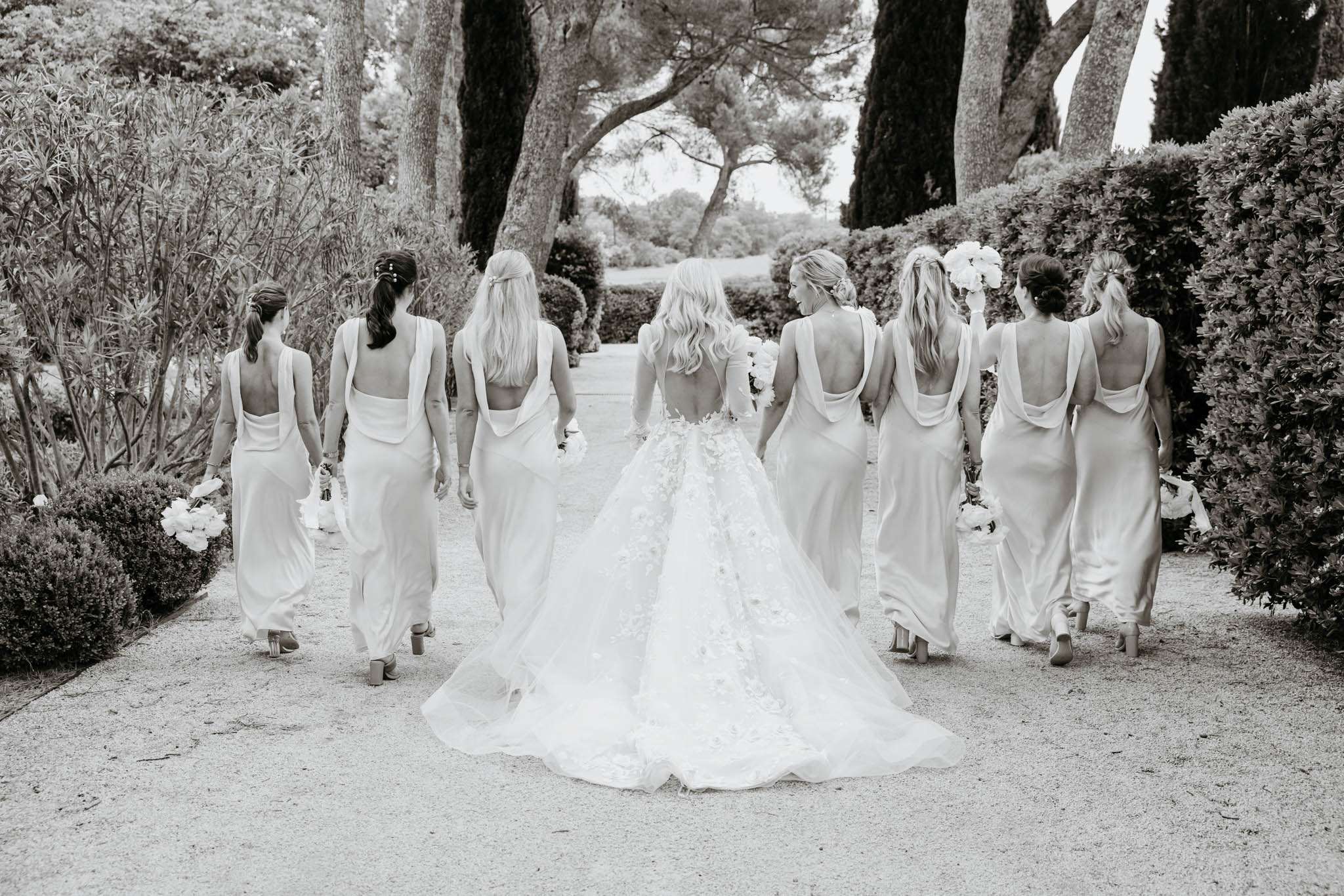
Wedding Dress for Outdoor & Château Venues
The wedding dress does not exist in isolation. It exists in relation to a staircase, a courtyard, a ceremony lawn, a gravel path, a dance floor, and 8 to 12 hours of wearing it through all of them. At a French wedding venue, these elements are more varied and more challenging than at a hotel ballroom or a country house with manicured lawns. A château has cobblestones, narrow spiral staircases, and stone terraces that catch hemlines.
A mas in Provence has gravel, dry grass, and 35-degree heat that tests every fabric choice. A villa on the Riviera has tiled steps, a pool edge, and a terrace that is part of the ceremony space. The dress needs to work with the venue, not against it. What follows is how to match your dress to your venue type, which fabrics and silhouettes perform well in French conditions, and the practical considerations that protect both the dress and the experience of wearing it. This forms part of the full planning guide for destination weddings in France. For the full chapter, see our complete final details guide.
Key Takeaways
- The venue type dictates practical dress decisions: train length (cobblestones catch cathedral trains), fabric weight (structured satin overheats in Provence), hemline (grass stains and gravel damage the bottom 6 inches), and silhouette (narrow doorways and spiral staircases limit ball gown volume).
- Château weddings suit structured gowns with manageable trains that can be bustled for the reception. A-line and fit-and-flare silhouettes navigate stone staircases and narrow corridors better than full ball gowns.
- Mas and domaine weddings in Provence suit lighter fabrics (chiffon, crepe, tulle, cotton-blend lace) and relaxed silhouettes that move naturally outdoors. Heavy satin and boning are uncomfortable in sustained heat.
- Detachable trains offer the best of both: ceremony drama and reception practicality. Remove the train after photographs and dance freely for the rest of the evening.
- Pack a second pair of shoes (flats or block heels) for the reception. Ceremony shoes and dancing shoes are different categories at a French venue wedding.
How Does Your Venue Type Affect Your Dress Choice?
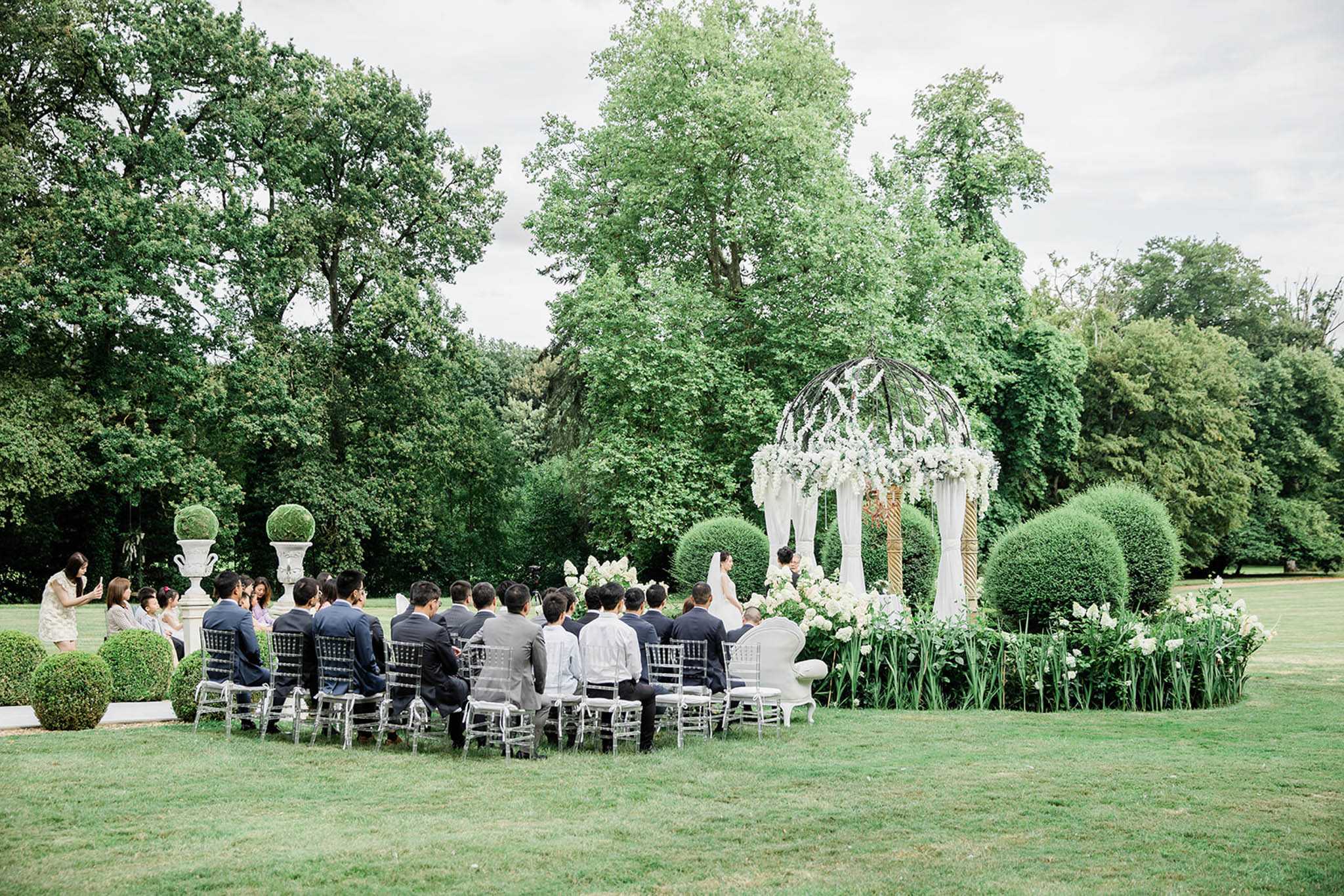
Every French venue category presents a different physical environment. The dress must function in that environment for an entire day, from getting ready at 10am to the last dance at 3am. Thinking about the dress as architecture (how it occupies space, how it moves through doorways, how it responds to heat and terrain) leads to better decisions than thinking about it as a photograph. Châteaux are the most formal venue type and traditionally suit the most formal dress. A structured gown with a train reads well against stone walls, parquet floors, and grand staircases. But the same château has narrow spiral staircases between floors, low doorways between rooms, cobblestone courtyards, and gravel paths between the chapel and the reception terrace. A cathedral train dragging across cobblestones accumulates grit, catches in gaps between stones, and requires constant management by attendants. An A-line or fit-and-flare silhouette with a chapel-length train (extending 3 to 4 feet) is the practical sweet spot: dramatic enough for the architecture, manageable enough for the terrain.
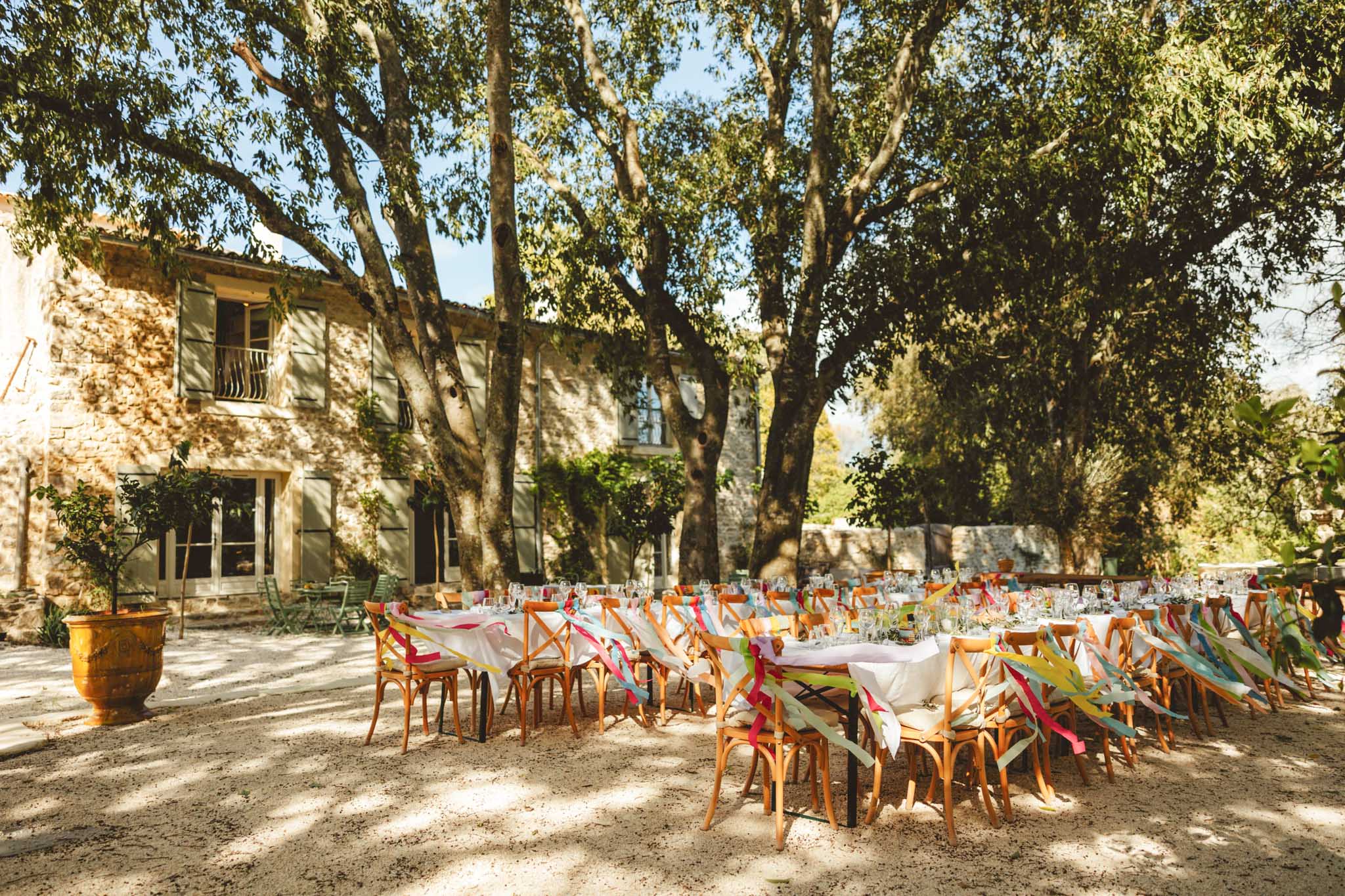
Mas (Provençal farmhouse) and domaine weddings are outdoor-first. The ceremony is in the garden, the apéritif is on the terrace, and the dinner is under the plane trees. The dress is outdoors for 6 to 8 hours in heat that regularly exceeds 30 degrees. Heavy, structured fabrics (duchesse satin, mikado, heavy beaded lace) trap heat against the body and become visibly uncomfortable. Lighter fabrics that breathe and move are the right choice here.
Chiffon, crepe, soft tulle, cotton-blend lace, and lightweight silk all perform well in heat. The silhouette should allow air circulation: an open back, a flowing skirt, sleeveless or thin-strap construction. Provençal farmhouse weddings have a relaxed register that suits softer, more romantic dress styles. A heavily structured corset ball gown looks out of place against lavender fields and rough stone walls. For the range of rustic French wedding venues, softer dress styles consistently photograph better against the natural backdrop.
Villas (particularly on the Riviera and in Provence) are intimate, modern, and often have a poolside ceremony or terrace reception. The scale is smaller than a château, and the atmosphere is closer to a private party. Sleek, modern silhouettes suit villa weddings: column gowns, slip dresses, sheath designs, and minimalist crepe. Heavy trains and voluminous skirts can overwhelm a small terrace and look disproportionate against a villa's more human-scale architecture. For villa venues in France, the dress should complement the setting's intimacy, not compete with it.
What Works at a Château vs a Mas vs a Villa?
Scroll →
| Venue Type | Best Silhouettes | Best Fabrics | Train Recommendation |
|---|---|---|---|
| Château (formal) | A-line, fit-and-flare, ball gown (if manageable) | Mikado, structured lace, silk faille | Chapel to sweep; bustle for reception |
| Château (relaxed) | A-line, sheath, modified ball gown | Crepe, tulle, soft lace | Sweep or detachable |
| Mas / domaine | Flowing A-line, empire, boho fit-and-flare | Chiffon, lightweight lace, cotton blend, soft crepe | None or sweep; detachable optional |
| Villa | Column, slip, sheath, minimalist A-line | Crepe, charmeuse, lightweight silk | None or minimal sweep |
| Vineyard / wine estate | Romantic A-line, soft fit-and-flare | Tulle, organza, lightweight lace | Sweep or none |
| Barn / converted farm | Boho A-line, tea-length, two-piece | Cotton lace, chiffon, lightweight fabrics | None recommended (hay, dust, uneven floors) |
What Practical Considerations Matter for French Venues?
Cobblestones and gravel. The bottom 6 inches of a dress that drags across cobblestones for 200 metres will pick up grit, dirt, and potential snags. A hemline that clears the ground by 1 to 2 centimetres prevents this entirely. If a floor-length dress is non-negotiable, have the seamstress reinforce the hem with a horse-hair braid or an extra layer of fabric. After the ceremony photographs, bustle the train so it clears the ground for the rest of the evening. Staircases. Grand stone staircases are one of the most photographed features of French châteaux, and they are also one of the most dangerous for a long dress. A train that pools on the steps behind you is a tripping hazard for you and for anyone walking behind. If the staircase is part of your ceremony route, practice walking it in the dress and shoes at your final fitting. Ask an attendant to manage the train on the stairs. And know how to bustle before you reach the bottom.
Heat and perspiration. In 30 to 35-degree heat, the body sweats. Fabrics that do not breathe (polyester lining, heavy satin, structured boning) trap moisture against the skin. The visible result is discomfort, visible perspiration marks, and a bride who is visibly hot in every photograph from the apéritif onward. Choose fabrics with natural fibre content (silk, cotton, linen-blend) for the layers closest to the skin. Ask your seamstress about a cotton or silk lining instead of a synthetic one. For hair and makeup strategies that handle southern France heat, see our dedicated guide.
Wind. Outdoor ceremonies in Provence and on the Riviera are subject to the mistral (a strong north-west wind that can reach 60km/h in the Rhône valley) and coastal breezes. A lightweight veil in a mistral becomes a hazard. Secure veils with multiple combs and consider a shorter length (fingertip or elbow) for outdoor ceremonies in wind-prone regions. Alternatively, choose a hair accessory (floral crown, jewelled pins, a headband) that is not affected by wind.
The shoe strategy. Ceremony shoes, reception shoes, and dancing shoes are three different footwear needs at a French venue wedding. The ceremony pair should be photogenic and terrain-appropriate (block heels or wedges on gravel, flat embellished sandals on grass). The reception pair should be comfortable for standing through a 2-hour apéritif and sitting through a 4-hour dinner. The dancing pair should be flat, broken in, and disposable enough that you do not care about scuff marks at 2am. Pack all three. Change discreetly between the ceremony and the reception, and again before the dance floor opens.
Detachable elements. A detachable train, detachable sleeves, or a detachable overskirt gives the ceremony the drama it deserves and the reception the freedom it needs. After the formal photographs, remove the extra layer and move, eat, dance, and socialise without managing fabric. This solution is increasingly popular at French weddings because it addresses the fundamental tension between a formal ceremony setting and a long, active evening.
Related Articles
- Final details: the complete guide
- Hair, makeup and getting ready
- Couple's packing list
- French wedding emergency kit
- Guest dress code for a French wedding
- French bridal designers
- Seasonal weather and climate guide
- Château wedding venues in France
- Rustic wedding venues in France
- Villa wedding venues in France
- Browse all wedding venues in France
Frequently Asked Questions
Can I wear a ball gown to an outdoor French wedding?
Yes, but choose the fabric and construction carefully. A tulle ball gown is lighter and more breathable than a satin one. Avoid heavily boned bodices in summer heat. Keep the train at sweep or chapel length so it does not drag across gravel for the full evening. A ball gown works at a formal château with a large courtyard or garden. It is harder to manage at a small mas or a villa with narrow paths and intimate spaces.
What about a tea-length or midi dress for a French wedding?
Tea-length and midi dresses solve the terrain problem entirely: no hemline dragging on cobblestones, no train catching on gravel, no bustle needed. They are well-suited to barn weddings, vineyard weddings, and relaxed domaine celebrations. At a formal château, a tea-length dress may feel under-dressed unless the design is intentionally structured and formal in its own right. Consider the venue's formality level before committing.
Should I get the dress hemmed for flat shoes?
If you plan to wear flats for the ceremony, yes. The dress should be hemmed to the flat shoe height so that the front hem clears the ground. If you are switching between heels and flats during the day, hem to the flat shoe height and accept that the dress will be slightly shorter in heels. The alternative (hemming for heels and tripping in flats) is worse.
Explore Every Guide in This Chapter
Deep-dive into each topic covered above.