
Dietary Requirements: Vegan, Allergies, Kosher/Halal
French cuisine is built on butter, cream, meat, and wheat flour. For guests with dietary requirements, a French wedding dinner raises real questions. Can a traditional traiteur handle a vegan table? Will gluten-free guests eat well across seven courses, or survive on cheese and salad?
Is kosher or halal preparation even possible at a rural château? The answers are more nuanced than a simple yes or no, and they depend on when you ask, who you hire, and how clearly you communicate. What follows is what French caterers can and cannot do, what to expect for specific dietary needs, and how to ensure every guest eats well. For the full food and drink chapter, see our complete food and drink guide. For a broader view of every step involved, see planning your destination wedding in France from start to finish.
Key Takeaways
- Most French traiteurs can accommodate vegetarian, gluten-free, and common allergy requirements when given 3 to 4 weeks' notice. Vegan, kosher, and halal menus require specialist caterers or advance coordination.
- France's plant-based dining scene has expanded significantly since 2020, particularly in Paris, Provence, Lyon, and Bordeaux. Rural traiteurs may have less experience with fully vegan menus but can adapt with guidance.
- Kosher and halal catering at French wedding venues requires an external specialist caterer. Most venues permit external caterers, but kitchen access, equipment separation, and certification must be arranged in advance.
- The most effective approach is collecting dietary requirements through your wedding website RSVP form, sharing the data with your traiteur 4 weeks before the wedding, and scheduling a call (not just an email) to discuss each requirement in detail.
How Do French Caterers Handle Dietary Requirements?
French traiteurs are trained in classical cuisine, which centres on animal proteins, butter-based sauces, and wheat-flour pastry. Dietary modifications are not the default. They are accommodations. This does not mean French caterers refuse them. It means the communication must be explicit, early, and detailed. A request sent by email two weeks before the wedding reading "3 vegetarians, 1 gluten-free" is not enough. A phone call or video meeting 4 to 6 weeks out, walking through the menu course by course and confirming what each dietary guest will receive, produces dramatically better results. Standard accommodations that most French traiteurs handle comfortably: vegetarian (lacto-ovo), gluten-free, nut-free, lactose-free, and shellfish allergy. These are modifications within the classical system. A vegetarian entrée substitutes fish or vegetable for meat. A gluten-free plat replaces wheat-flour elements with potato, rice, or polenta. Nut-free desserts omit praline and almond. The traiteur adapts within their existing repertoire.
Accommodations that require more planning or specialist sourcing: fully vegan (no dairy, eggs, honey, or animal-derived ingredients across all courses), kosher (supervised preparation, separate equipment, certified ingredients), halal (halal-certified meat, no alcohol in cooking, separate preparation), and complex multi-allergen requirements (simultaneous gluten, dairy, nut, and soy restrictions). For these, discuss with your traiteur at the booking stage, not the final planning stage. If your traiteur cannot accommodate, they will say so honestly, and you can source a specialist provider for those guests.
Based on destination weddings featured on French Wedding Style, approximately 8 to 12 percent of guests at international weddings report a dietary requirement. For a 100-guest wedding, that means 8 to 12 guests need modified plates. Your traiteur needs this number and the specific requirements at least 4 weeks before the wedding to price, source, and prep correctly. Your traiteur guide covers the full booking and communication process.
What Should You Know About Vegan and Vegetarian Options in France?
Vegetarian dining in France has progressed substantially since 2020. Most traiteurs now offer a full vegetarian menu option without hesitation. The quality is high because French cuisine already has a strong vegetable tradition: ratatouille, gratin dauphinois, tarte aux légumes, soupe au pistou, and artichoke preparations all feature prominently in classical cooking. A vegetarian guest at a French wedding will eat well, often better than at an equivalent UK or US celebration, because the vegetable courses are prepared with the same technique and attention as the meat courses. Vegan dining is more challenging. French classical cooking relies on butter, cream, eggs, and cheese as foundational ingredients. A fully vegan menu requires the traiteur to step outside the classical system entirely. In Paris, Lyon, Provence, and Bordeaux, forward-thinking traiteurs offer compelling vegan menus built around seasonal vegetables, legumes, grains, and plant-based proteins. In rural areas, vegan experience varies widely. Some countryside traiteurs have adapted. Others have not worked with a fully vegan brief.
The practical approach for a mixed guest list: request a vegan adaptation of the standard menu rather than a separate vegan menu. Course by course, the traiteur substitutes: olive oil for butter in the entrée, a vegetable-centred plat with legume protein instead of meat, a plant-based cheese selection or additional vegetable course instead of fromage, and a fruit-based dessert or sorbet instead of the cream-based original. This keeps the vegan guests eating in the same rhythm as everyone else, which matters at a long French dinner where courses arrive sequentially and everyone should be served together.
For a fully vegan wedding (where the entire menu is plant-based), hire a traiteur who specialises in plant-based cuisine. Asking a classical French caterer to produce an entirely vegan five-course dinner is asking them to work outside their training. The result may be technically correct but lack the depth and creativity of a specialist. A vegan traiteur will build a menu with the same progression, presentation, and regional identity as a classical one, using entirely plant-based ingredients. Expect to pay a similar per-head rate as a conventional menu.
How Do Kosher and Halal Requirements Work at French Venues?
Kosher and halal catering at a French wedding venue is possible but requires advance planning and, in most cases, an external specialist caterer. Standard French traiteurs do not hold kosher or halal certification and cannot produce certified meals in their standard kitchens. The solution is to hire a certified kosher or halal caterer who brings their own equipment, ingredients, and (for kosher) a mashgiach (supervisor). Most French wedding venues that permit external caterers will accommodate a specialist kosher or halal caterer. The venue provides kitchen access, and the caterer brings their own equipment (pots, pans, utensils, serving ware) to maintain separation. For kosher catering specifically, confirm with the venue that the kitchen can be made available exclusively to the kosher caterer during preparation, as kashrut requirements typically prohibit shared cooking surfaces and equipment with non-kosher preparation.
Kosher caterers operating in France are concentrated in Paris and the south (Marseille, Nice, Lyon). For weddings in rural regions, the caterer will travel, but delivery and setup logistics require more planning. Halal caterers are more widely available across France, including in smaller cities and towns. As of 2026, expect to pay 20 to 40 percent more for certified kosher catering compared to a standard traiteur, reflecting the specialist sourcing and supervision requirements. Halal catering is typically priced comparably to conventional catering.
For a mixed guest list where only some guests require kosher or halal meals, two approaches work. First, hire a single certified caterer for the entire event (all guests eat the same certified menu). Second, hire your standard traiteur for the majority and a specialist caterer for the certified meals only, served simultaneously. The second approach requires more coordination but allows the full traditional French wedding menu for the main guest list. Your wedding planner is essential for managing two caterers in one kitchen.
How Do You Communicate Dietary Needs to a French Traiteur?
The communication gap is the biggest risk factor. A French traiteur who speaks limited English and receives an email saying "vegan" may interpret this differently from what the guest intends. Vegan in the strict Anglo sense (no animal products whatsoever, including honey and some wine fining agents) is not the same as what a French chef might assume (no meat, possibly okay with butter or eggs). Specificity prevents problems. The recommended communication process has four steps. First, collect requirements through your wedding website RSVP form with a free-text field. Second, compile the data into a clear summary: "4 vegetarian (lacto-ovo), 2 vegan (no dairy, eggs, honey), 1 celiac (strict gluten-free, no cross-contamination), 1 severe nut allergy (anaphylaxis risk)." Third, schedule a call with your traiteur (through your planner if language is a barrier) to walk through the menu course by course, confirming exactly what each dietary guest will receive. Fourth, request a written confirmation of the dietary menu in advance.
For allergy-critical requirements (anaphylaxis risk from nuts, severe celiac), communicate the severity explicitly. The French term for allergy is allergie. The term for intolerance is intolérance. These carry different weight in a French kitchen. An allergie triggers strict avoidance protocols (separate prep surfaces, dedicated equipment). An intolérance triggers ingredient substitution but not the same level of separation. If your guest has a true allergy with anaphylaxis risk, use the word allergie and state "risque d'anaphylaxie" in writing. This triggers the correct kitchen protocol.
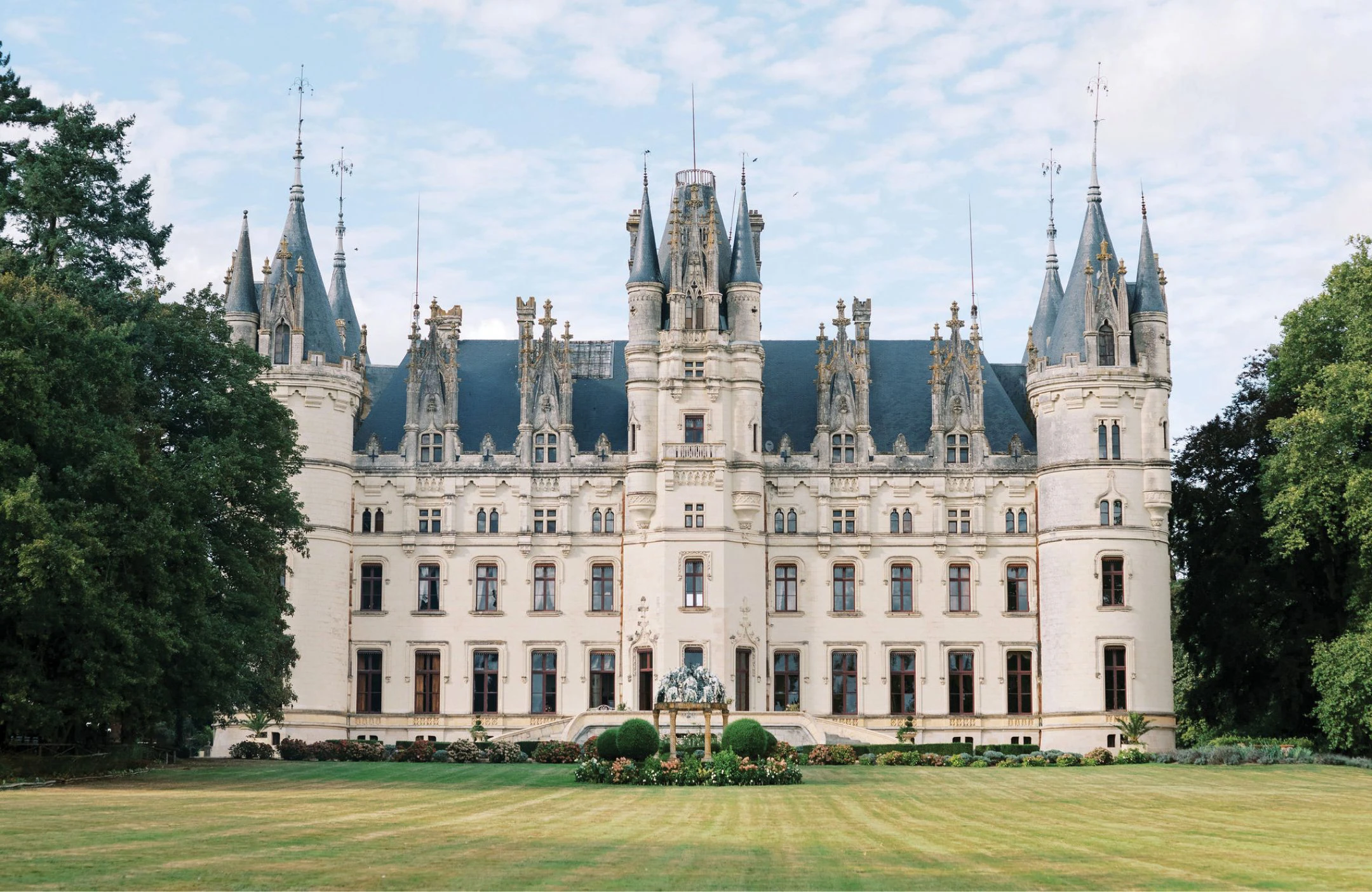
Timing matters. Share the dietary summary with your traiteur at least 4 weeks before the wedding for standard requirements and 6 to 8 weeks for specialist needs (vegan, kosher, halal, multiple severe allergies). Last-minute additions (a guest announcing a new dietary need one week before) are manageable for simple substitutions but not for complex requirements. The traiteur needs sourcing time. See how this couple brought this to life at Château de Challain in the Loire Valley.
Scroll →
| Dietary Need | French Term | Traiteur Capability | Notice Required |
|---|---|---|---|
| Vegetarian (lacto-ovo) | Végétarien(ne) | Standard. All traiteurs accommodate. | 3 to 4 weeks |
| Vegan | Végan(e) / végétalien(ne) | Variable. Urban traiteurs strong. Rural may need guidance. | 4 to 6 weeks |
| Gluten-free | Sans gluten | Standard. Substitutions within classical system. | 3 to 4 weeks |
| Nut-free | Sans noix / sans fruits à coque | Standard. Alert kitchen to severity level. | 3 to 4 weeks |
| Lactose-free | Sans lactose | Standard. Olive oil and plant-based substitutions. | 3 to 4 weeks |
| Kosher | Casher | Specialist caterer required. Paris, Marseille, Nice, Lyon. | 8 to 12 weeks |
| Halal | Halal | Specialist caterer or halal-certified ingredients. Widely available. | 6 to 8 weeks |
Related Articles
- Food and drink for a French wedding: the complete guide
- Traditional French wedding menus: course by course
- Le trou normand, cheese course, and French dining traditions
- Wine selection for your French wedding
- Choosing a caterer (traiteur) in France
- Choosing a wedding planner in France
- Planning a multicultural wedding in France
- Browse all wedding venues in France
Frequently Asked Questions
Is France a difficult country for vegan wedding guests?
It is more challenging than the UK or US but improving rapidly. Urban traiteurs in Paris, Lyon, Bordeaux, and Provence offer strong vegan options. Rural caterers may have less experience but can adapt with clear communication and advance notice. The key is hiring a traiteur willing to engage with the brief rather than one who sees it as an inconvenience. Ask during the booking conversation.
Can French venues accommodate a fully kosher wedding?
Yes, at venues that allow external caterers (the majority of venues on French Wedding Style). A certified kosher caterer brings their own equipment, ingredients, and supervision. The venue provides kitchen access. Book the kosher caterer 8 to 12 weeks in advance and confirm kitchen logistics with the venue coordinator. Paris-based kosher caterers regularly travel to venues across France.
Should we mention dietary requirements on the invitation?
Not on the printed invitation. Collect dietary requirements through the RSVP form on your wedding website. A free-text field ("Please list any dietary requirements or allergies") captures the information without cluttering the stationery. This data feeds directly to your traiteur through your planner.
What if a guest has a severe allergy?
Communicate it to your traiteur in writing using the French term "allergie" and specify the severity: "allergie sévère aux arachides, risque d'anaphylaxie" (severe peanut allergy, anaphylaxis risk). This triggers strict avoidance protocols in a French kitchen: separate preparation surfaces, dedicated equipment, and explicit ingredient checks. Confirm the protocol in writing before the wedding. If the guest carries an EpiPen, inform the venue coordinator and the traiteur's head waiter.
How much extra does dietary accommodation cost?
Standard accommodations (vegetarian, gluten-free, nut-free, lactose-free) are typically included in the per-head price with no surcharge. Vegan modifications may incur a small premium (€5 to €15 per plate) if they require ingredient substitutions the traiteur does not stock. Certified kosher catering costs 20 to 40 percent more than standard catering. Halal catering is generally priced comparably to conventional. Confirm any surcharges at the booking stage.
Explore Every Guide in This Chapter
Deep-dive into each topic covered above.