
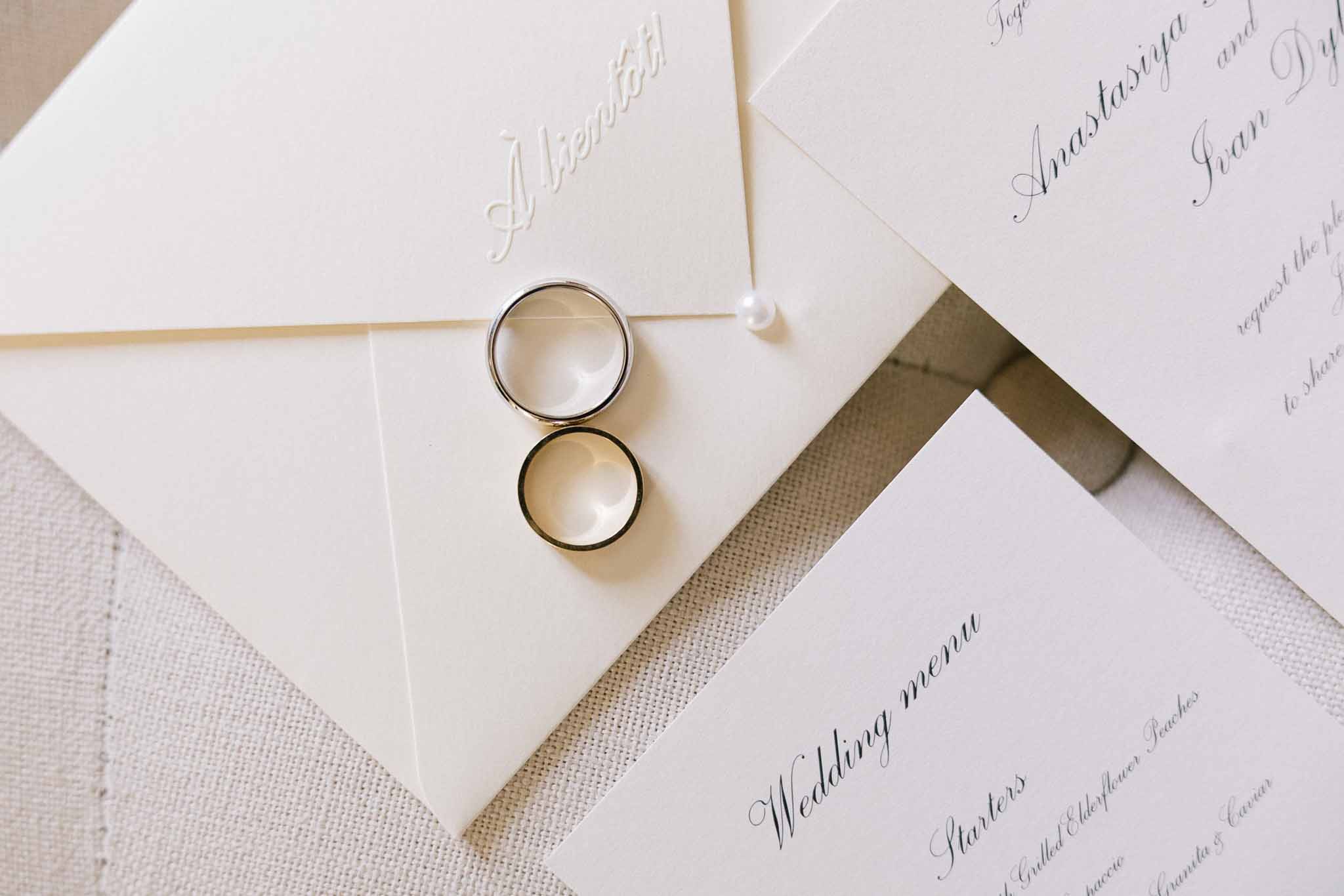
Day-Of Stationery at a French Wedding
Day-of stationery is the final layer of your design story. The menus on each table, the order of ceremony tucked into a pew, the hand-written place card at every setting, the seating chart on an easel at the entrance. These are the pieces your guests hold, read, and photograph. They are also the pieces that bridge the cultural gap at a bilingual celebration.
Menus in two languages. Programs that explain French traditions your international guests have never seen. A plan de table that follows French seating conventions rather than Anglo ones. Below is what you need, how bilingual formatting works, and the specific French conventions for seating displays and place cards. For the full stationery journey, see our complete invitations and stationery guide. For a broader view of every step involved, see our complete guide to planning a destination wedding in France.
Key Takeaways
- Essential day-of stationery at a French wedding includes: menus (one per guest or one per two guests), an order of ceremony program, place cards (marque-places), and a plan de table (seating display at the reception entrance).
- Bilingual menus list the French course name first, with the English description below or beside it. This preserves the authenticity of French culinary terms while ensuring international guests understand every dish.
- A plan de table is the French seating chart displayed on an easel, mirror, or board at the entrance to the dining room. Guests find their table assignment here before sitting. Individual place cards then confirm their exact seat.
- French place card convention (marque-place) uses first name only at informal weddings and full name at formal celebrations. The card sits above the plate or on the folded napkin, never tucked into a glass.
What Day-Of Stationery Do You Need at a French Wedding?
Four items are standard at every French wedding reception. A printed menu for the table. An order of ceremony or wedding program. Place cards for the seating. And a plan de table at the reception entrance. Beyond these four, couples add signage (welcome boards, bar menus, dessert table labels) and favour tags as budget and design vision allow. Across destination weddings featured on French Wedding Style, these four core items appear at virtually every celebration, from intimate garden dinners to 200-guest château receptions. Menus. One per guest is ideal. One per two guests is the practical standard. The menu lists every course from the apéritif through dessert, including wine pairings if served course-by-course. At a traditional French wedding dinner of five to seven courses, the menu helps guests pace themselves. It also prevents the most common question at international tables: "How many more courses are there?" For guidance on the full course structure, see our guide to traditional French wedding menus.
Order of ceremony. A folded card or single sheet listing the ceremony structure, readings, hymns, and any rituals. For a bilingual ceremony, the program is essential. French guests need to follow English readings. English-speaking guests need context for French traditions like the cortège (processional) or the exchange of arrhes (coins). A two-sided program (French left, English right) handles this cleanly.
Place cards. Every seated dinner in France uses individual place cards. This is not optional at a formal celebration. The card tells each guest their exact position at the table, placed above the plate or resting on the folded napkin.
Plan de table. The seating display at the entrance to the dining room. Guests consult it as they arrive from the vin d'honneur and find their assigned table before entering. This is the equivalent of a British or American "seating chart" but presented differently in the French tradition.
How Do Bilingual Menus and Programs Work?
Bilingual menus at a French wedding follow a consistent format: French course name first, English description below. The French name is the dish as the chef presents it. The English line explains what it is. This is not a word-for-word translation. It is a companion description. "Filet de bar rôti, écrasé de pommes de terre à l'huile d'olive" becomes, in English: "Roasted sea bass with crushed olive oil potatoes." The French title preserves the culinary tradition. The English line ensures your guests from Manchester or Melbourne know what they are eating. Layout options for bilingual menus include side-by-side columns (French left, English right), stacked format (French above, English below in a lighter typeface), and two-sided cards (French on front, English on back). The side-by-side format is the most common at destination weddings because guests can reference both languages at a glance. The stacked format works better for long menus of six or seven courses, where a side-by-side layout would make the card impractically wide.
For the ceremony program, separate the languages clearly. A booklet format with French pages on the left and English pages on the right works well for longer ceremonies with multiple readings, hymns, and rituals. A single folded card works for shorter symbolic ceremonies. Include a brief explanatory note for any French tradition that international guests will not recognise: "The cortège: in the French tradition, the couple leads the guests from the ceremony to the reception in a joyful procession." This kind of context transforms confusion into delight.
Wine menus and bar signage follow the same principle. List wines by their French appellation (Côtes de Provence Rosé, Saint-Émilion Grand Cru) and add a one-line English descriptor: "Dry rosé from the hills behind the Riviera" or "Full-bodied red from Bordeaux's right bank." For couples selecting wine for their French wedding, the menu card is where those regional choices become part of the guest experience.
What Is a Plan de Table and How Do French Seating Displays Work?
A plan de table is the seating chart display positioned at the entrance to the dining room or marquee. It shows every guest which table they are assigned to. In France, this is a visual feature of the reception, not a utilitarian printout taped to a wall. The plan de table is often the first designed element guests see when transitioning from the vin d'honneur to dinner, and it sets the tone for the room they are about to enter. Common formats include a large illustrated board on an easel, a vintage mirror with calligraphy or vinyl lettering, a framed print with table names and guest lists, or a creative display that ties to the wedding theme (wine corks, vintage postcards, botanical prints, each labelled with a table assignment). At château venues with stone entrance halls, an oversized gilded mirror propped against the wall is a popular choice. At outdoor receptions, a wooden A-frame or olive wood board suits the landscape.
The key design rule: readability from a distance. Guests approach the plan de table in a group after the vin d'honneur. If 80 people are scanning for their names at the same time, the text must be large enough to read from two metres away. Table names or numbers in bold, guest names in a slightly smaller but still clear typeface. Avoid script calligraphy that sacrifices legibility for aesthetics. If guests cannot find their name within 10 seconds, the design has failed its purpose.
French tables are typically named rather than numbered. Lavender, Rosemary, Olive, Jasmine. Or Bordeaux, Champagne, Loire, Provence. Or the names of favourite destinations, songs, or shared memories. Naming creates conversation ("Oh, we're at Table Lavender, I love that"). Numbering creates hierarchy ("Why are we at Table 12?"). Among the celebrations we have covered, named tables appear in approximately 70 percent of French celebrations.
Scroll →
| Display Type | Best Setting | Approximate Cost | Readability |
|---|---|---|---|
| Framed printed board on easel | Indoor reception, marquee | €50 to €150 | High. Clean typography, any font size. |
| Vintage mirror with calligraphy | Château, formal indoor | €100 to €300 (mirror + calligrapher) | Medium. Depends on mirror size and hand. |
| Wooden board / pallet | Outdoor rustic, garden | €30 to €80 | Medium. Ensure contrast between text and wood. |
| Individual escort cards on display | Any (cards on table or rack) | €40 to €120 | High. Each guest finds their own card. |
| Creative themed display | Varies by theme | €80 to €250 | Variable. Prioritise function over form. |
What Are the French Place Card Conventions?
A marque-place (literally "mark the place") is the French place card. It sits at each guest's assigned seat and confirms their position at the table. The plan de table tells guests which table. The marque-place tells them which chair. Both are used at formal French weddings. Omitting place cards and letting guests sit freely at their assigned table is acceptable at casual celebrations but unusual at a traditional dinner. The convention for names is straightforward. At formal weddings: "Monsieur Jean-Pierre Dupont" or "Madame Claire Martin." The title (Monsieur, Madame) is included for older guests and formal registers. At semi-formal and modern weddings: first name only. "Jean-Pierre" or "Claire." This is the more common choice at destination weddings with a mixed international guest list, where titles and formality levels vary by culture and imposing a single convention feels forced. See how this couple brought this to life at Château Les Crostes in Provence.
Placement: the card sits flat above the plate, centred between the glassware. Alternatively, it rests on the folded napkin or leans against a glass in a card holder. We cover this in our guide to regional French details to incorporate into your wedding day stationery. It does not go inside a wine glass (this is a UK convention, not a French one) or under the plate. The card should be immediately visible when the guest arrives at their seat.
Materials range from heavy card stock matching the invitation suite to creative alternatives: wooden name tags, pressed flower cards, calligraphed river stones, ceramic tile markers. For Provençal rustic celebrations, natural materials (olive wood, linen card, dried lavender sprigs attached to the card) feel authentic. For classic French weddings, a cream or ivory card with serif typography and a subtle border matches the register. The marque-place should feel like part of the table design, not an afterthought placed on top of it.
For bilingual tables where French and international guests are mixed, the marque-place can include a small motif or colour coding that subtly indicates which menu language to reference. A discreet flag icon, a coloured dot, or a bilingual menu at every place eliminates the need entirely. Couples who approach their colour palette as a design system rather than just a flower choice often extend that palette through these small stationery details.
Related Articles
- Invitations and stationery for a French wedding: the complete guide
- French wedding invitation wording and etiquette
- Save-the-date timeline for a destination wedding in France
- What your destination wedding website must include
- Traditional French wedding menus explained
- Château table décor ideas for French wedding dining rooms
- Colour palettes for French wedding venues
- Browse all wedding venues in France
Frequently Asked Questions
How many menus should we print?
One per guest is the gold standard for formal celebrations. One per two guests is the practical standard and widely accepted at French weddings. For long banquet tables, one menu between every two seats ensures everyone can read the courses without passing cards around. At round tables of 8 to 10, three to four menus per table works if budget is a concern. Never fewer than that, or guests spend the meal guessing.
Should the ceremony program match the invitation design?
Visual consistency is ideal but not required. Using the same typeface, paper stock, and colour palette as your invitation suite creates a cohesive design story from the first save-the-date through to the last thank-you card. If budget is limited, match the typeface and colour. The paper stock can differ. The design should feel related, not necessarily identical.
Do we need signage beyond the plan de table?
Common additional signage includes a welcome board at the ceremony entrance, a bar menu listing cocktail and wine options, dessert table labels (particularly for a dessert buffet or macaron tower), and a photo booth instruction sign. Keep all signage in the same design language. A mismatched welcome board next to a carefully designed plan de table undermines both.
Can we DIY place cards for a French wedding?
Yes, and many couples do. Hand-written calligraphy place cards are a classic DIY project. Allow 3 to 4 hours for 80 cards if you are not a trained calligrapher (plus spares for mistakes). Heat and humidity affect ink drying, so prepare them the week before rather than the morning of. If hand-writing is not your strength, printed cards on quality stock look equally polished and are faster to produce.
What is the difference between a plan de table and escort cards?
A plan de table is a single display showing all guests and their table assignments in one view. Escort cards are individual cards, one per guest, arranged on a table or display. Each guest picks up their card, which shows their table number or name. Both achieve the same result. The plan de table is the French convention. Escort cards are more common in American weddings. Either works at a destination celebration. The plan de table saves paper and creates a visual focal point. Escort cards allow more creative display options.
Should we include a timeline on the ceremony program?
For a symbolic ceremony, a brief timeline (welcome, reading, vows, exchange of rings, signing, recessional) helps guests follow the flow, particularly if elements are in a language some guests do not speak. For a civil ceremony at the mairie, the officiant controls the structure and a program is not expected. For a religious ceremony, follow the church or temple's guidance on printed materials. Many French churches provide their own livret de messe and prefer couples not to print competing programs.
Explore Every Guide in This Chapter
Deep-dive into each topic covered above.