
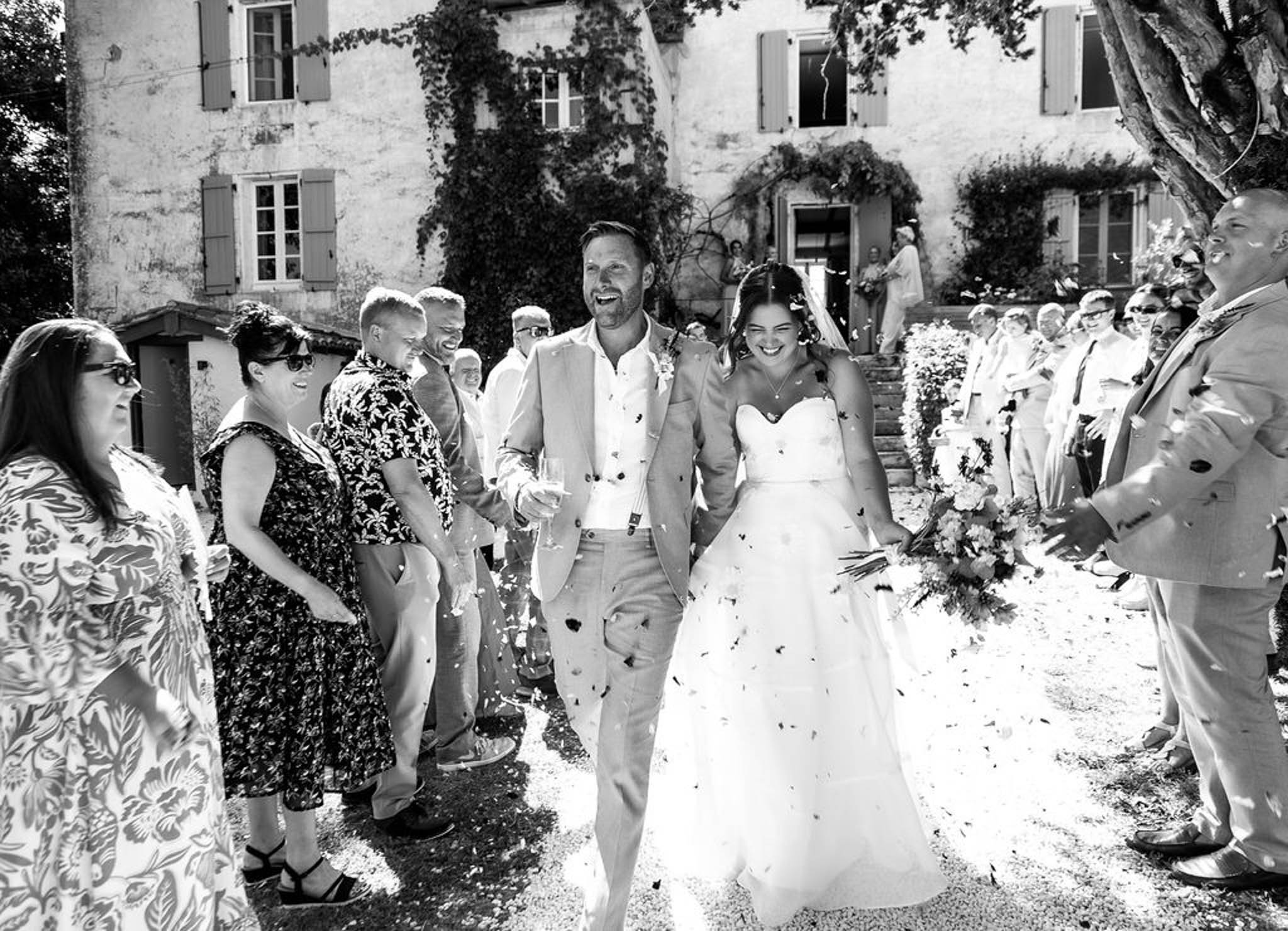
How to Convince Your Partner (or Parents)
You have seen the photos. You have pictured the courtyard, the long table under the trees, the rosé catching the last of the afternoon sun. You know France is the answer. But someone in your life is not convinced yet. Maybe your partner thinks it costs too much.
Maybe your parents want the wedding close to home. Maybe a guest has already said they cannot travel. Every one of these objections is real. Every one of them also reverses once people understand what a French wedding weekend actually looks like. The practical arguments, the emotional ones, and the specific numbers that turn doubt into enthusiasm. It connects to our broader guide to choosing France for a destination wedding. For a broader view of every step involved, see our step-by-step destination wedding planning guide for France.
Key Takeaways
- A French destination wedding for 80 guests often costs less than a 150-guest wedding at home because the smaller guest list, inclusive venue packages, and local wine prices reduce total spending.
- The multi-day format gives parents more time with the couple than a traditional six-hour reception. Frame it as a family holiday, not just a wedding.
- Guest attendance is consistently higher than expected. Once people book the flight, France sells itself. Anxiety about low turnout is almost always disproportionate.
- Bilingual suppliers handle everything. Couples do not need to speak French. The destination wedding infrastructure in France has served English-speaking clients for over two decades.
- "Too far" becomes "best weekend of our lives" after arrival. Travelling somewhere together makes people more present, more connected, and more invested in the celebration.
How Do You Make the Case for a Destination Wedding in France?
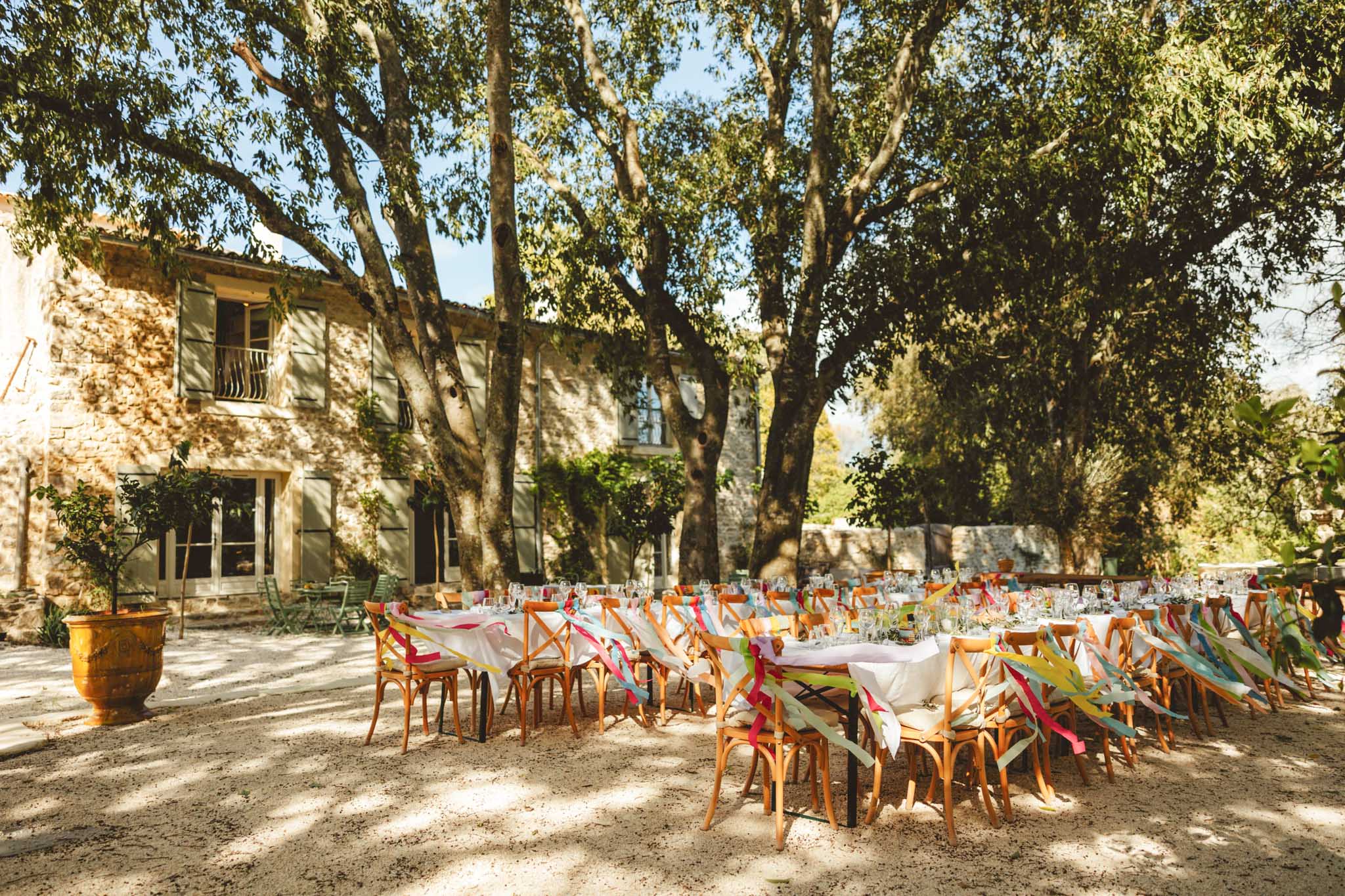
The strongest case for a destination wedding in France is not emotional. It is structural. France offers a format that most home weddings cannot replicate: a full weekend where the venue, the accommodation, the food, the wine, and the setting all work together as a single experience. A home wedding gives you six hours in a hotel function room. A French wedding weekend gives you Friday evening through Sunday brunch at a property your guests will remember for the rest of their lives. The case is not "let's go somewhere far away for a wedding." The case is "let's have the kind of wedding that only works when everyone is together for three days." Start with the experience, not the destination. Describe the weekend: Friday night drinks in the garden as people arrive and settle in. Saturday ceremony under the trees, cocktails on the terrace, a four-course dinner with local wine, dancing until 3am in a stone barn with the doors thrown open.
Back the emotional case with numbers. An 80-guest weekend at a French château or domaine costs €40,000 to €80,000 including venue hire, catering, wine, and accommodation for the couple. A 150-guest wedding at a country house hotel in England or a comparable US venue often costs the same or more, with a shorter event, less time together, and wine that costs three to four times what it costs in France. The full wedding cost breakdown shows the comparison in detail.
What If Your Partner Thinks It Is Too Expensive?
The cost objection is the most common and the easiest to address with data. As of 2026, a destination wedding in France for 80 guests costs less than most couples expect, and often less than a home wedding for 150 guests. The saving comes from three structural factors: a smaller guest list, inclusive venue pricing, and local wine costs. Smaller guest list. A destination wedding naturally trims attendance from 150 (typical home wedding) to 60 to 100. Fewer guests means lower catering costs, less stationery, a smaller cake, less table décor, and a venue that does not need to hold 200 people. Every line item shrinks with headcount. The per-guest experience improves while the total spend decreases. Inclusive venue pricing. Most French exclusive-use wedding venues include weekend hire, on-site accommodation for 20 to 40 guests, outdoor ceremony space, and use of grounds and gardens in a single fee. At a UK or US venue, each of those is billed separately: room hire, ceremony licence, accommodation per room, garden access.
Wine savings. In France, you buy directly from the producer or the vineyard next door. A Côtes de Provence rosé or a Bergerac red that would retail for three to four times the price at a UK hotel or New York event space costs €7 to €15 at source. Multiply the difference across 80 to 120 bottles for a weekend celebration, and the total saving reaches €2,000 to €4,000. That freed-up budget covers a guest shuttle, a second photographer, or return flights for two.
Present the comparison as a table. The French option wins on every metric except raw headcount, and the headcount reduction is a feature. Based on pricing data across the French wedding regions, the Dordogne, South-West, and Normandy offer the strongest value.
| Factor | Destination Wedding (France, 80 guests) | Home Wedding (UK, 150 guests) |
|---|---|---|
| Total cost | €40,000 to €80,000 (as of 2026) for a full weekend including venue, catering, wine, and core suppliers | £40,000 to £70,000+ for a single-day event at a hotel or country house, with each element billed separately. At March 2026 exchange rates (approx. £1 = €1.17), the French range converts to approximately £34,000 to £68,000. |
| Guest experience | Three days together at a private estate with gardens, pool, and communal spaces. Guests explore the region between events. | One evening at a venue shared with other bookings. Guests arrive and leave the same day. |
| Time with the couple | 48 hours across Friday evening, Saturday celebration, and Sunday brunch. Real conversations, not rushed hellos. | Roughly 6 hours, with the couple pulled between photos, table visits, speeches, and first dances. 20 minutes of real conversation per guest group. |
| Venue character | Stone châteaux, converted barns, Provençal mas properties, vineyard estates. Exclusive use is standard. | Hotel function rooms, marquees on rented land, or country house venues shared with other events on the same weekend. |
| Food and wine quality | Four to six-course seated dinner with wine sourced locally at €7 to €15 per bottle. Seasonal, regional ingredients as standard. | Three-course meal from a set hotel menu. Wine marked up 200 to 400% over retail. Fewer courses, shorter dining time. |
| Weekend duration | Friday evening welcome through Sunday brunch. Two nights, three meals, plus the main celebration. | Single afternoon and evening. Guests who travel may need a hotel room, adding cost without adding shared time. |
| Guest memories | A holiday and a wedding combined. Guests remember the market trip, the pool morning, the midnight dancing, and the Sunday farewell. | A single evening. Guests remember the ceremony, dinner, and a few conversations before the taxi home. |
What If Your Parents Want a Wedding Close to Home?
Parents who want the wedding close to home are rarely objecting to France specifically. They are worried about logistics, about elderly relatives who might struggle to travel, about missing the traditions they associate with weddings, and about feeling sidelined in the planning process. Address each concern directly rather than dismissing the overarching objection. Frame the weekend as a family holiday, not just a wedding. The multi-day format gives parents more time with the couple than any home wedding. At a six-hour UK reception, parents typically get 20 minutes of real conversation with the couple between table visits, photo calls, and first dances. At a French wedding weekend, parents arrive on Friday, have dinner together, spend Saturday morning with the family before the ceremony, and share Sunday brunch before departures. The total face time is measured in hours, not minutes. For parents, the French format is actually more generous, not less.
Invite parents into the planning. If they feel ownership over the weekend (choosing the wine, selecting the cheese for the Sunday brunch, planning the Friday evening welcome), they move from sceptics to advocates. One couple featured on French Wedding Style asked the groom's parents to organise the Friday evening welcome dinner, and the parents flew to France a week early to source ingredients from local markets. They went from "why can't we do this at home" to "we are already planning our next trip back."
For elderly or less mobile relatives, the exclusive-use format is actually gentler than a hotel wedding. Guests stay on-site. Everything happens within walking distance. There are no taxis, no car parks, no late-night navigating unfamiliar streets. A venue with on-site accommodation keeps everyone together and removes the transport logistics that make travel harder for older guests.
What If Guests Say They Cannot Travel?
Guest attendance at French destination weddings is consistently higher than couples expect. Across weddings featured on French Wedding Style over 15 years, the pattern is the same: couples worry about low turnout, send invitations with genuine apologies for asking people to travel, and then discover that 70 to 85% of invited guests say yes. France is not a hard sell. A weekend in the French countryside with good food, local wine, and a pool is something most people actively want to do. The practical barriers are lower than they appear. As of 2026, return flights from London to Bordeaux, Toulouse, or Marseille cost €80 to €150 in shoulder season. Paris is reachable by Eurostar without flying at all. For US guests, direct flights connect JFK and Newark to Paris CDG, with onward TGV connections to every major wedding region in under three hours. For Australian guests, the journey is longer, but France is a destination many have on their travel list regardless of weddings.
For guests who genuinely cannot travel (health, finances, work commitments), the response is the same as it would be for any wedding: understanding and no pressure. A destination wedding will have a smaller guest list than a home wedding. That is part of the design. The guests who attend are the ones who chose to be there, which creates an energy and commitment that a local obligation-invite wedding rarely matches. Quality of attendance matters more than quantity.
How Do You Address the "We Don't Speak French" Concern?
The language concern dissolves on contact with reality. Every major French wedding region has a deep network of bilingual suppliers who work with English-speaking couples as a core part of their business. A bilingual wedding planner in France handles all communication with French-only suppliers, venue staff, mairie officials, and local authorities. The couple and their guests never need to navigate a language barrier personally. The destination wedding market in France has been serving international clients for over 20 years. In Provence, the Riviera, Bordeaux, the Loire Valley, and Paris, English is the working language of the wedding industry. Bilingual photographers, florists, caterers, and celebrants operate in every region. Venue coordinators at properties listed on French Wedding Style communicate in English as standard. The concern that language will be a barrier reflects an outdated picture of France, not the current reality of its wedding industry.
For guests, the language barrier is equally minimal. Restaurants in wedding regions have English menus. Airport and train station signage is bilingual. Rental car companies operate in English. Most French people under 40 in tourist and hospitality areas speak conversational English. Guests who worry about not speaking French will arrive, order a coffee, buy bread at the boulangerie with a smile and a "merci," and wonder why they were ever concerned.
What Changes People's Minds Once They Arrive?
Everything changes once people arrive. This is far and away the most consistent observation from couples who have hosted destination weddings in France, and it applies to sceptical partners, reluctant parents, and hesitant guests alike. The objections exist in the abstract. They dissolve in the specific. The specific is a stone courtyard where the air smells like lavender and warm bread. The specific is a glass of cold rosé handed to you by someone you love as the sun drops behind a row of cypress trees. The specific is your father-in-law, who said he did not want to travel, sitting at a table with people he met 12 hours ago, laughing about something that happened at the market that morning. Travelling somewhere together makes people more present. At a home wedding, guests arrive from their normal lives, attend for a few hours, and return to their normal lives. They are still mentally in their routines.
At a destination wedding, the journey itself creates a break. By the time guests arrive at a French venue, they have left their routines behind. They are available, relaxed, and ready to be fully in the moment. This shift in attention is the invisible advantage of every destination wedding, and it is why guests consistently describe French wedding weekends as "the best wedding I have ever been to."
The reversal is particularly strong with parents. Based on couples featured on French Wedding Style, the most sceptical parents become the most enthusiastic advocates after the weekend. The combination of quality time with the couple, a striking setting, good food, and the pride of watching their child celebrate in an environment this considered turns "I wish you had done it closer to home" into "when can we come back?" The anxiety about the destination, in almost every case, was disproportionate to the reality of the experience.
Practical Steps for the Conversation
If you are preparing to have the conversation with your partner, parents, or key guests, structure it around these five points in order. Lead with the experience (the weekend format, the time together, the setting). Follow with the cost comparison (80 guests in France vs 150 at home). Address logistics third (flights, accommodation, accessibility). Handle specific concerns fourth (elderly relatives, language, legal). Close with the invitation: come and see. A venue visit to France converts more sceptics than any spreadsheet. For partners, the cost data usually closes the conversation. Show the side-by-side: what the same budget buys at home versus in France. The French option delivers a longer celebration, a more distinctive venue, better food, and better wine for the same or lower cost. If your partner is visual, show them 5 to 10 real wedding features from French Wedding Style. The imagery does what words cannot.
For parents, the time-together argument is the strongest. Quantify it: "At a hotel wedding, we will have 20 minutes together across the whole day. In France, we will have two full evenings and a morning." Then invite them into the process. Giving parents a role in the weekend (welcome dinner, Sunday brunch, wine selection) turns resistance into ownership.
For guests, remove uncertainty early. A save-the-date with a clear FAQ (flights, costs, accommodation, itinerary) eliminates the "I don't know what this involves" barrier. Guests who understand the logistics commit. Guests who are left to imagine the logistics hesitate. Provide two to three accommodation options at different price points, a suggested flight route from each major guest origin, and a note confirming that the venue has everything within walking distance. Make it easy to say yes.
Related Articles
- Why get married in France: the complete case for a French destination wedding
- 15 reasons to get married in France in 2026
- France vs Italy vs Spain: destination wedding comparison
- The complete guide to French wedding costs in 2026
- Guest accommodation for a French destination wedding
Frequently Asked Questions
What percentage of guests typically attend a destination wedding in France?
Guest attendance at French destination weddings typically runs 70 to 85% of invited guests. This is higher than most couples expect and significantly higher than destination weddings in more distant locations (Caribbean, Southeast Asia) where 50 to 65% is more common. France benefits from accessible flights, an existing cultural appeal, and the perception that the trip doubles as a holiday. Send save-the-dates 10 to 12 months in advance to maximise attendance.
How much does it cost for a guest to attend a wedding in France?
A guest attending a French destination wedding should budget €300 to €800 per person for travel and accommodation, depending on origin and the duration of stay. Return flights from London cost €80 to €200 depending on region and season. A hotel room near the venue costs €80 to €150 per night. Guests staying at the venue (where on-site accommodation is included in the couple's package) pay only for travel. Couples can reduce guest costs by choosing a venue in a region with affordable local accommodation and good transport links.
What if elderly grandparents cannot make the trip?
For elderly relatives who genuinely cannot travel, the options are the same as for any guest who cannot attend: understanding, no pressure, and alternative ways to include them. Some couples arrange a video call during the ceremony. Others host a small celebration at home before or after the French wedding. The exclusive-use venue format is actually gentler on elderly guests who do attend: everything is on-site, distances are short, and the multi-day pace is slower than a single-day event with tight transitions.
How do you split costs between the couple and the guests?
Standard practice for French destination weddings is that the couple covers the wedding itself (venue, catering, wine, entertainment, décor) and guests cover their own travel and accommodation outside the venue. Many couples also cover accommodation for their immediate family and bridal party. Providing 2 to 3 accommodation options at different price points (budget, mid-range, splurge) near the venue is considerate and expected. Some couples contribute to a group shuttle from the nearest airport or train station as a goodwill gesture.
Is it rude to ask guests to travel for a wedding?
No. An invitation is an invitation, not a summons. Guests who want to come will come. Guests who cannot will decline, and a genuine "we completely understand" in the invitation removes any pressure. The destination wedding format is now well-established enough that most guests expect to travel for at least some weddings in their lifetime. France, specifically, is a destination that most people are happy to visit. Frame the invitation warmly: "We would love you to join us for a weekend in France, and we completely understand if travel is not possible for you."
Start your search with the regions that offer the strongest combination of venue quality and guest accessibility. Browse destination wedding venues across France or explore wedding venues in the South of France for warm-weather properties with on-site accommodation. Every listing on French Wedding Style has been individually reviewed.
Explore Every Guide in This Chapter
Deep-dive into each topic covered above.