
The Ceremony at a French Wedding: Civil, Symbolic, Religious
The ceremony is the still point at the centre of a French wedding day. Everything before it is preparation. Everything after it is celebration.
And the ceremony itself, whether it happens in a stone mairie with fluorescent lights and a tricolour sash, under a canopy of wisteria in a private garden, or inside a 12th-century chapel with light streaming through stained glass, is the moment the day becomes real. In France, the legal and the emotional can happen separately, which gives international couples a freedom that does not exist in many countries: you can fulfil the paperwork in one setting and create your personal ceremony in another. What follows is how each ceremony type works, what the timing looks like, and how to structure a bilingual ceremony that honours both languages without doubling the length. This forms part of the complete French destination wedding planning resource. For the full chapter, see our complete wedding day timeline guide.
Key Takeaways
- France requires a civil ceremony at the local mairie for the marriage to be legally valid. Religious and symbolic ceremonies are optional additions, not legal substitutes. The civil ceremony takes 15 to 30 minutes.
- Most international couples hold the civil ceremony a day or two before the main celebration (often the Thursday or Friday), then have a symbolic ceremony on the wedding day itself. This separates the administrative from the personal.
- Symbolic ceremonies offer complete creative freedom: any location, any officiant, any structure, any language. They typically last 20 to 40 minutes and can include readings, vows, rituals, and music of the couple's choosing.
- Bilingual ceremonies work best when the celebrant speaks both languages and weaves them naturally, rather than repeating every line twice. A 30-minute ceremony in one language becomes a 50-minute ceremony when fully translated.
- French ceremony settings provide their own atmosphere. The architecture, the gardens, the light at 5pm in July. The most striking ceremonies are the ones that work with the setting rather than against it.
How Do Civil, Symbolic, and Religious Ceremonies Differ?
The civil ceremony is the legal requirement. It happens at the mairie (town hall) of the commune where the wedding venue or one of the couple's residences is located. The maire or an adjoint (deputy) conducts it. The ceremony follows a set legal format: reading of civil code articles, exchange of consent, signing of the registre, and the couple receives a livret de famille. Two to four témoins (witnesses) must be present. The room is typically a formal council chamber with a French flag, a portrait of the president, and sometimes a sash worn by the officiating official. The atmosphere ranges from warm and personal (in small village mairies) to functional (in city town halls). The ceremony takes 15 to 30 minutes. For international couples, the civil ceremony paperwork is the most complex part of getting married in France. Our complete civil ceremony guide covers the document requirements, the publication of banns, and the timeline for preparing everything.
The symbolic ceremony is what most international couples think of as "the wedding." It is the designed, personal, emotionally resonant ceremony that happens at the venue. It has no legal standing in France, which means it has no rules. Any person can officiate. Any words can be spoken. Any location can be used. Any ritual can be included. The couple writes the ceremony, or they work with a professional celebrant who designs it around their story, their values, and the setting.
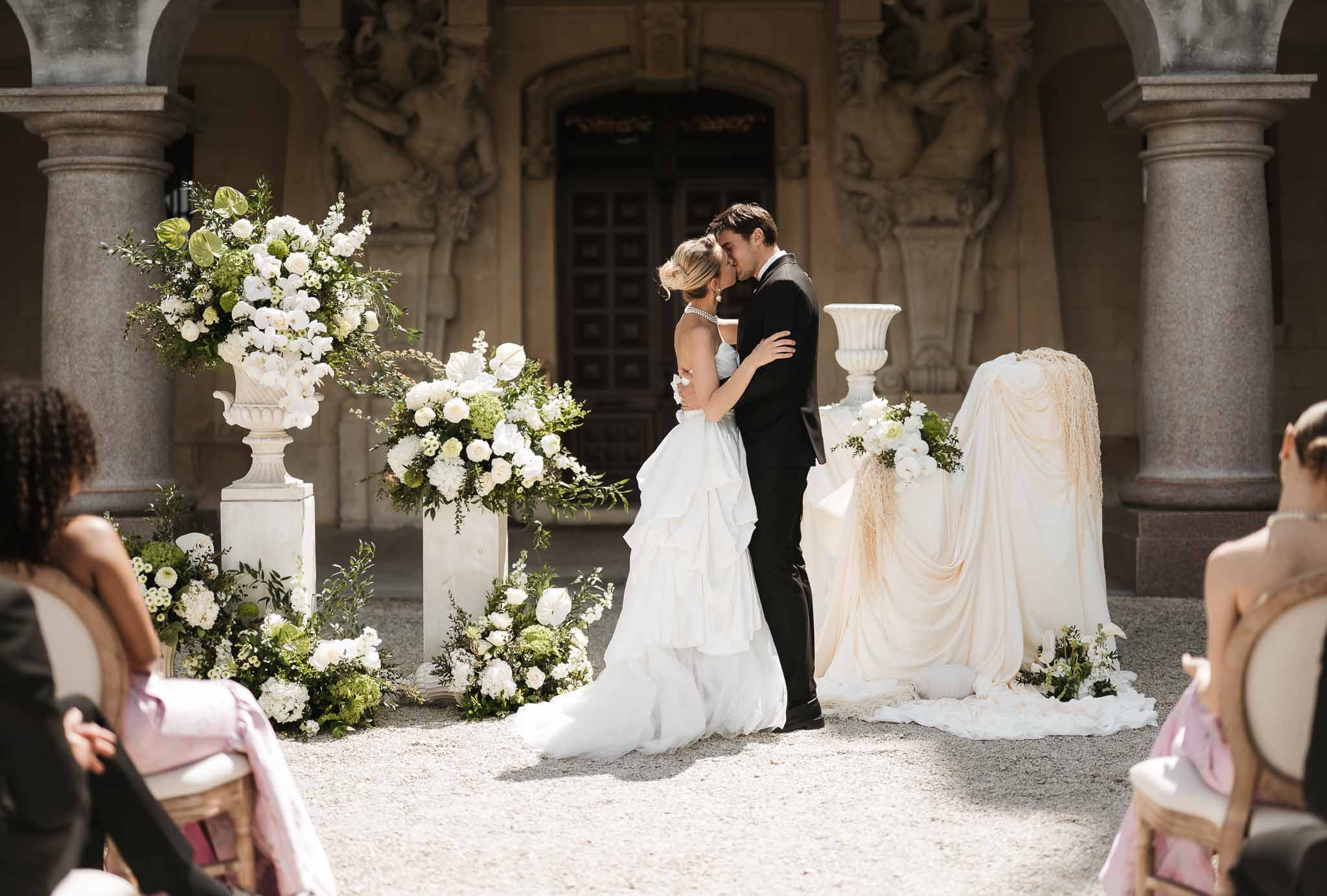
Symbolic ceremonies typically last 20 to 40 minutes. Under 20 minutes feels rushed. Over 40 minutes tests the attention of guests who are standing in afternoon sun. The structure usually follows: processional, welcome, reading or poem, the couple's story, vows, ring exchange, pronouncement, and recessional. Music marks the transitions.
Religious ceremonies in France require the civil ceremony to have taken place first (this is French law). A Catholic wedding mass takes 45 to 60 minutes and follows the liturgy, with limited room for personalisation. A Protestant ceremony is shorter (30 to 40 minutes) and allows more flexibility in readings and music. Jewish, interfaith, and other religious ceremonies vary in length and structure. The venue must be a consecrated space for Catholic and many Protestant ceremonies, which limits location options to churches and chapels.
Scroll →
| Factor | Civil | Symbolic | Religious |
|---|---|---|---|
| Legal status | Legally binding | No legal standing | Not legal alone (civil required first) |
| Location | Mairie only | Anywhere | Church, chapel, or synagogue |
| Officiant | Maire or adjoint | Anyone | Ordained clergy |
| Duration | 15 to 30 min | 20 to 40 min | 30 to 60 min |
| Language | French (translation provided) | Any language | Depends on denomination |
| Personalisation | Minimal | Complete freedom | Limited to some readings and music |
| Typical day | Thu/Fri before, or morning of | Sat/Sun afternoon | Sat afternoon or Sun morning |
What Is the Typical Ceremony Timeline?
At most French weddings with a symbolic ceremony at the venue, the ceremony begins between 4pm and 6pm. This is later than many British or American couples expect, but it follows the rhythm of the French wedding day: late ceremony, long vin d'honneur, dinner at 8pm or later, dancing until the early hours. Here is what the ceremony window looks like in practice: 60 minutes before the ceremony: Chairs or benches are set. The florist places the final ceremony arrangements. Sound is tested (microphone, speakers for music, or acoustic instruments). The celebrant arrives and reviews the running order with the couple or planner. 30 minutes before: Guests begin arriving. They are guided to the ceremony area by signage or a member of the planning team. Background music plays. Guests choose their seats (or are directed to seats if there is a formal seating plan).
Ceremony start: The music shifts. The processional begins. At a French symbolic ceremony, the processional order varies. Some couples walk in together. Some follow the Anglo tradition (groom waits, bride walks in with father or parent). Some follow the French tradition, where the groom enters with his mother and the bride enters with her father, and the parents are seated before the ceremony begins. Discuss the processional with your celebrant to find the format that fits your family dynamics.
During the ceremony (20 to 40 minutes): Welcome, reading(s), personal address, vows, ring exchange, pronouncement, recessional. If you include a unity ritual (sand ceremony, handfasting, wine box, tree planting), add 5 to 10 minutes. If guests participate (a group blessing, a ring warming), add another 5 minutes.
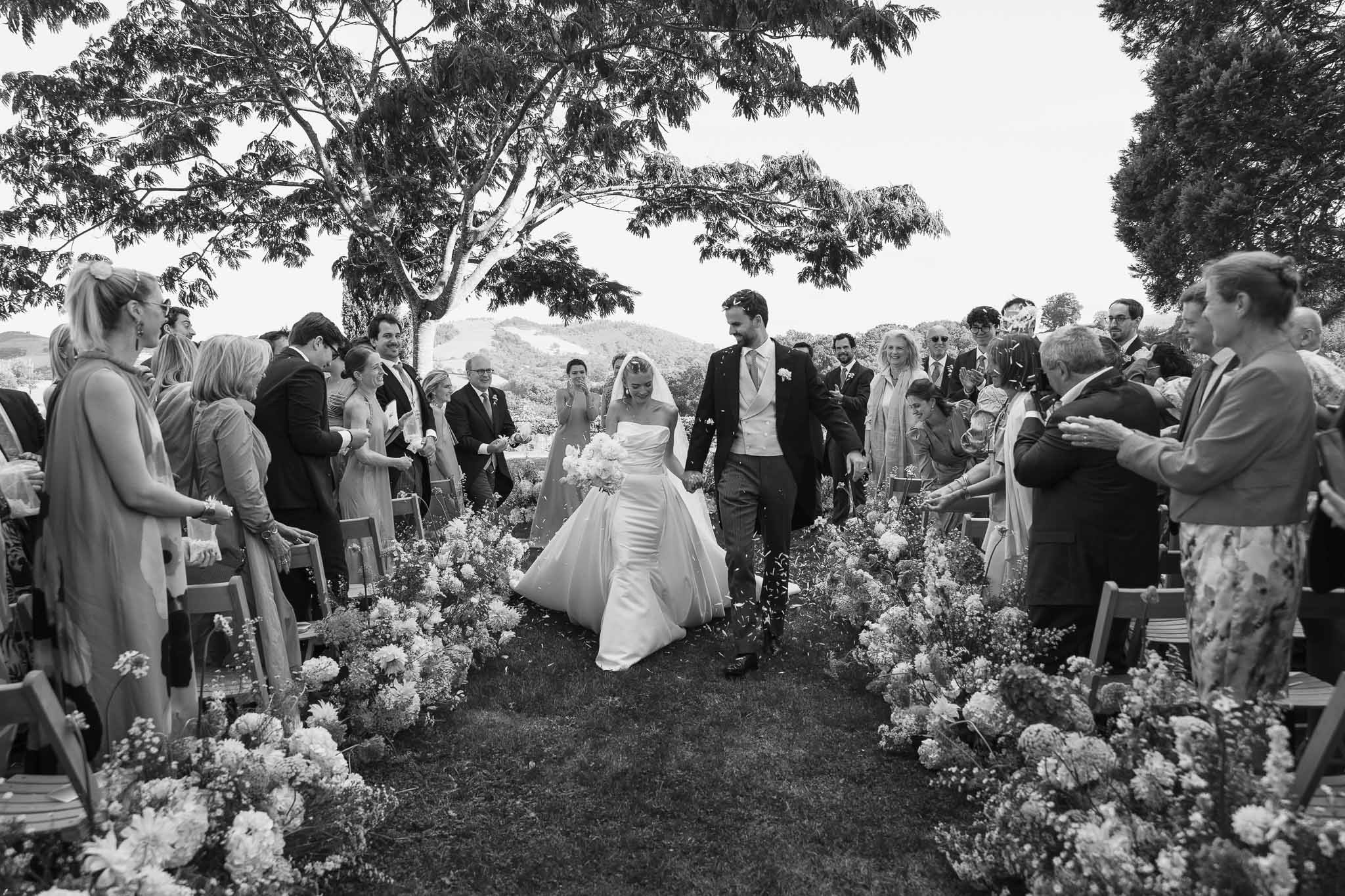
Immediately after: The couple walks back down the aisle. Guests applaud, throw petals or confetti (check with the venue), and follow the couple to the vin d'honneur area. The transition from ceremony to cocktails takes 10 to 15 minutes.
How Do Bilingual Ceremonies Work?
Bilingual ceremonies are the norm at French destination weddings. The couple may be English-speaking, but the families may include French grandparents, or the French guests may not speak fluent English, or the couple simply wants to honour the country they have chosen to marry in. The worst approach is a line-by-line translation. The celebrant says a sentence in English, then repeats it in French. Every reading is given twice. The ceremony doubles in length, the rhythm is broken, and both language groups spend half the time waiting. The approach that works: the celebrant speaks primarily in one language (usually the language the majority of guests understand) and weaves the second language into specific moments. The welcome might be given in both languages. One reading is in English, one in French. The vows are spoken in the couple's language, and the celebrant provides a brief summary in the other language before moving on. The pronouncement is given in both languages. This creates a ceremony that feels bilingual without feeling repetitive.
A skilled bilingual celebrant does not translate. They communicate. The French version of a passage is not a word-for-word mirror. It captures the same meaning in language that sounds natural to French speakers. This is why hiring a celebrant who is genuinely fluent in both languages (not just reading a translation from a page) makes such a difference to the emotional quality of the ceremony.
For the civil ceremony at the mairie, a sworn translator (traducteur assermenté) may be required if one or both partners do not speak French. The mairie conducts the ceremony in French, and the translator provides real-time interpretation. Your wedding planner can arrange this.
What Makes a French Ceremony Setting Distinctive?
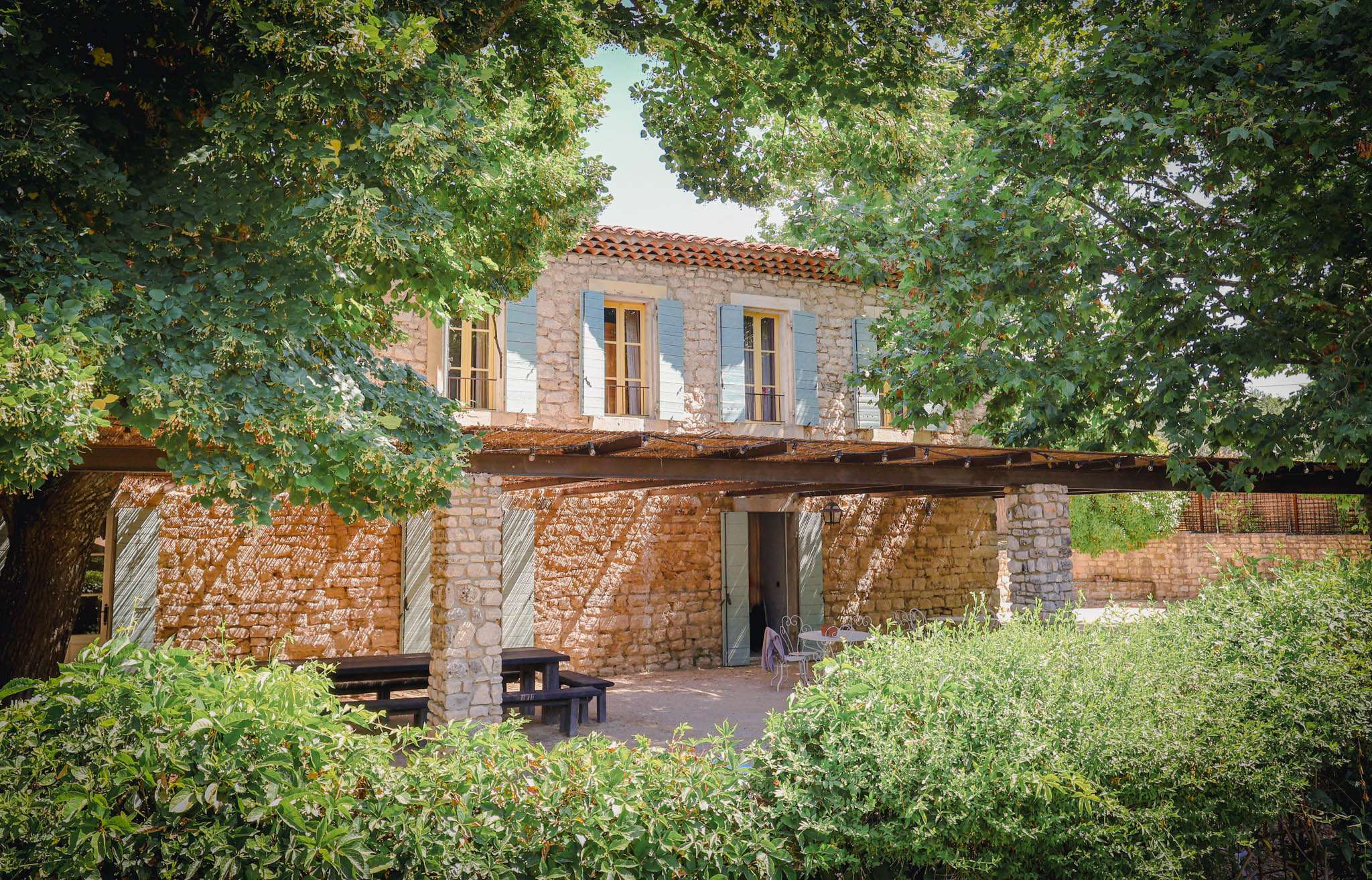
The setting does much of the work. This is the advantage of getting married in France that is hardest to replicate elsewhere. Consider a late-afternoon ceremony in the garden of a Provence bastide. The sun is lower. The light is warm and golden, filtering through olive trees and casting long shadows across the gravel path. The stone walls of the house glow amber. Lavender borders the aisle. The air smells of rosemary and warm earth. Guests sit on mismatched vintage chairs under the canopy of a centuries-old oak. No arch is needed. No draped fabric. No imported staging. The place itself is the ceremony design. Or a Loire Valley château where the ceremony takes place in the formal French garden. Clipped box hedges form geometric patterns on either side of a central gravel path. A circular fountain marks the focal point where the couple stands. The château rises behind them, all pale tuffeau stone and slate roofs.
Or a small village church in the Dordogne, where the Romanesque doorway frames the couple as they exit into the square. The stone is honey-coloured and warm in the afternoon light. The village bell rings. Guests line the narrow street. The celebration spills from the sacred to the secular in a single step.
What makes these settings work is age and specificity. French wedding venues were not built for weddings. They were built as homes, places of worship, and agricultural estates. The beauty is earned, accumulated over centuries of weather and use. A ceremony that respects that history, that lets the setting breathe rather than covering it with decoration, draws emotional power from the place itself. When couples choose a ceremony backdrop, the most resonant choice is often the simplest one.
The light in France at 5pm in July is different from the light in England or California at the same hour. It is lower, warmer, and more directional. Photographers know this. It is why so many recommend a late-afternoon ceremony: not just for the French dinner schedule, but because the quality of the light between 4pm and 6pm produces images with depth, warmth, and atmosphere that earlier ceremonies cannot match. Scheduling your ceremony to coincide with this golden window is one of the simplest and most effective design decisions you can make.
Related Articles
- Wedding day timeline: the complete guide
- Morning: getting ready at a French venue
- From vin d'honneur to dinner
- The evening: dinner and dancing
- Civil ceremony in France: the complete guide
- Symbolic ceremonies in France
- How to choose a wedding celebrant in France
- Writing your vows for a French wedding
- Ceremony backdrops at French venues
- Blending traditions at a French wedding
- Château wedding venues in France
- Garden wedding venues in France
- Outdoor wedding venues in France
- Destination wedding venues in France
- Browse all wedding venues in France
Frequently Asked Questions
Can we skip the civil ceremony and just have a symbolic one?
You can have a symbolic ceremony in France without a civil ceremony, but the marriage will not be legally recognised. Some couples marry legally in their home country before or after the French celebration and use the symbolic ceremony as the emotional centrepiece of the wedding day. This is common for UK, US, and Australian couples who find the French paperwork timeline (starting 2 to 3 months before the wedding) too tight.
Do we need a microphone for an outdoor ceremony?
Almost always yes. Even with 50 guests, an outdoor setting with wind, birdsong, and ambient noise makes it difficult for guests beyond the third row to hear the officiant and vows. A discreet lapel microphone on the celebrant and a small speaker system placed behind the guests is the standard solution. Your DJ, musician, or AV rental company can provide this. Test it during the rehearsal.
What happens if it rains during an outdoor ceremony?
Every French venue with an outdoor ceremony space has a rain backup: a covered terrace, an indoor salon, a chapel, or a marquee. Confirm the backup plan with the venue and your planner at least a month before the wedding. The decision to move indoors is typically made 2 to 3 hours before the ceremony based on the weather forecast. Once the decision is made, commit to it. Do not wait until the last minute hoping the rain will stop.
Explore Every Guide in This Chapter
Deep-dive into each topic covered above.