
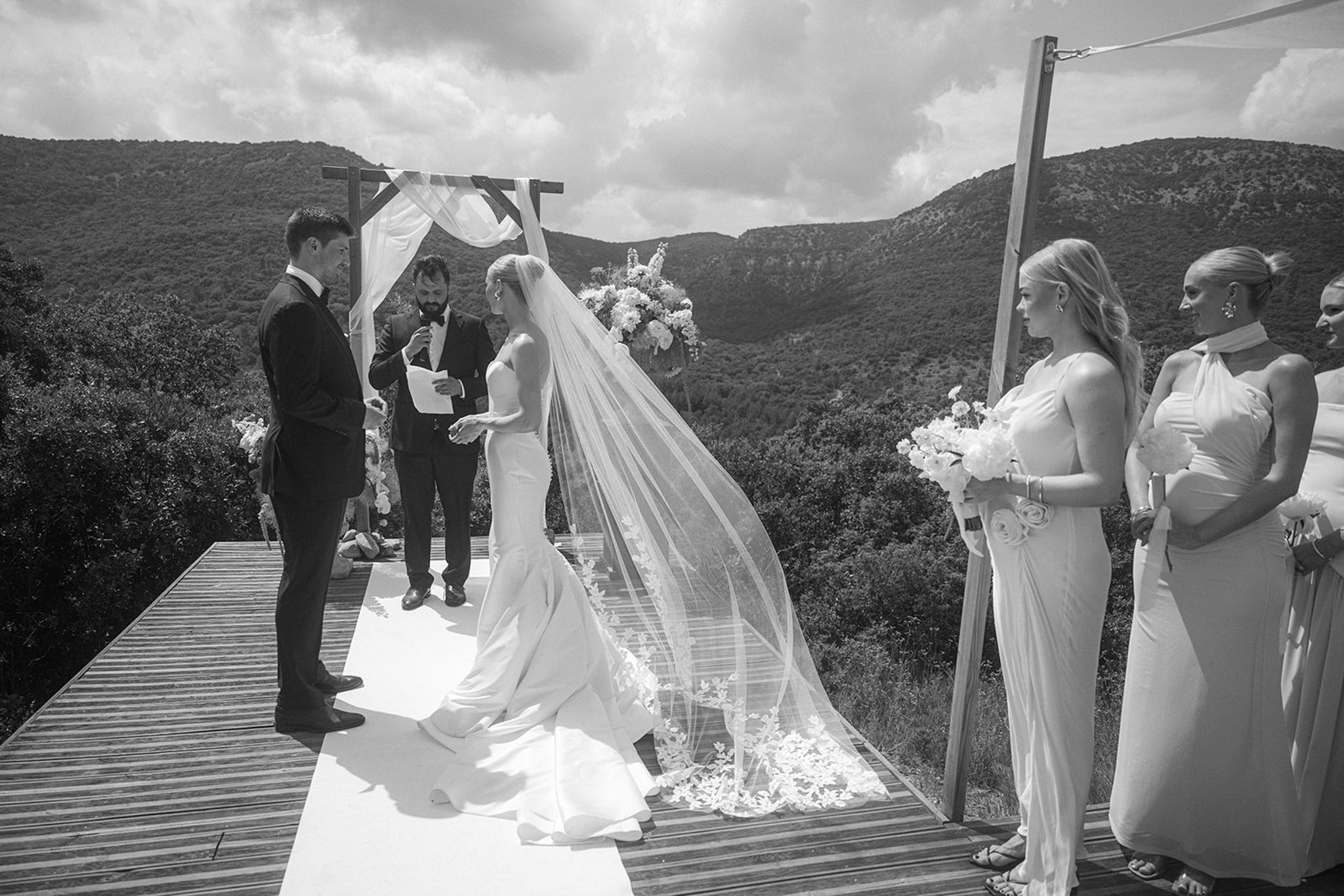
Wedding Arch & Ceremony Backdrops
The question most couples ask their stylist is "what kind of ceremony arch should we have?" The question a French venue asks back, quietly, through its stone doorways and garden walls and vine-covered pergolas, is "do you need one at all?" French wedding venues come with backdrops already built into the architecture. A chapel doorway framed by climbing roses. A courtyard wall with 300 years of weathered stone. A row of plane trees stretching toward the horizon. An olive grove where the light filters through silver leaves.
The decision is not always about what to add. Sometimes it is about what to leave alone. Below is when a ceremony backdrop enhances a French venue and when it competes with one, as part of our complete styling and design chapter. For a broader view of every step involved, see our complete guide to planning a destination wedding in France.
Key Takeaways
- French venues often provide a natural ceremony backdrop through their architecture: stone walls, chapel doorways, garden arches, vineyard perspectives, courtyard features. Adding a constructed arch risks competing with what already exists.
- When the ceremony space is open (a flat lawn, an empty terrace, a beach), a focal structure gives the eye a resting point and frames the couple in photographs. This is when a ceremony arch earns its presence.
- The French aesthetic for ceremony design favours restraint. Asymmetric, organic, and understated arrangements read as intentional. Over-structured, heavily decorated arches read as imported from a different design language.
- Outdoor installations require wind anchoring, heat planning, and access for delivery vehicles. A ceremony arch in a vineyard or on a hilltop faces practical challenges that a sheltered courtyard does not.
Do You Need a Ceremony Backdrop at a French Venue?
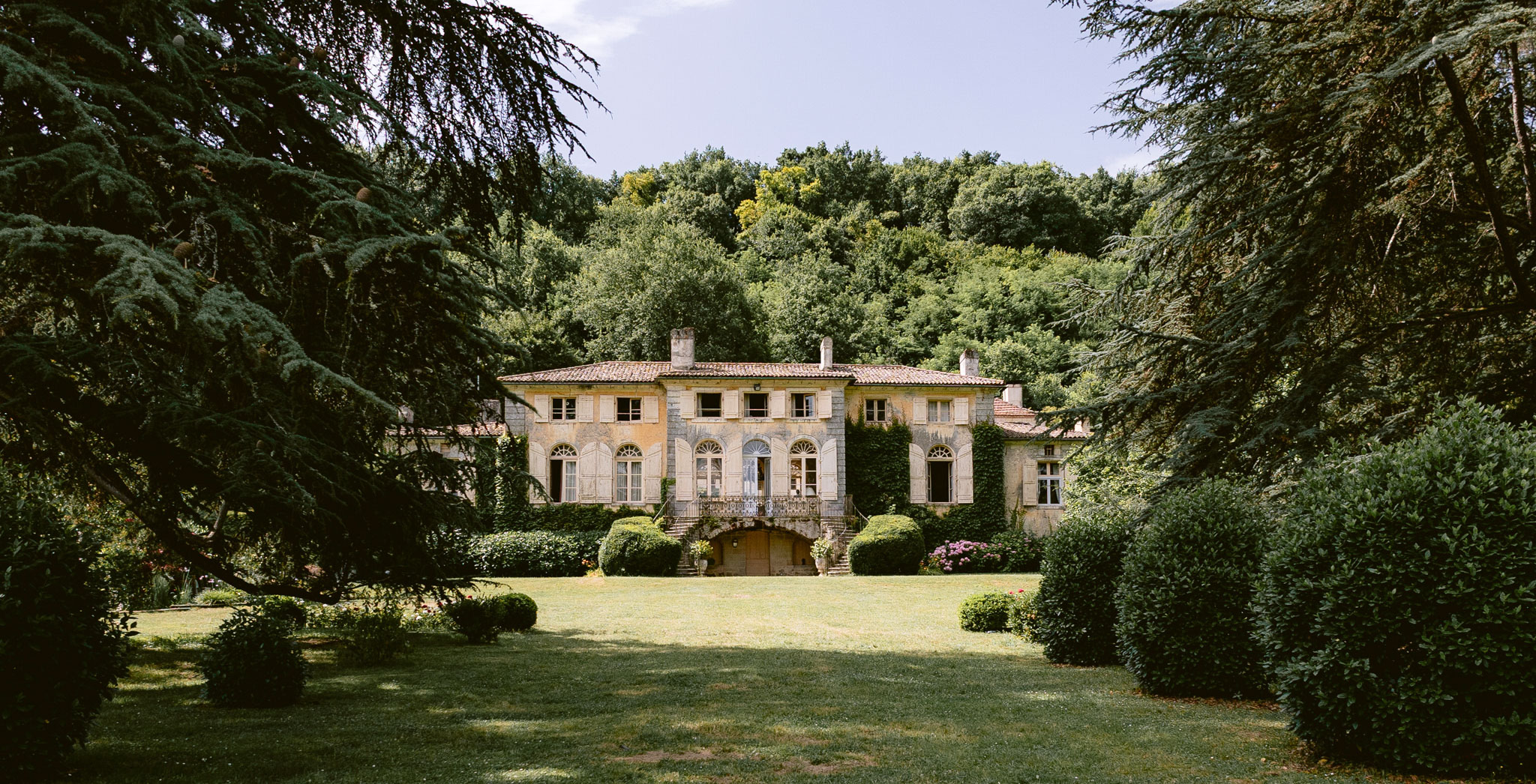
Honestly, often you do not. Walk through the ceremony spaces at any well-maintained château, domaine, or bastide in France and you will find features that serve as natural focal points. A stone archway leading from the garden into the courtyard. A fountain centred in a gravel parterre. A chapel with an arched doorway flanked by lavender. A terrace overlooking a valley where the landscape itself is the backdrop. These are not accidental. French properties were designed with sightlines, symmetry, and visual composition in mind. The architects who built them understood perspective and framing centuries before wedding photography existed. Adding a ceremony arch in front of a stone chapel doorway is like hanging a painting over a window. It blocks the view it is supposed to frame. The photographs from the ceremony will show the arch, not the building. The backdrop you chose competes with the backdrop the venue spent 400 years growing into.
The couples whose ceremony photographs resonate most on French Wedding Style are, consistently, the ones who let the setting carry the visual weight. A simple aisle of olive branch garlands laid along the ground. A single floral arrangement on a stone ledge. Petals scattered on flagstones. The ceremony read as part of the place, not imposed on it. When planning a ceremony at a garden venue in France, the existing planting and architecture often provide everything the scene needs.
Which Arch Styles Complement French Architecture?
When the ceremony space genuinely needs a focal structure (a flat lawn with no feature, an open terrace, a beach), the style of that structure matters because it sits alongside centuries-old architecture. It needs to belong. Organic and asymmetric. A loose arrangement of foliage and flowers on a simple metal or wooden frame, fuller on one side than the other. This reads as grown rather than constructed. It suits Provence bastides, vineyard settings, and informal garden ceremonies. The plant material does the talking: trailing jasmine, olive branches, garden roses placed as though the wind arranged them. The frame is secondary. This is the style most commonly used by experienced French floral designers because it harmonises with the landscape rather than imposing geometry on it. Minimal frame. A clean copper, brass, or raw steel geometric frame (rectangular, hexagonal, or triangular) with little or no floral decoration. The structure provides the visual anchor without competing with the building behind it. A single asymmetric cluster of flowers at one corner. Trailing ribbon.
Living green arch. A frame densely covered in foliage (eucalyptus, ruscus, ivy, smilax) with flowers as accents rather than the dominant element. Green arches blend into garden settings and feel like an extension of the landscape. They suit any French region and any season except deep winter, when the dense green reads as artificial against a bare landscape.
Stone or found-object framing. Some couples work with the venue's existing materials: stacking terracotta pots, framing the ceremony with borrowed stone urns from the garden, or positioning antique iron gates as a ceremonial threshold. This approach requires coordination with the venue but produces a result that looks like it has always been there. It is the most characteristically French approach because it uses what already exists rather than importing something new.
What does not work at most French venues: a heavily decorated circular arch (moon gate) covered in dense flowers, which reads as event-industry rather than landscape. A draped fabric arch, which reads as tropical or beach rather than European. A rustic wooden log arch at a formal château, or a geometric metal arch at a rustic farmhouse. The mismatch between structure and setting is the issue, not the structure itself.
When Should You Let the Setting Speak for Itself?
The decision framework is simple. Ask two questions. First: does the ceremony space have a natural focal point behind where the couple will stand? If the answer is a stone wall, a doorway, a garden feature, a view, or any architectural element that draws the eye, you likely do not need to add a structure. Enhance the edges (aisle markers, petal scatters, low arrangements on ledges), but leave the focal point alone. Second: will the ceremony photographs read as "a wedding at this place" or "a wedding that could be anywhere"? If the backdrop is generic (a blank wall, a flat lawn with no feature, an empty courtyard), a ceremony structure provides the missing visual identity. If the backdrop is specific and characterful, the structure dilutes rather than enhances it. The strongest ceremony designs at French venues use minimal intervention. At vineyard venues across France, the vine rows themselves create a natural aisle and backdrop. At coastal properties on the Riviera, the Mediterranean provides the only backdrop anyone needs.
The French aesthetic for ceremony design can be summarised in one principle: the setting is the design. Everything else is optional.
What Are the Practical Considerations for Outdoor Installations?
If you do install a ceremony backdrop outdoors, the logistics require more planning than the design itself. Wind. Outdoor ceremony structures must be anchored. In the Mistral corridor (Provence, the Rhône Valley, the Riviera), wind speeds can reach 60km/h with little warning, even on an otherwise calm day. A freestanding arch that is not weighted or staked will fall. Your florist or rental company must provide ground stakes (for soil), weight bags (for stone or gravel), or cross-bracing (for hard surfaces). Discuss wind anchoring specifically. A ceremony arch that falls during the ceremony is not a charming mishap. It is a safety issue. Heat and flower survival. Outdoor summer ceremonies in the south of France take place in temperatures above 30°C, often in direct sun. Cut flowers in foam-based arrangements begin wilting within 90 minutes of setup. Water-fed arrangements (stems in concealed vessels) last longer. Foliage-heavy designs with fewer cut flowers survive heat better than bloom-heavy designs.
Delivery access. Vineyard hillsides, château gardens, and rural properties often lack vehicle access to the ceremony location. The florist may need to hand-carry the arch structure, foliage, and flowers across 200 metres of gravel path. This affects what is feasible. A dense floral arch weighing 40kg is manageable in a courtyard with van access. The same arch carried up a hillside path requires a team and significantly more installation time. Tell your florist exactly where the ceremony location is and how to reach it. A site visit is not optional for outdoor installations.
Repurposing. The most budget-effective approach: design the ceremony backdrop so that elements transfer to the reception. A freestanding arch can relocate to frame the entrance to the reception space. The flowers from a ceremony arrangement can redistribute across reception tables. A hanging installation above the ceremony aisle can move to hang above the head table. Discuss this with your florist during the design stage, not on the day. A design intended for repurposing uses modular construction. One that was not intended for it will fall apart during disassembly.
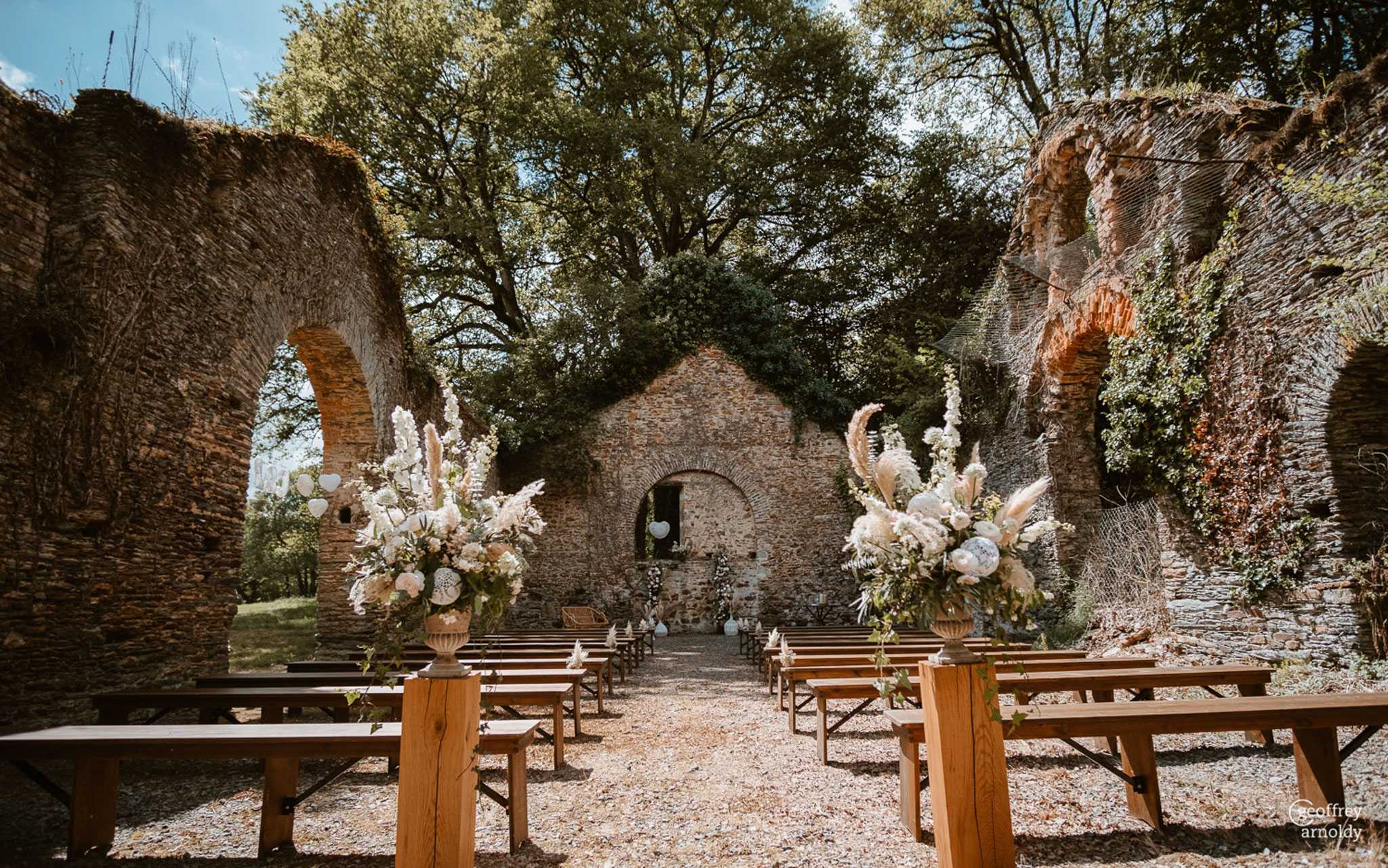
The principle that runs through every ceremony backdrop decision at a French venue is the same one that runs through French design in general: do less, better. A single well-placed floral arrangement on a stone ledge, positioned where the afternoon light catches it, will outperform a fully decorated arch every time. The setting is already doing the work. Your role is to notice that and respond to it. For couples weighing the full scope of ceremony and reception design decisions, our guides to colour palettes for French stone types and château table décor styling cover the remaining visual choices.
Related Articles
- Styling and design for a French wedding: the complete guide
- French wedding aesthetics: what makes them different
- Colour palettes for French wedding venues
- Château table décor ideas for French wedding dining rooms
- Lighting guide: fairy lights, candles, and lanterns
- Choosing a wedding florist in France
- Planning a symbolic ceremony in France
- Style guide: Provençal rustic weddings
- Style guide: boho chic weddings in France
- Outdoor wedding venues across France
Frequently Asked Questions
How much does a ceremony arch cost in France?
A simple foliage arch (greenery on a metal frame, minimal flowers) costs €400 to €800 from a French florist, including installation. A heavily floral arch with premium blooms (garden roses, peonies in season, ranunculus) ranges from €800 to €2,000. A large-scale custom installation (double arch, suspended structure, multi-element design) starts at €2,000 and can reach €4,000 or more. These costs include the structure, plant material, setup labour, and same-day breakdown. Transport is additional if the venue is more than 30 minutes from the florist's base.
Can we use the venue's existing garden features as a backdrop?
Most French venues welcome and encourage this approach. Rose-covered pergolas, stone archways, fountain courtyards, and garden walls are designed to be used. Ask the venue coordinator which ceremony locations they recommend and which have been used most successfully at previous weddings. Some venues have designated ceremony spots that are already framed and proportioned for the purpose. Using existing features costs nothing beyond the couple choosing to let them speak.
What happens to the ceremony backdrop if it rains?
Every outdoor ceremony in France needs a wet-weather contingency. If your ceremony arch is outdoors, the backup plan must account for it. Options: relocate the arch indoors (only feasible if the structure is freestanding and the indoor space accommodates it), leave the arch outdoors and move the ceremony indoors without it, or design a backdrop that works in both locations. The simplest approach is a freestanding structure on a weighted base that two people can carry indoors within 15 minutes. Discuss the rain plan with your florist, planner, and venue coordinator in advance.
Should the ceremony backdrop match the reception décor?
The ceremony and reception should share a visual language (same colour palette, same flower species, same design sensibility) but do not need to match precisely. The ceremony backdrop tends to be more natural and open because it sits in the landscape. The reception décor is more structured because it sits on a table. Consistency comes from using the same materials, not from replicating the same design. A garden-style asymmetric arch at the ceremony pairs naturally with loose, garden-gathered table arrangements at dinner. A geometric metal arch pairs with clean, architectural centrepieces.
Do we need permission from the venue to install a ceremony structure?
Always confirm in advance. Most venues allow freestanding ceremony structures on their grounds with no issue. The restrictions typically involve attachment to the building (no drilling, no adhesives, no hooks on historic stonework), ground anchoring in manicured gardens (stakes may damage irrigation or root systems), and weight limits on terraces or elevated structures. Your planner or the venue coordinator will confirm what is permitted. Ask during the planning stage, not the week before the wedding. A venue that learns about a large structure on installation day may not permit it.
Explore Every Guide in This Chapter
Deep-dive into each topic covered above.