
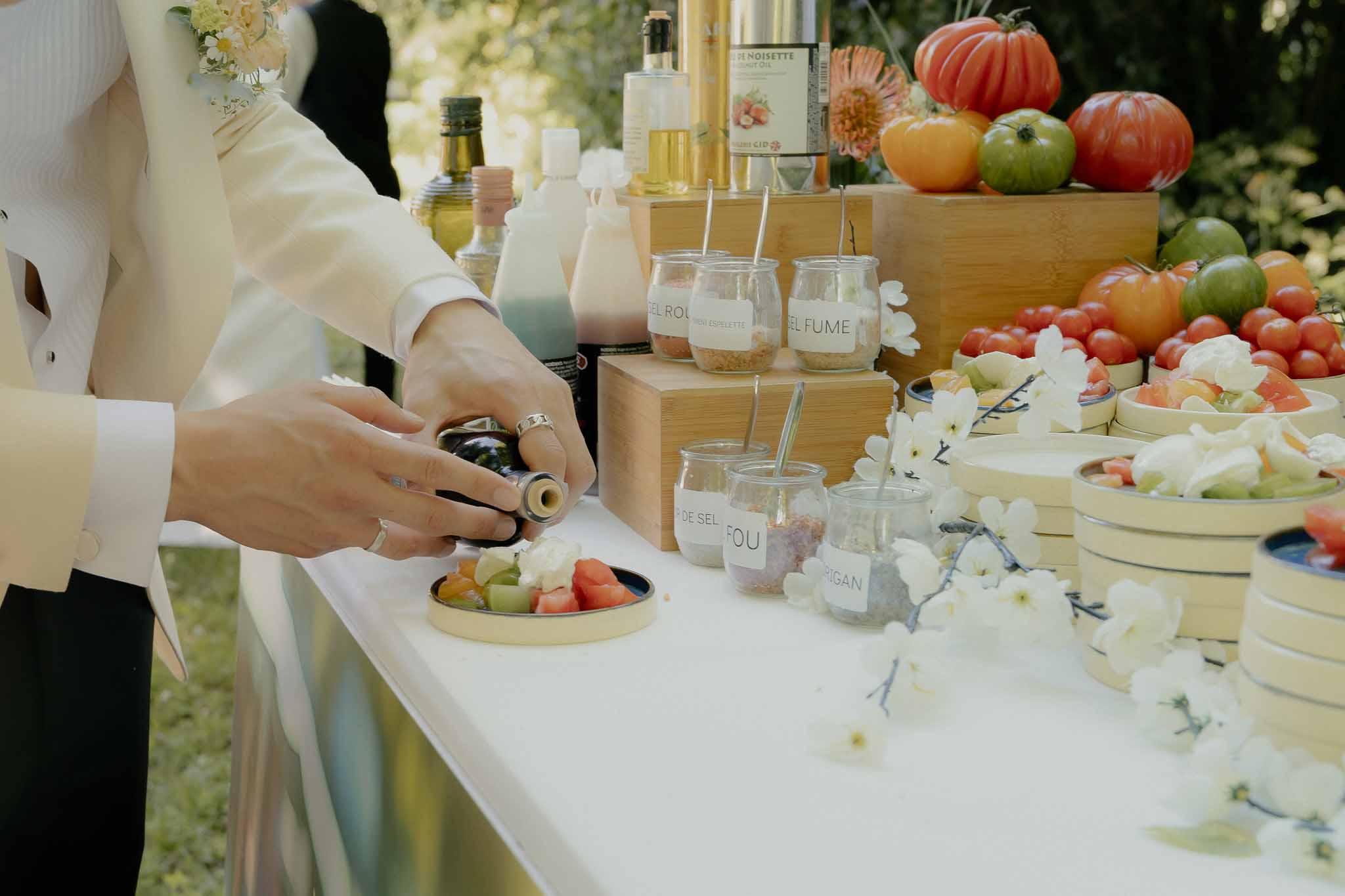
Choosing a Caterer (Traiteur)
Catering at a French wedding does not work the way it does in the UK, the US, or Australia, and the system that replaces it has no direct equivalent in the English-speaking wedding industry. A traiteur is a French caterer who provides full event catering including food, staff, equipment, tableware, and service for the entire meal.
Understanding how traiteurs operate, how venues structure their catering arrangements, and what a French wedding meal actually involves will prevent the two most common international couple mistakes: choosing a venue before understanding its catering model, and budgeting for food without accounting for everything the traiteur invoice covers. This forms part of our complete guide to planning a destination wedding in France. For a full picture of how these costs fit together, see our complete French wedding cost guide. Based on pricing data from the French Wedding Style vendor network, catering is the single largest line item after the venue fee itself, and the one where informed decisions save the most money.
Key Takeaways
A traiteur is a French caterer who provides a complete event catering operation far broader in scope than a British or American caterer, covering food, service staff, kitchen equipment, tableware, and full event management for the wedding meal. Across the FWS venue collection, 66% of venues require an external traiteur: 37% allow completely open choice while 29% provide an approved list, and only 18% have an in-house chef. Food costs run €150 to €280 per head before drinks in 2026, with drinks adding €30 to €80 per head, bringing the total catering budget to €200 to €400 per head all-in. Wine can be venue-supplied, subject to corkage at €5 to €12 per bottle, or BYO with zero corkage at 78 of 105 BYO-friendly venues on the platform. Request your menu tasting at the venue rather than the traiteur's showroom, because kitchen conditions on the day are what determine the food quality.
- A traiteur is a French caterer who provides food, service staff, kitchen equipment, tableware, and full event management for the meal. This is more comprehensive than a UK or US caterer.
- 66% of French Wedding Style listed venues require an external traiteur: 37% allow open choice, 29% provide an approved list. Only 18% have an in-house chef.
- Food costs €150 to €280 per head before drinks. Drinks add €30 to €80 per head. Total catering budget: €200 to €400 per head all-in.
- Wine can be venue-supplied, subject to corkage (droit de bouchon at €5 to €12 per bottle), or BYO. 78 of 105 BYO venues on FWS charge zero corkage.
- Always request your menu tasting at the venue, not the traiteur's showroom. The kitchen, equipment, and logistics at the venue are what determine the food on the day.
What Is a Traiteur and How Does French Wedding Catering Work?
A traiteur is a professional event caterer in France who provides a complete catering operation for weddings and private celebrations. Unlike a restaurant chef who cooks in their own kitchen, a traiteur brings everything to your venue: the food, the cooking equipment, the serving staff, the tableware (plates, glasses, cutlery), the kitchen setup, and the service coordination for the entire meal.
The traiteur manages the apéritif, the seated dinner, the dessert service, and often the late-night food. They hire and manage the waitstaff, the kitchen team, and the bar service. In many cases, the traiteur also supplies the tables, chairs, and linens if the venue does not provide them.
This scope is broader than what British or American couples expect from a "caterer." In the UK, a caterer provides food and staff. In France, a traiteur provides a full production operation that transforms an empty venue into a functioning dining room. The invoice reflects that scope. When a traiteur quotes €200 per head, they are quoting for food, staff, equipment, tableware, and service, not just the meal. Understanding this distinction is critical for comparing quotes accurately and for understanding why French catering costs appear higher than UK equivalents at first glance.
The traiteur model exists because the majority of French wedding venues are private estates, châteaux, domaines, and mas that do not have permanent commercial kitchens. The venue provides the space. The traiteur provides everything needed to feed 80 to 200 people within that space. This is why understanding your venue type before booking is so important. This separation of property and catering is the defining structural feature of the French wedding market, and it shapes every decision from choosing between all-inclusive and dry-hire venues to setting your final budget.
What Are the Three Catering Models at French Venues?
Every wedding venue in France operates under one of three catering models, and knowing which model applies before you book a venue is as important as knowing the site fee. Across the FWS collection, the split is clear: 18% of venues have an in-house chef or kitchen team, 29% provide an approved traiteur list, and 37% allow completely open choice of caterer. The remaining venues use hybrid arrangements.
In-house catering (18% of FWS venues). The venue employs or contracts a permanent chef and kitchen team. Your catering is included in the venue fee or charged as a per-head addition. You eat what their chef prepares, with limited customisation. The advantage is simplicity: one contract, one point of contact, one invoice. The disadvantage is limited choice. If the in-house chef's style does not match your vision, you cannot bring someone else. In-house catering is most common at hotel-style venues, Relais & Châteaux properties, and larger commercial estates. Many all-inclusive wedding venues in France use this model.
Approved traiteur list (29% of FWS venues). The venue provides a shortlist of three to eight traiteurs who have worked at the property before and meet the venue's standards. You choose from the list. The advantage is quality control: every traiteur on the list knows the venue's kitchen, the logistics, and the timing. The disadvantage is restricted choice and the potential for mark-ups if the venue takes a commission on traiteur bookings. Ask the venue whether they receive a referral fee from their listed traiteurs. Ask the traiteurs the same question.
Open choice (37% of FWS venues). You find your own traiteur. The venue places no restrictions beyond basic insurance and logistical requirements (delivery access, waste disposal, kitchen standards). The advantage is full creative freedom: you can hire any traiteur in France whose style, cuisine, and budget match your vision.
The disadvantage is that the research, vetting, and coordination are entirely your responsibility. A traiteur who has never worked at your venue will need a site visit, a logistics plan, and clear communication with the venue coordinator about kitchen setup, power supply, water access, and timing. For more on how this choice affects your total budget, see our guide to French venue pricing structures.
How Much Does a French Wedding Caterer Cost?
Food costs at a French wedding in 2026 run €150 to €280 per head before drinks, depending on the traiteur's level, the menu complexity, and the region. Drinks service adds €30 to €80 per head for wine, champagne, and soft drinks through the apéritif and dinner. The total catering budget, including food, drinks, staff, equipment, and tableware, lands between €200 and €400 per head all-in.
Scroll →
| Budget Level | Food Per Head | Drinks Per Head | All-In Per Head | Total for 80 Guests |
|---|---|---|---|---|
| Mid-range regional traiteur | €150 to €180 | €30 to €45 | €200 to €250 | €16,000 to €20,000 |
| Established traiteur, Provence or Bordeaux | €180 to €220 | €40 to €60 | €250 to €310 | €20,000 to €25,000 |
| Premium traiteur, Côte d'Azur or Paris | €220 to €280 | €50 to €80 | €300 to €400 | €24,000 to €32,000 |
These figures include the traiteur's full service: food preparation, cooking equipment, refrigeration, tableware rental, waitstaff, kitchen team, bar service, and cleanup. They do not include furniture rental if the venue does not provide tables and chairs. Confirm whether the traiteur quote is HT (hors taxes) or TTC (toutes taxes comprises). French VAT on catering services is 10%, so a quote of €200 HT becomes €220 TTC per head. Across 80 guests, that is a €1,600 difference. For a complete picture of where catering sits in your total budget, read our guide to hidden costs of a destination wedding in France.
What Should You Ask a Traiteur Before Booking?
Seven questions will tell you everything you need to know about a traiteur before signing. First, have you worked at our venue before? A traiteur who knows the kitchen layout, the power supply, the delivery access, and the serving distances will produce better food with less stress. Second, what is included in the per-head price? Get a line-by-line breakdown: food, staff, equipment, tableware, setup, cleanup. Third, how many staff will be on-site? The standard ratio is one waiter per 10 to 12 guests for a seated dinner. Below that, service slows and food arrives cold.
Fourth, can we do a menu tasting at the venue? A tasting at the traiteur's showroom tells you what they can cook in their own kitchen. A tasting at the venue tells you what they can deliver in the conditions of the actual wedding day. The venue's kitchen setup, equipment limitations, and serving logistics all affect the final result. Request the tasting at the venue. If the traiteur resists, ask why.
Fifth, what is your overtime policy? French traiteur contracts specify a service window. If dinner runs long, if speeches push the dessert service back, if the couple wants a late-night food station at 1am, overtime rates apply. Know the hourly rate and the trigger before signing. Sixth, do you handle the apéritif dinatoire or is that quoted separately?
Some traiteurs include the cocktail hour canapés in the per-head price. Others quote dinner only and charge the apéritif as a separate line. Seventh, what happens if you cancel or the date changes? Cancellation terms, deposit schedules, and date change policies vary widely. Get them in writing.
How Does Wine Work at a French Wedding?
Wine at a French wedding operates under one of three models, and the model your venue uses will affect your total beverage budget by €1,000 to €4,000 depending on guest count and consumption. Venue-supplied wine charges €25 to €40 per bottle for quality that retails at €8 to €15, the simplest option where you choose from the venue's list and the total appears on the final invoice. Corkage or droit de bouchon at €5 to €12 per bottle allows you to buy your own wine and pay a per-bottle fee, saving significantly when sourcing direct from a local domaine at €8 to €15 per bottle. BYO with zero corkage is available at 78 of the 105 BYO-friendly venues in the FWS collection, making it the most cost-effective model for budget-conscious couples. Confirming the wine policy before signing any venue contract shapes your entire drinks budget from the first conversation.
Venue-supplied wine. The venue provides all wine at a per-bottle markup, typically €25 to €40 per bottle for quality that retails at €8 to €15. This is the simplest option. You choose from the venue's list, the wine is served by the venue or traiteur staff, and the total appears on the final invoice. The premium covers storage, service, glassware, and the venue's margin. This model is standard at hotel venues and properties with in-house catering.
Corkage or droit de bouchon. You buy your own wine and pay the venue a per-bottle fee for the privilege of bringing it onto the property. A droit de bouchon is a corkage fee, typically €5 to €12 per bottle in 2026. For a wedding serving 200 bottles, corkage adds €1,000 to €2,400 to the budget. The advantage is sourcing freedom: you can buy direct from a local domaine at €8 to €15 per bottle and serve better wine for less money, even after corkage. This model is common at dry-hire châteaux and domaines in wine-producing regions.
BYO with zero corkage. The venue allows you to bring your own wine with no additional fee. Of the 105 BYO-friendly venues in the FWS collection, 78 charge zero corkage. This is the most cost-effective wine model for couples managing their overall French wedding budget.
Couples who buy direct from a Bordeaux wine country or Languedoc domaine at €8 to €12 per bottle and pay no corkage serve excellent wine at a fraction of venue-supplied prices. For a 200-bottle order, the saving versus venue-supplied wine is €2,000 to €5,000. Ask the venue about their wine policy before signing. It is one of the first questions in any venue conversation.
Where International Couples Go Wrong with French Catering
Comparing French quotes to UK or US prices like-for-like. A UK caterer quoting £80 per head covers food and basic staff. A French traiteur quoting €200 per head covers food, full kitchen operation, tableware, glassware, serving staff, bar service, equipment transport, setup, and cleanup. The French quote is not twice the price for the same thing. It is a different thing entirely. Adjust your comparison accordingly.
Signing a venue contract before understanding the catering model. A couple who falls in love with a dry-hire château and signs at €12,000, then discovers that the open-choice catering model requires them to source everything from the traiteur to the tableware to the generator for the temporary kitchen, faces a budget reality that the site fee alone did not reveal. Understand the catering model before you commit to the venue. Read our comparison of all-inclusive versus dry-hire venue costs in France for the full breakdown.
Accepting a showroom tasting as proof of quality. A traiteur's showroom tasting demonstrates their culinary ability under ideal conditions. The wedding day conditions are not ideal. The kitchen is temporary. The equipment is transported. The prep space is limited. The serving distances are longer. A tasting at the venue reveals how the food performs under real conditions. If the traiteur delivers a polished showroom tasting but the venue tasting falls short, you have discovered the problem before the wedding, not during it.
Underestimating the full French meal structure. An apéritif dinatoire is a cocktail hour with substantial canapés and passed food, not a few bowls of crisps. The seated dinner follows a sequence: entrée, plat (main course), fromage (cheese course), dessert, and often a pièce montée (the traditional French wedding cake, a towering croquembouche of profiteroles held together with caramel). Late-night food after midnight is standard at weddings that run past 1am. Each stage adds to the per-head cost. Budget for the full sequence from the start.
Related Articles
These five guides connect directly to the catering decisions covered above. The vendor team guide provides the broader framework for sourcing and contracting all French wedding suppliers, with the traiteur typically the largest single contract after the venue. The all-inclusive versus dry-hire comparison shows how the venue model determines your catering options and total food budget. The venue pricing guide explains how site fees, mandatory vendor lists, and wine buy-out clauses interact with traiteur costs. The hidden costs guide identifies the extras that sit outside standard catering quotes, including overtime charges and vendor meal costs. The wedding planner guide explains why professional coordination is particularly valuable when managing an independent traiteur at a dry-hire venue.
- Building your vendor team for a French destination wedding
- All-inclusive versus dry-hire venue costs in France
- How venue pricing works in France: site fees, packages, and what they cost
- Hidden costs of a destination wedding in France
- How to choose a wedding planner in France
Frequently Asked Questions
What is an apéritif dinatoire?
An apéritif dinatoire is the French cocktail hour, served outdoors at most venues between the ceremony and the seated dinner. It typically lasts 60 to 90 minutes and includes champagne or crémant, wine, soft drinks, and a selection of passed canapés, charcuterie boards, and small bites. It is substantially more food than a British or American cocktail hour. Most traiteurs include it in the per-head price, but confirm this explicitly.
What is a pièce montée?
A pièce montée is the traditional French wedding cake. It is a tower of choux pastry profiteroles filled with crème pâtissière and bound together with spun caramel. The structure can reach 60 to 80 centimetres tall for 100 guests. Many couples serve a pièce montée alongside a modern dessert table or a wedding cake in another style. The traiteur typically prepares it, though specialist pâtissiers can be hired separately for more elaborate designs.
Can we bring our own food or have a food truck at a French wedding?
Food trucks and self-catered elements are possible at some dry-hire venues with open catering policies, but they are uncommon at traditional French wedding properties. Most venues require professional catering with proof of insurance and compliance with French food safety regulations (normes HACCP). A food truck for late-night snacks (crêpes, burgers, pizza) is more widely accepted than replacing the seated dinner entirely. Confirm with your venue before planning any non-traditional catering arrangement.
How many courses are served at a French wedding dinner?
A traditional French wedding dinner follows a set progression: apéritif dinatoire (cocktail hour), then the seated meal of entrée (starter), plat (main course), fromage (cheese course served before dessert, which surprises many international guests), dessert, and the pièce montée or wedding cake. Coffee and mignardises (petit fours) follow. Late-night food, often a simple station of charcuterie, cheese, or croque-monsieurs, appears after midnight. The full meal runs three to four hours, which is normal for a French celebration.
Do we tip the traiteur staff?
Tipping is not expected in France in the same way as in the US, but it is appreciated. A collective tip of €200 to €500 for the kitchen and service team is a generous gesture that recognises a long and demanding day. Hand it to the chef de service or head waiter directly at the end of the evening. Your wedding planner can coordinate this if you prefer.
Taste the menu at the venue, not the showroom. The temporary kitchen, the serving distances, and the equipment limitations at your property are what determine the food on the day. Browse caterers and traiteurs across France in our vendor directory to start building your shortlist.
Explore Every Guide in This Chapter
Deep-dive into each topic covered above.