
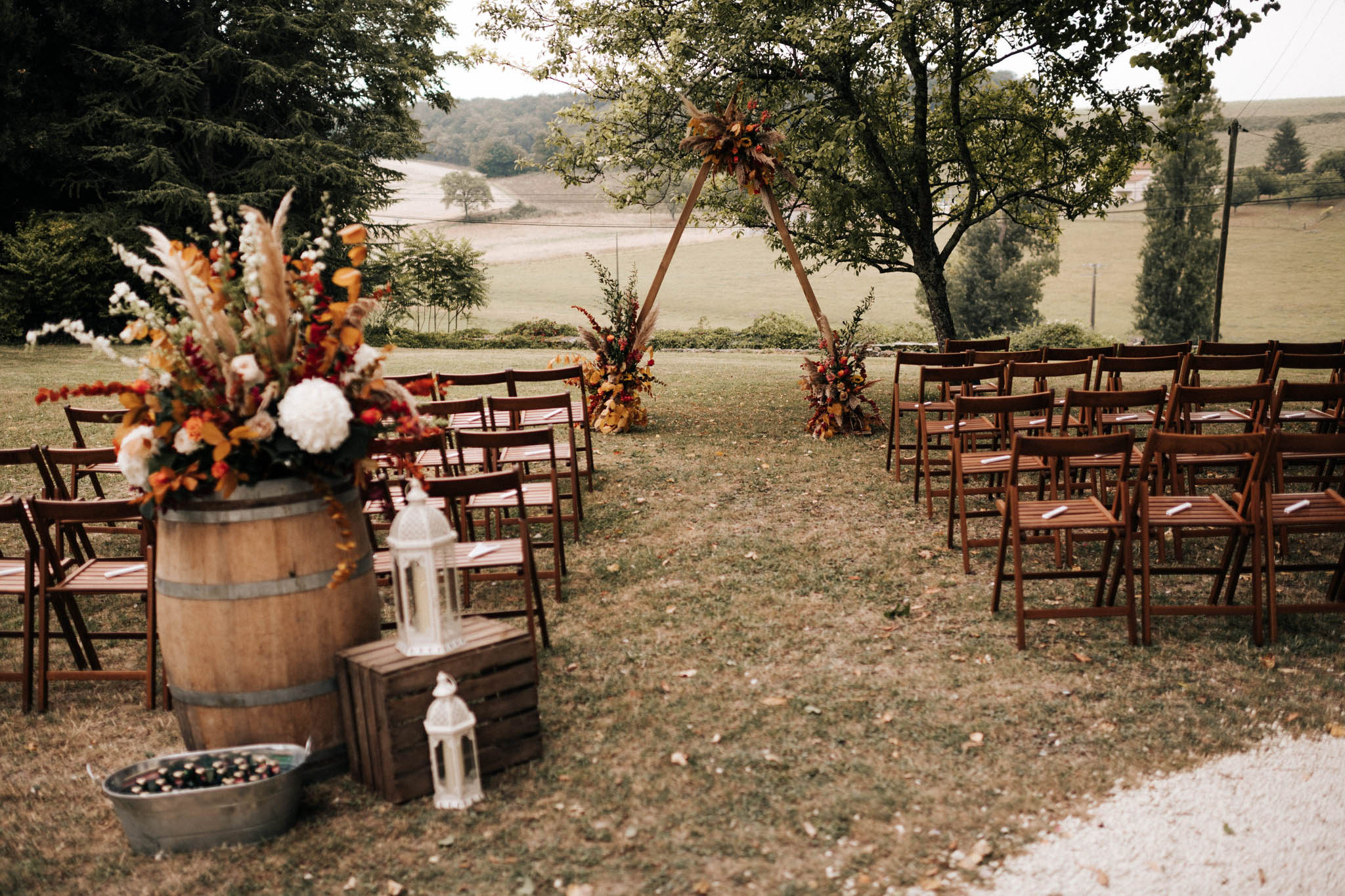
Boho chic in France is not what it is in the UK or the US. Drop the festival tents, the flower crowns made of daisies, and the barefoot-on-damp-grass aesthetic that defines Anglo-American bohemian weddings. French boho is more refined, more considered, and more grounded in the landscape it occupies.
It borrows from the same free-spirited impulse but filters it through a sensibility that values material quality, natural colour, and visual coherence over eclectic accumulation. Think dried grasses and raw linen in a sun-drenched field rather than bunting and fairy lights in a muddy meadow. How French boho works in practice: the colour and texture palette, the venue requirements, the flower choices, and the practical realities of styling an outdoor celebration in the French climate. For the core principles that underpin every French wedding style, start with our guide to French wedding aesthetics. For a broader view of every step involved, see the complete French destination wedding planning resource.
Key Takeaways
- French boho is refined rather than festival. It shares the free-spirited ethos of Anglo-American boho but applies it with greater material restraint: quality fabrics, a tighter colour range, and fewer competing textures.
- The outdoor elements that define boho styling face real challenges in the French climate. Wind, heat, and unpredictable weather require practical solutions that most mood boards do not show.
- The boho colour palette in France draws from the natural landscape: dried grasses, terracotta earth, sage green, warm cream, and sun-bleached wood. It avoids the bright jewel tones and heavy patterns of festival boho.
- Venues with outdoor space, natural shade, and transition areas between inside and outside give boho styling the best foundation. A property with gardens, trees, and open fields serves the look better than a formal courtyard.
How Does French Boho Differ from UK and US Festival Boho?
The difference is tonal. UK festival boho celebrates maximalism: layers of pattern, bright colour, mixed metallics, macramé at every turn, and a deliberately mismatched, eclectic energy. It embraces imperfection as an aesthetic statement. Wellington boots on the dance floor. Rain on the tipi. Coloured smoke bombs in the field. The vibe is joyful chaos. US boho leans toward the southwestern and coastal: pampas grass in enormous quantities, rattan and wicker furniture, hanging macramé installations, and a colour palette of blush, sage, and terracotta. It is styled for the desert, the beach, or the California ranch, and it tends toward more production value than UK boho, with professional installations and styled lounge areas. French boho sits between the two but with a distinctly French filter. The materials are natural but considered. The colour range is narrow. The textures are fewer but richer. A French boho table might have raw linen runners in oatmeal, terracotta dinner plates, dried grass centrepieces in clay vessels, and brass votives.
That is four materials. Four textures. One colour family. The UK version of the same table might carry eight to ten different textures in three different colour families. The US version might add rattan chargers, macramé napkin rings, and wooden name cards to the same surface. French boho edits down to the essentials and trusts the landscape to fill the visual gaps.
The bridal fashion tells the same story. French boho brides wear flowing silk or cotton in cream and champagne: a low back, delicate straps, light fabric that moves in the wind. Hair is loose, sometimes with a single dried flower or leaf tucked in. No flower crown (too costume), no fringe jacket (too festival), no coloured dress (too statement). The gown is simple. The setting is the statement. If you are comparing approaches, our French aesthetics guide explains why restraint is the recurring principle across all French wedding styles.
Which Outdoor Elements Work in the French Climate?
French boho is inherently outdoor. The aesthetic relies on natural light, open space, fields, trees, and the visual relationship between décor and landscape. But the French climate, particularly in the south during peak wedding season, introduces challenges that indoor celebrations do not face. Here is what works and what does not in practical outdoor boho styling: The most meaningful practical decision for a boho wedding in France is the weather backup plan. The aesthetic depends on outdoor dining, but the French climate does not guarantee dry evenings. A venue with a covered terrace, a barn within steps of the outdoor dining area, or a sailcloth tent already in place provides insurance without sacrificing the feel. Venues that offer only indoor backup in a formal dining room create a jarring tonal shift if rain forces a move. When browsing outdoor wedding venues across France, ask specifically about covered outdoor spaces that maintain the open-air atmosphere.
| Element | Works Well | Practical Challenge |
|---|---|---|
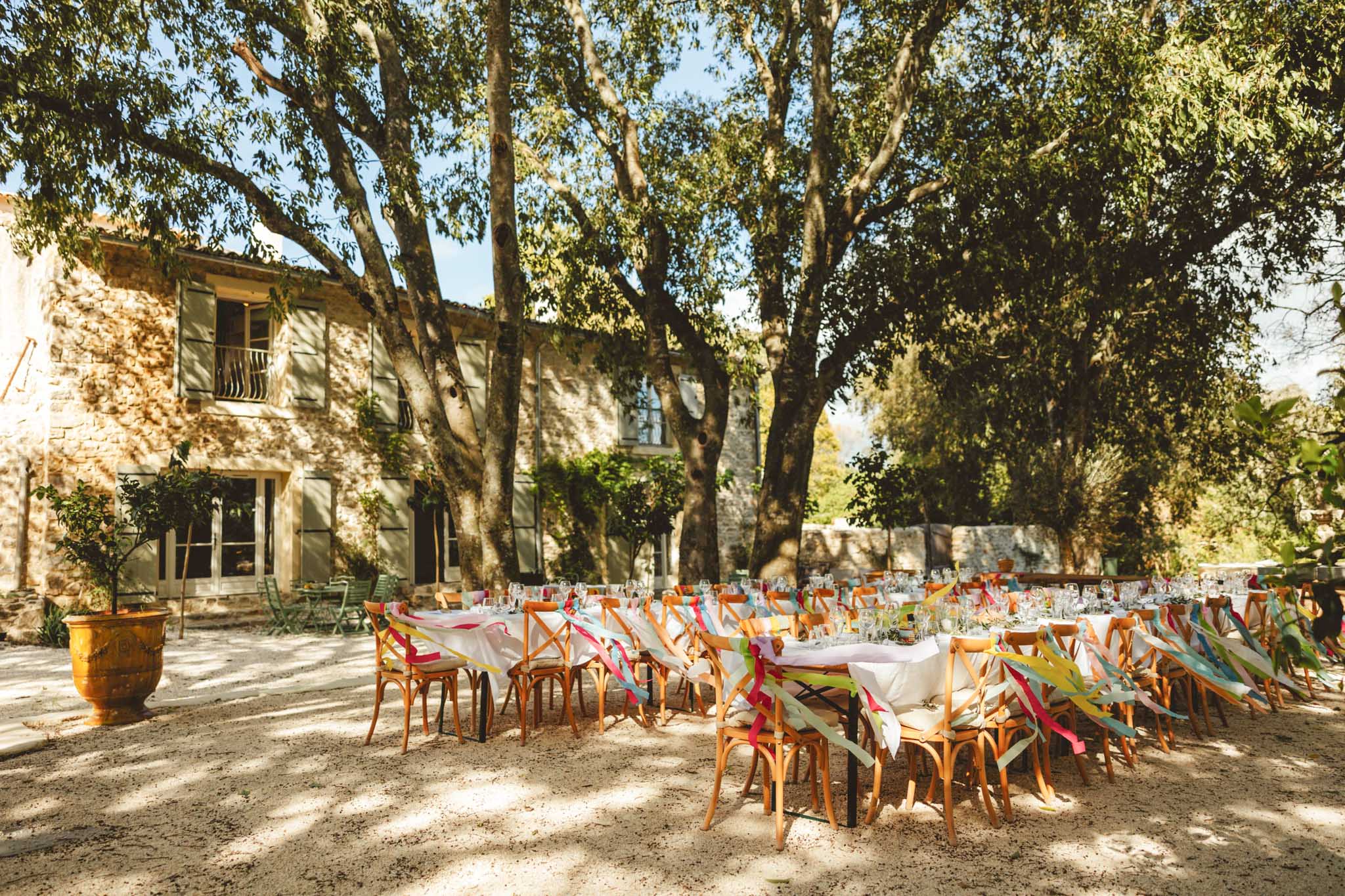
| Long farm tables under trees | Provence, Dordogne, Loire Valley: plane trees and oaks provide natural canopy and dappled light | Sap drops, falling debris, bird activity. Protect table settings with last-minute lay. |
| Stretch tents or sailcloth | Translucent fabric diffuses harsh sun and provides rain backup while keeping the outdoor feel | Wind. The Mistral in Provence and Atlantic gusts in the south-west require engineered anchoring, not DIY stakes. |
| Lounge areas with rugs and cushions | Golden hour. A styled lounge area on a lawn at sunset photographs well and gives guests a reason to linger outdoors. | Morning dew, ground moisture, insect activity. Use outdoor-rated fabrics. Set up same day, not the night before. |
| Ground-level tablescapes (picnic style) | Casual, photogenic, and distinctly boho. Works for welcome drinks or a brunch the next day. | Uneven ground. Guest comfort for longer than 30 minutes. Not practical for a three-hour dinner. |
| Hanging installations (macramé, dried flowers, lanterns) | Strong visual impact. Defines a zone without walls. | Wind catches hanging décor. Anchor points must be structural (trees, beams) not decorative (tent poles, stakes). |
| Naked flame candles | Essential for evening atmosphere. | Wind extinguishes. Use hurricane lanterns or enclosed glass vessels. Check venue fire rules for open countryside. |
What Is the Boho Colour and Texture Language in France?
The French boho palette is warm, earthy, and monochromatic with intentional variation within a narrow band. It draws from dried natural materials rather than living ones: the straw of dried wheat, the sand of raw linen, the clay of terracotta, the grey-green of dried sage. The effect is sun-warmed and faded, as if the décor has been sitting in the French countryside for a season and the sun has softened every edge. The core palette: Colours that do not belong in French boho: bright pink, cobalt blue, emerald green, black, bright white, neon anything. The palette stays within the temperature range of late-afternoon sunlight. If a colour would not look right bathed in golden hour light, it does not fit. Textures are tactile and natural. Raw linen with visible weave. Jute or sisal for rugs. Cotton rope for hanging elements. Dried pampas and grasses (in moderation, not as a wall). Crinkled cotton or gauze for canopies and draping. Handmade ceramic with visible brush marks.
- Base tones: cream, oatmeal, warm sand, unbleached cotton. These cover table linen, canopy fabric, and the majority of the visual field.
- Earth accents: terracotta, sienna, dried clay. Appear in plates, pots, tiles, and floor cushions.
- Green notes: sage, dried olive, eucalyptus. Present in foliage, candles, or a single fabric accent.
- Warm metallics: aged brass, copper patina. Sparingly, in candleholders and small vessels.
- Wood tones: bleached driftwood, pale oak, weathered pine. Furniture, signage, and structural elements.
Which French Venues Suit a Boho Celebration?
Boho needs space, nature, and informality. The venue should feel like an escape: fields, woods, water, gardens. Formal courtyards and symmetrical façades work against the aesthetic. The best boho venues in France share these qualities: open grounds with mature trees, transition spaces between inside and outside, relaxed architecture (farmhouses, converted barns, country estates), and a setting that feels connected to the landscape rather than carved out of it. Specific venue types that suit boho styling: Venues that clash with boho: grand formal châteaux with manicured parterre gardens, urban hotel ballrooms, and any property where the interior cannot be freely styled (heavy furniture, protected interiors, rigid layout). The boho couple needs permission to move furniture, set up outdoor zones, bring in external styling, and use the grounds freely. Check these permissions early. Properties with exclusive-use arrangements typically offer the most flexibility for outdoor boho celebrations.
- Domaines with open grounds: Wine estates, olive farms, and country properties with meadows, orchards, and natural shade. The combination of cultivated garden and wild landscape gives boho its visual range.
- Converted barns and granges: Raw stone, exposed timber, open floor plan. The agricultural character suits boho's informal energy. Outdoor ceremony in the field, dinner in the barn.
- Riverside or lakeside properties: Water adds a dimension that fields alone lack. Reflections, movement, the sound of water. A ceremony by a river in the Dordogne or a lake in the Auvergne gives boho styling a natural focal point.
- Mountain retreats: Chamonix, the Pyrenees, the Alpilles. Altitude brings cooler air, pine forest backdrops, and a wilder landscape that suits boho more naturally than formal lowland estates.
What Are the Practical Challenges of Boho Styling Outdoors?
Every mood board shows the best-case scenario: golden light, calm air, dry ground, happy guests in flowing linen. Reality in France introduces variables that styling alone cannot solve. Wind. The Mistral in Provence blows at 50 to 100 km/h without warning. Lighter gusts across the south-west are common in late afternoon. Anything hanging, draped, or placed on a surface without weight will move. Napkins need rings or a plate edge. Menus need holders or stone weights. Table runners need invisible clips. Hanging installations need structural anchor points and flexible attachments that allow movement without breaking. Canopy fabric needs tensioning that allows wind to pass through rather than catching it like a sail. Heat. July and August in southern France mean 35 to 38°C. Guests seated outdoors without shade for a 45-minute ceremony will be uncomfortable within 20 minutes. Shade is non-negotiable: tree canopy, sailcloth, parasols, or timing the ceremony for after 5pm when the sun drops. Flowers wilt. Cheese sweats. Chocolate favours melt.
Ground conditions. Grass dies in southern French heat by August. Fields are dry, uneven, and dusty. Rain transforms them to mud within hours. Heels sink. Furniture legs need pads or boards. Rugs on grass need anti-slip backing. A wooden plank pathway from the car park to the ceremony site prevents ankle injuries and looks intentional rather than improvised.
Insects. Mosquitoes after sunset. Wasps around food and drink. Ants on ground-level seating. Citronella candles help. Professional mosquito treatment of the grounds the day before helps more. Food service rather than buffet reduces wasp activity. Elevated seating rather than floor cushions for dinner reduces ground-level insect contact.
Related Articles
- Styling and Design: the complete chapter guide
- French wedding aesthetics: what makes them different
- Style guide: classic French weddings
- Style guide: Provençal rustic weddings
- Style guide: modern minimalist weddings in France
- French wedding florist: costs and seasonal guide
- Boho wedding venues across France
- Outdoor wedding venues across France
- Colour palettes for French wedding venues
- Ceremony backdrops at French venues
- Lighting guide: fairy lights, candles, and lanterns
Frequently Asked Questions
Is pampas grass still appropriate for a French boho wedding?
In moderation. A few tall stems in a clay vessel or flanking a ceremony point read as natural and grounded. An entire wall of pampas, a pampas arch, pampas on every table, and pampas in the bouquet reads as 2020 Instagram. The trend peaked. Use pampas as one element in a mixed scheme of dried grasses, wheat, lunaria, and fresh foliage rather than as the defining feature. In Provence and the south-west, locally harvested wild grasses provide a similar visual effect with more regional authenticity and lower cost.
Can boho work for an autumn or winter wedding in France?
Autumn is arguably boho's strongest season in France. The natural palette shifts to burnt orange, deep terracotta, burgundy, and gold. Dried foliage is abundant and costs nothing. The lower sun creates the warm golden light that boho styling depends on. Outdoor dining moves indoors to barns and converted outbuildings, where the raw architecture serves the style well. Winter is harder because the outdoor component is lost, but a barn wedding with fires, fur throws, warm spiced drinks, and candlelight creates a moody, intimate boho atmosphere. The outdoor ceremony becomes a brief, wrapped-up gathering around a fire pit rather than a long seated affair. Our seasonal guide covers regional temperatures and conditions month by month.
How does French boho bridal fashion differ?
French boho brides favour simplicity in high-quality fabric: flowing A-line or empire-waist gowns in silk, cotton, or crepe. Low backs and thin straps are common. Lace appears as fine overlay, not heavy all-over embroidery. No fringe. No heavy beading. No crop tops or separates (those sit more in US boho territory). Hair is loose, air-dried in texture, with perhaps a single fresh or dried flower or a delicate hair vine. No flower crowns in the full-circle style, which reads as costume in the French context. Shoes are flat: leather sandals, woven espadrilles, or bare feet on warm grass. The overall look is relaxed, sun-warmed, and natural. She looks like she belongs in the landscape, not like she is dressed for a theme.
What is the biggest mistake couples make with boho styling in France?
Treating boho as a permission to accumulate. The word "bohemian" suggests creative freedom, and couples interpret that as adding more: more textures, more colours, more hanging elements, more lounge furniture, more pampas, more macramé, more mixed ceramics, more patterned rugs. The result is visual chaos dressed as free-spiritedness. French boho works because it applies the same less-is-more principle as every other French wedding style. Fewer elements, better quality, stronger cohesion. A boho table with raw linen, terracotta plates, and dried grass centrepieces in clay pots is three materials doing the work that ten attempted and failed. For guidance on the broader aesthetic principles, see our foundational guide to French wedding aesthetics.
What flowers work for a French boho bouquet?
A French boho bouquet is loose, unstructured, and looks like it was gathered from a garden rather than constructed in a workshop. The stems are visible. The shape is organic, not round. Dried grasses, wheat stems, and lunaria mix with fresh garden roses and trailing greenery. The colour palette stays within the warm earth-tone range: cream, sand, blush, dried terracotta. Ribbon is raw cotton, linen, or silk in oatmeal. No satin. No rhinestone pins. No wired structure. The bouquet should feel light enough to carry in one hand and look like it could sit in a clay jar on a kitchen table without looking out of place.
French boho is not festival boho cleaned up. It is a distinct aesthetic that uses natural materials, warm earth tones, and outdoor settings to create a celebration that feels connected to the land it sits on. Start with the landscape. Choose materials that belong to it. Style for the sun and the wind, not just the camera. Let the field, the light, and the season do the work that props and installations cannot.
Explore Every Guide in This Chapter
Deep-dive into each topic covered above.