
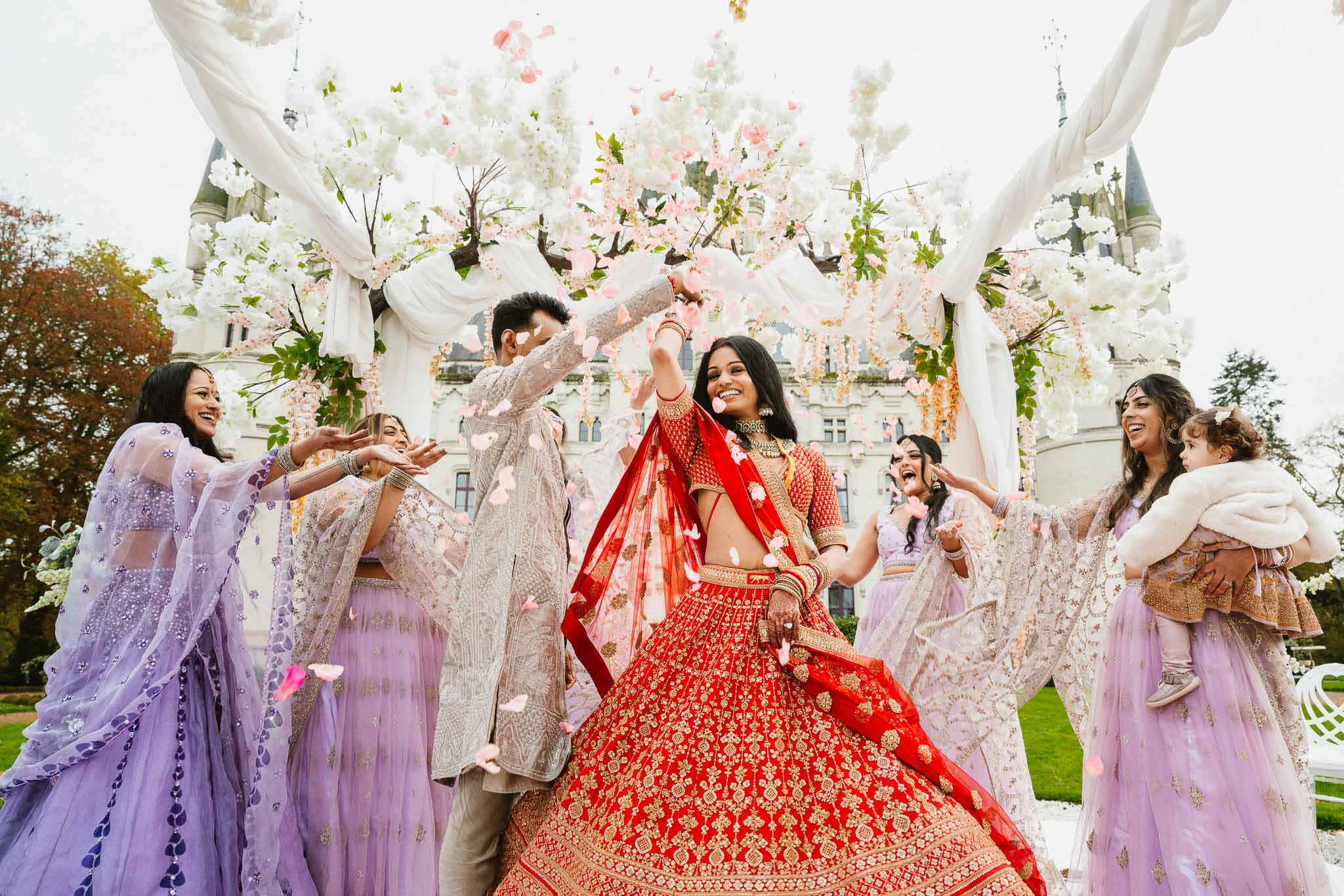
Blending Your Traditions with French Customs
The best destination weddings in France are not purely French. They are something new. A blend of the couple's home traditions and the French customs that surround them, layered into a celebration that could only happen in this country, with these people, on this particular weekend. The couples who get it right do not pick one culture over the other.
They build a third thing. A ceremony with vows in two languages. A dinner table where Champagne sits beside a Scottish whisky toast. A playlist that moves from Cabrel to Motown without anyone noticing the shift. Which French traditions adopt most naturally, which home traditions translate well to a French setting, and how to handle the moments where two cultures need to share the same stage, as part of our French wedding traditions chapter. For a broader view of every step involved, see planning your destination wedding in France from start to finish.
Key Takeaways
- The most successful blended weddings adopt two or three French traditions (vin d'honneur, late dining, croquembouche) and adapt two or three home traditions (speeches, first dance format, dress code) rather than trying to include everything.
- Bilingual ceremonies work best with alternating languages rather than line-by-line translation, keeping flow and emotional momentum.
- French guests genuinely enjoy experiencing foreign traditions. A Scottish cèilidh, an Indian baraat procession, or a Greek plate-smashing moment adds energy and creates shared memories.
- The vin d'honneur is the easiest French tradition to adopt. It requires no cultural knowledge from guests and naturally extends the celebration.
- Family negotiation is the real challenge. Start the conversation about which traditions to include at least six months before the wedding.
How Do International Couples Blend Their Traditions with French Customs?
The framework used by experienced planners working with international couples across the venues featured on French Wedding Style is simple: adopt, adapt, or leave. Adopt the French traditions that genuinely enhance the day. Adapt home traditions so they work in a French setting. Leave behind anything that creates friction, feels forced, or requires too much explanation. The goal is not a cultural showcase. It is a wedding that feels natural, personal, and celebratory. Adoption works best when the tradition is self-explanatory. The vin d'honneur requires no cultural briefing. Guests receive champagne and canapés in a garden. They understand. The long French dinner, with courses spaced across four hours and speeches between them, works because the rhythm is pleasant, not because guests know it is a French tradition. The croquembouche arriving on sparklers is a visual spectacle that transcends language. These traditions succeed because they feel generous, not performative.
Adaptation is where creativity matters. A British couple who wants a traditional speech block (best man, father of the bride, groom) can scatter those speeches between courses, French-style, rather than grouping them before dinner. The content stays British. The timing becomes French. An American couple who wants a choreographed first dance can have their spotlight moment, then transition into the French ouverture de bal as family joins 60 seconds in. The result honours both traditions.
Which French Traditions Are Easiest to Incorporate?
Some French wedding traditions require no cultural translation at all because they work through universal appeal: the vin d'honneur (cocktail hour with Champagne and canapes), the piece montee (a towering croquembouche or profiterole tower), and the midnight Champagne toast all translate seamlessly across cultures. Others carry more specific cultural weight. The trou normand (a mid-meal palate cleanser of Calvados sorbet), the bouquet ceremony sequence, and the traditional marche nuptiale processional order follow French conventions that foreign guests may find unfamiliar without context or explanation. The most successful cross-cultural French weddings adopt three to four traditions that align naturally with the couple's own background, rather than attempting to incorporate every custom. The table below ranks the most common French wedding traditions by how easily international couples can incorporate them, with practical notes on what works without explanation and what benefits from a brief introduction.
| Tradition | Ease of Adoption | Why It Works (or Does Not) |
|---|---|---|
| vin d’honneur | Very easy | Champagne and food in a garden. Self-explanatory. Universally enjoyed. |
| Long dinner with courses | Easy | Most guests enjoy a leisurely meal. Brief them on timing so they pace themselves. |
| Speeches between courses | Easy | Keeps energy high. No cultural explanation needed. |
| Late-night celebration (to 3am+) | Easy | Guests who want to leave early can. Those who stay enjoy the best hours. |
| Croquembouche / pièce montée | Easy | Visual drama. Sparklers. Everyone understands cake. |
| Guest performances | Moderate | Mention the tradition in advance. International friends may need encouragement. |
| Two-tier guest list | Moderate | Works culturally in France. May feel exclusionary to British or American guests without clear communication. |
| French processional order | Difficult | Groom enters with mother, not standing at the altar. Confuses Anglo guests unless explained. |
| La jarretière (garter tradition) | Skip | An older French tradition involving the groom's garter. Considered dated by most modern couples and planners. |
The strongest approach is picking two or three from the "easy" category and committing fully. A couple who adopts the vin d'honneur, the long dinner format, and the croquembouche moment has created a celebration that feels authentically French without requiring guests to navigate unfamiliar cultural territory. Adding one tradition from the "moderate" category (guest performances, for example) gives the day a distinctive French character without overwhelming the programme.
Which Home Traditions Adapt Well to a French Setting?
Not every tradition travels well. A receiving line that works in a British church doorway feels awkward on the gravel drive of a Provençal château. A cookie table from a Pittsburgh wedding has no equivalent infrastructure at a rural domaine. But many traditions not only survive the transplant, they improve in a French context. British speeches. The British speech tradition (father of the bride, groom, best man) is one of the strongest cultural exports. French guests find the emotional range, from sincere to darkly funny, fascinating. The adaptation: scatter them between courses rather than grouping them. Duration: three to five minutes each. This plays to both cultures. Scottish cèilidh dancing. A cèilidh set of three or four dances works brilliantly at French weddings. The caller instructs. Everyone participates. French guests love the structured chaos of Strip the Willow or the Dashing White Sergeant. Schedule it for 30 minutes between the formal dinner and the DJ set, around 10:30 to 11pm. It serves as a natural warm-up before the ouverture de bal.
Traditions That Translate Well
American rehearsal dinner. The welcome dinner at a French destination wedding functions identically to the American rehearsal dinner, gathering the inner circle the evening before. Host it at a local restaurant in Aix-en-Provence or a riverside terrace in the Dordogne for €50 to €90 per person.
Indian baraat procession. The groom's processional with music, dancing, and colour translates well to a French château courtyard. The architecture provides a natural stage. The visual contrast of vibrant colour against honey stone creates extraordinary photographs. Discuss timing with your venue and planner so the procession does not conflict with the ceremony start.
Jewish hora. Chair dancing works on any flat surface. The hora at a French wedding, usually during or after the ouverture de bal, creates an energy spike that French guests find irresistible. Many join without understanding the tradition, carried by the music and collective joy.
How Do Bilingual Ceremonies Handle Two Cultures?
Bilingual ceremonies at French destination weddings are common, and the couples who handle them well share one principle: alternate languages rather than translating every line. A ceremony where each sentence is repeated in a second language takes twice as long and loses all emotional momentum. The words feel like an administrative exercise rather than a declaration. Alternation keeps the rhythm alive. The most effective structure, recommended by experienced celebrants working with international couples in France, alternates blocks of content by language. The officiant's welcome might be in English. A reading by a French family member follows in French. The officiant's reflection on the couple returns to English. The vows happen in each partner's preferred language. The declaration of intent is delivered in both languages, one question at a time. Practical approaches that work well at French venues:
- Dual officiant model: One English-speaking celebrant and one French-speaking friend or family member share the ceremony. They alternate naturally, each taking sections in their language. This avoids the awkwardness of a single officiant switching between languages.
- Hybrid approach: A primary officiant conducts in one language (usually English for international couples) while key moments, vows, declaration of intent, pronouncement, are delivered in both. French guests hear the emotional peaks in their language.
- Printed bilingual programme: A ceremony programme with the text in both languages allows every guest to follow along regardless of which language is being spoken at any given moment. This is the simplest and most inclusive solution.
Vow language is personal. Each partner may read in their own language. Some couples write vows in one language and deliver a brief summary in the other. A French groom reading vows in French, followed by a three-sentence English summary for his partner's family, is graceful and practical. The full emotional weight lands in the native language. The summary ensures no one feels excluded.
What Cultural Moments Surprise International Guests?
Based on real weddings featured across French Wedding Style, five cultural moments consistently catch international guests off guard, in the best possible way. The vin d'honneur scale. Guests expecting a 45-minute cocktail hour find themselves still in the garden two hours later, with trays of foie gras and local cheeses still circulating. The abundance surprises. The pace relaxes. By the time dinner is announced, guests have already had a complete social experience. Dinner starting at 8pm or later. British guests accustomed to eating at 6:30 or 7pm find the late start disconcerting at first. By the second course, they understand the rhythm. The late start means the evening stretches ahead rather than winding down. Dinner at 8pm followed by dancing at midnight is a revelation for couples used to everything ending by 11pm. Guest performances between courses. The first time a group of friends stands up to sing a rewritten chanson about the couple, international guests are visibly moved. The sincerity and effort transcend language.
The pièce montée entrance. The room goes dark. Sparklers ignite. A tower of golden choux pastry appears on a trolley, caramel threads catching the light. Guests who have never seen a croquembouche stand and cheer instinctively. It is the most theatrical moment in a French wedding, and it takes no cultural knowledge to appreciate. See how this couple brought this to life at Château de la Mogere in Montpellier.
Still going at 3am. British and American guests are accustomed to weddings ending around midnight. At a French wedding, midnight is when the party properly begins. Our guide to ceremony backdrop ideas that honour blended cultural traditions in France breaks this down further. Guests who planned to leave early find themselves still on the dance floor at 2am, shoes abandoned under a table, convinced this is the best wedding they have ever attended. The late-night soupe à l'oignon at 3am seals it.
What Do International Couples Get Wrong About Blending Traditions?
The pitfall we see most often is trying to include every tradition from both cultures. A wedding that features a Scottish cèilidh, a Chinese tea ceremony, a French vin d'honneur, an Indian mehendi, a British speech block, and an American bouquet toss is not a blended celebration. It is an exhausting schedule. Choose three or four traditions total, from any combination of cultures, and give each one proper space and attention. Less is always more at a destination wedding where guests are already absorbing a new country, a new venue, and a new rhythm. A second mistake is assuming French guests will instinctively understand foreign traditions. They will not, any more than your British aunt understands the croquembouche. Our guide to French regions that naturally complement multicultural wedding celebrations covers this in detail. Brief both sides. A printed programme, a short explanation from the MC, or a note on the wedding website prevents confusion and lets guests enjoy traditions they have never encountered before.
A third mistake is waiting too long to discuss traditions with families. The question of which cultural or religious elements to include, and which to leave behind, touches identity, heritage, and family expectations. Start the conversation six months before the wedding, not six weeks. For mixed-nationality couples where one partner is French and the other is not, the negotiation often involves both sets of parents. A bilingual wedding planner experienced with cross-cultural celebrations can mediate these conversations and suggest compromises that honour both families.
Frequently Asked Questions
Can we have a religious ceremony at a French venue?
A symbolic religious ceremony (blessing, prayer, religious readings) can take place at almost any venue in France. It carries no legal standing, which means no restrictions on location, officiant, or format. A legal religious ceremony (Catholic, Protestant, or Jewish) must happen at a registered place of worship. Most international couples hold the religious ceremony at home and the symbolic celebration at the French venue. See our guide to multicultural ceremonies in France for faith-specific details, and our LGBTQ+ wedding planning guide for inclusive ceremony advice.
Do French guests expect to eat French food, or are they open to international cuisine?
French guests expect good food, not necessarily French food. A high-quality Indian feast, a Japanese omakase-style dinner, or a Middle Eastern mezze spread all work if the quality is genuinely excellent. What French guests do not enjoy is mediocre food justified by novelty. Discuss your catering vision with your traiteur early. Most experienced French caterers can adapt international menus or collaborate with specialist chefs for specific cuisines.
How do we handle dress code when two cultures have different expectations?
State your dress code clearly and specifically on the invitation or wedding website. "Black tie" and "cocktail attire" translate across cultures. If you want guests to incorporate cultural elements (kilts for a Scottish contingent, colourful attire for an Indian reception), mention it explicitly. French guests default to formal and dark-coloured if no guidance is given. British guests default to colourful and hat-forward. Clear communication prevents both groups from feeling out of place.
Is it possible to have two ceremonies on the same day?
Yes, though timing requires careful planning. A brief civil ceremony at the mairie in the morning, followed by a symbolic ceremony at the venue in the late afternoon, is a common format. The two ceremonies are separated by three to four hours, which allows for lunch, rest, and a change of outfit if desired. Your planner can coordinate the logistics between the mairie and the venue. Our guide to writing wedding vows in France covers bilingual vow options in detail.
What if one family is very traditional and the other is not?
Identify the non-negotiable traditions for each family early. Usually, each family has one or two elements that genuinely matter and several others that are more habit than conviction. Focus on the non-negotiables. A formal parent dance may be deeply important to one family and irrelevant to the other. Include it. The reverse may be true for speeches. Include those too. The goal is not equal representation but genuine significance. A tradition included because it matters will always feel more authentic than one included for balance.
Should we have an MC or master of ceremonies to manage the cultural transitions?
Strongly recommended. A bilingual MC who understands both cultures can explain traditions, manage language transitions, keep the timeline on track, and ensure every guest feels included. This role is often filled by the celebrant, the planner, or a charismatic friend. Professional MCs who specialise in international weddings in France cost €500 to €1,500 and are worth every cent at a complex, multi-cultural celebration.
Explore Every Guide in This Chapter
Deep-dive into each topic covered above.