
All-Inclusive vs Dry-Hire: Cost Comparison
Choosing between an all-inclusive package and a dry-hire venue is the single biggest financial decision in French wedding planning, and the answer is not what most international couples expect. For 80 guests at a mid-range French venue in 2026, an all-inclusive wedding costs €35,000 to €58,000 in total, while a dry-hire wedding typically reaches €53,000 to €101,000 once all logistics are added. This guide compares both models with real pricing so you can make the right choice for your French wedding budget. For a broader view of every step involved, see the complete French destination wedding planning resource.
Key Takeaways
The choice between an all-inclusive package and a dry-hire venue is the single biggest financial decision in French wedding planning, and the numbers consistently surprise international couples who expect dry-hire to cost less. For 80 guests at a mid-range property in 2026, all-inclusive totals run €35,000 to €58,000 while dry-hire totals reach €53,000 to €101,000 once logistics, furniture, staffing, and a planner are added. The hybrid traiteur-list model, where the venue requires you to choose from pre-approved caterers, is the most common structure across France. One real-world example illustrates the pattern: a couple who budgeted €37,000 for dry-hire realistically spent €84,000, while the all-inclusive château they initially dismissed would have cost €55,000 to €62,000 fully coordinated. These five facts define the comparison.
- Dry-hire venues in France almost always cost more in total than all-inclusive venues for the same guest count, despite lower headline site fees.
- A couple who budgeted €37,000 for a dry-hire wedding realistically spent €84,000. The all-inclusive château they initially dismissed would have cost €55,000 to €62,000.
- The hybrid model, where a venue requires you to choose from a pre-approved traiteur list, is the most common pricing structure in France as of 2026.
- A wedding planner at a dry-hire venue is a necessity, not an optional extra. The planner fee of €5,000 to €10,000 consistently saves more than it costs through supplier negotiation and mistake prevention.
- Dry-hire delivers genuine value only when chosen deliberately, budgeted honestly, and managed professionally.
What Is the Difference Between All-Inclusive and Dry-Hire in France?
An all-inclusive French wedding venue (forfait mariage) provides a comprehensive package covering catering, accommodation, on-site coordination, and basic furniture for a set number of guests, typically costing €35,000 to €58,000 in total for 80 guests at a mid-range property in 2026. The venue delivers the complete framework for the wedding day, while décor, florals, entertainment, and external vendors such as photographers are arranged independently. A dry-hire venue (location sèche) rents the property with no services attached: no catering, no preferred suppliers, no coordination, no furniture. The couple sources everything independently, and the realistic total for 80 guests reaches €53,000 to €101,000 once logistics, staffing, and a planner are added.
Between these two extremes sits the hybrid model, the most common structure in the French market, where the venue requires couples to choose a caterer from a pre-approved list of traiteurs. Understanding which model your prospective venue operates is the first question to ask, because it determines every subsequent budget decision. Across the 438 venues listed on French Wedding Style, only 11% offer a genuinely all-inclusive model where a single price covers venue, catering, and drinks. The majority operate hybrid pricing (42%) or pure dry-hire (31%), where the site fee covers the physical venue and everything else is sourced independently.
What Does an All-Inclusive French Wedding Package Actually Include?
The definition of "all-inclusive" in France is more nuanced than in the US or UK market, and the gap between what international couples expect and what the package delivers is where budgets first go wrong. A genuine all-inclusive French venue provides venue privatisation for two to three nights, full catering including cocktail hour, seated dinner, and late-night food, drinks service with wine, champagne, and soft drinks, on-site accommodation with breakfast, a venue coordinator, basic furniture including tables, chairs, and linens, and cleaning, security, and utilities. Photography, florals, decor, entertainment, hair and makeup, stationery, and guest transport are excluded and arranged by the couple. The package price for 80 guests at a mid-range property runs €35,000 to €58,000, with an additional €8,000 to €15,000 typically spent on excluded vendors. The standard inclusions are listed below.
- Venue privatisation for two to three nights
- Full catering including cocktail hour, seated dinner, and late-night food
- Drinks service with wine, champagne, and soft drinks
- On-site accommodation with breakfast
- A venue coordinator
- Basic furniture including tables, chairs, and linens
- Cleaning, security, and utilities
Photography, florals, decor, entertainment, hair and makeup, stationery, and guest transport are excluded and arranged by the couple.
The package price for 80 guests at a mid-range property runs €35,000 to €58,000, with an additional €8,000 to €15,000 typically spent on excluded vendors. In France, "all-inclusive" means the venue handles hospitality while the couple handles the creative vision. This is fundamentally different from an American all-inclusive resort wedding, and couples who expect the US model will overshoot their budget.
| Included in the All-Inclusive Package | Not Included (Couple Arranges Separately) |
|---|---|
| Venue privatisation for 2 to 3 nights | Photographer and videographer |
| Catering: cocktail hour, seated dinner, late-night food | Florals, décor, and styling |
| Drinks service (wine, champagne, soft drinks) | Entertainment: DJ, band, musicians |
| On-site accommodation with breakfast | Wedding dress, suits, accessories |
| On-site wedding coordinator | Hair and makeup |
| Basic furniture: tables, chairs, linens | Stationery and signage |
| Cleaning, security, and utilities | Guest transport and shuttles |
| Garden and grounds maintenance | Wedding planner (optional at all-inclusive) |
What Does Dry-Hire Really Mean at a French Venue?
True dry-hire (location seche) at a French venue means renting the property with no services attached whatsoever: the venue provides the walls, the grounds, and the keys, while everything that happens inside is sourced, contracted, managed, and paid for by the couple or their wedding planner. The infrastructure costs that catch couples off guard are substantial: generator hire for rural châteaux at €800 to €2,000, premium portable toilet facilities at €1,500 to €3,000, professional post-event cleaning at €500 to €1,500, event liability insurance at €150 to €400, and furniture rental at €2,000 to €5,000. These items alone total €5,000 to €12,000 before any catering or entertainment enters the budget. The hybrid traiteur-list model sits between the two extremes and is the most common structure across France, offering quality control while giving couples a shortlist of approved caterers who know the property.
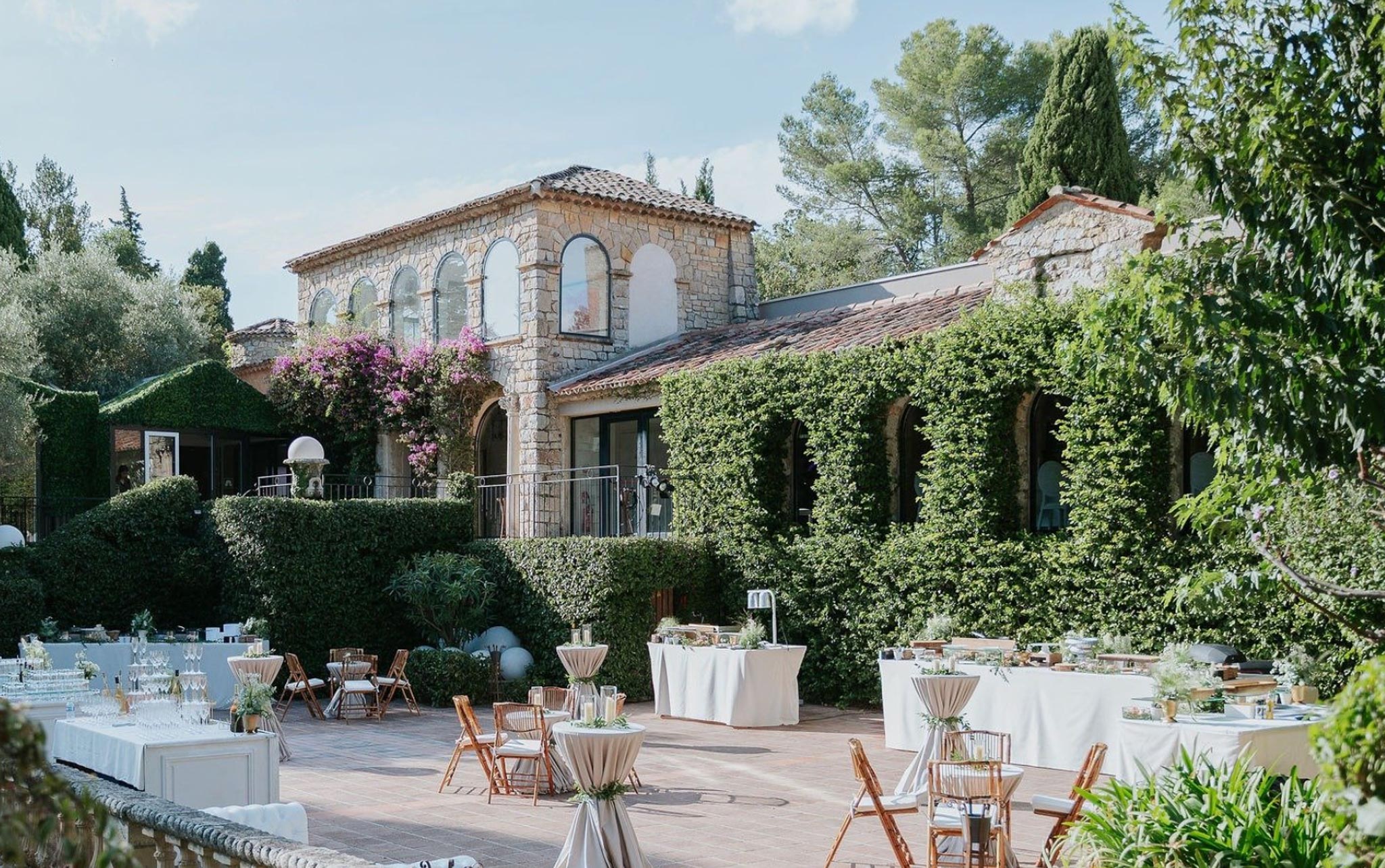
True dry-hire (location sèche) at a French venue means renting the property with no services attached whatsoever. The venue provides the walls, the grounds, and the keys. Everything that happens inside those walls is sourced, contracted, managed, and paid for by the couple or their wedding planner.
The infrastructure costs that catch couples off guard are substantial:
- Generator hire for rural châteaux: €800 to €2,000 for a weekend
- Premium portable toilet facilities for 80 or more guests: €1,500 to €3,000
- Professional post-event cleaning: €500 to €1,500
- Event liability insurance (responsabilite civile): €150 to €400
- Furniture rental for chairs, banquet tables, and linens: €2,000 to €5,000
These items alone total €5,000 to €12,000 before any catering or entertainment. The hybrid traiteur-list model sits between the two extremes and is the most common structure across France, offering the venue quality control while giving couples a shortlist of approved caterers who know the property and its kitchen.
How Do the Total Costs Compare for 80 Guests in 2026?
The headline site fee for a dry-hire venue is almost always lower than the package price at an all-inclusive property, and this illusion drives the most expensive mistake in French wedding planning. For a mid-range French venue hosting 80 guests in 2026, all-inclusive totals run €35,000 to €58,000 while dry-hire totals reach €53,000 to €101,000. The venue privatisation line is identical in both models at €8,000 to €20,000, but the gap opens on logistics, furniture, lighting, sound, toilets, and generator hire costing €12,000 to €20,000 at a dry-hire property versus included at an all-inclusive. Staffing and security add €3,000 to €6,000, a wedding planner that is optional at an all-inclusive becomes essential at dry-hire at €5,000 to €10,000, and TVA surprises with delivery fees add another €2,000 to €5,000 that all-inclusive venues absorb internally. In one of the most extreme cases we have seen, a couple who budgeted €37,000 for dry-hire spent €84,000 by the final invoice, while the all-inclusive château they dismissed would have cost €55,000 to €62,000 fully coordinated. The typical overspend on dry-hire is 40 to 60%, not this dramatic, but the pattern holds.
| Cost Category | All-Inclusive Route | Dry-Hire Route |
|---|---|---|
| Venue privatisation (inc. coordinator, staff, furniture) | €8,000 to €20,000 | €8,000 to €20,000 |
| Catering and drinks | €14,000 to €22,000 | €15,000 to €25,000 (independent traiteur) |
| Logistics (furniture, lighting, sound, toilets, generator) | Included | €12,000 to €20,000 |
| Staffing and security | Included | €3,000 to €6,000 |
| Wedding planner | Optional (€0 to €5,000) | Essential (€5,000 to €10,000) |
| Vendors (photography, florals, music) | €8,000 to €15,000 | €8,000 to €15,000 |
| TVA surprises and delivery fees | Minimal | €2,000 to €5,000 |
| Realistic Total | €35,000 to €58,000 | €53,000 to €101,000 |
Note: the all-inclusive total shows the planner as optional, while the dry-hire total includes a planner as essential. If a planner is added to the all-inclusive model at €3,000 to €5,000, the all-inclusive total rises to €38,000 to €63,000. The gap narrows but remains significant due to the logistics costs that all-inclusive venues absorb.

“Dry-hire couples almost always end up spending more. The rental of equipment, tables, chairs, cleaning, and waste sorting are the costs that tip the balance. Without a detailed budget of all additional costs from the very beginning, the savings you expected from dry-hire disappear.”
For a full breakdown of what French venues charge and why, see our guide to how venue pricing works in France.
Do You Need a Wedding Planner for Each Model?
The role of a wedding planner shifts fundamentally depending on the venue model, and understanding this distinction is one of the most important early planning decisions for destination couples in France. At an all-inclusive venue, the on-site coordinator manages logistics and supplier relationships, so a planner at €2,000 to €5,000 becomes a creative partner who personalises the experience and manages external vendors, and a competent, organised couple can manage without one. At a dry-hire venue, the planner stops being optional and becomes the operational backbone of the entire event, sourcing and contracting every supplier independently, managing delivery schedules across multiple companies, coordinating in French with vendors who may have limited English, and handling a budget across fifteen or more separate invoices. The planner fee of €5,000 to €10,000 consistently recovers its own cost through better supplier rates and prevented mistakes. Full planning runs €8,000 to €15,000, partial planning €4,000 to €8,000, and day-of coordination €2,000 to €4,000.
| Planning Model | Best For | Typical Fee |
|---|---|---|
| Full planning (venue search to farewell breakfast) | Dry-hire venues, all destination couples | €8,000 to €15,000 |
| Partial planning (steps in 3 to 6 months out) | All-inclusive venues, organised couples | €4,000 to €8,000 |
| Day-of coordination | All-inclusive venues with strong in-house team | €2,000 to €4,000 |
Day-of coordination at a dry-hire venue is a significant risk. The coordinator cannot manage a day they were not involved in building. Without deep prior knowledge of every supplier, every delivery schedule, and every contract term, the day cannot be managed effectively. To find a recommended wedding planner in France, browse our curated directory of planners who specialise in destination weddings.
When Does Dry-Hire Deliver Genuine Value?
Dry-hire delivers genuine value when it is chosen deliberately for creative freedom, budgeted honestly from the start, and managed by a professional planner. It fails when it is chosen primarily because the entry-level site fee looked cheaper than the all-inclusive alternative. The couples who succeed with dry-hire share five characteristics: they hire a local wedding planner on day one who knows regional suppliers and negotiates better rates, they ring-fence €15,000 for logistics before allocating anything else, they have existing supplier relationships through their planner rather than discovering vendors through trial and error, they choose a venue with solid infrastructure including sufficient power supply, adequate bathrooms, and a proper catering kitchen, and they genuinely prioritise total creative freedom over cost savings. Our guide to selecting the right French wedding caterer for your venue model covers this in detail. According to data from French Wedding Style's planner network, the average dry-hire overspend versus initial budget is 40 to 60% when no planner is involved. The best dry-hire weddings happen at exclusive-use estates that provide space and infrastructure without imposing restrictions.
- A local wedding planner hired on day one. Their planner knew regional suppliers, negotiated better rates than the couple could have achieved independently, and effectively paid for themselves within the first three bookings.
- A realistic logistics budget from the start. They had been briefed properly on what dry-hire actually means in France and ring-fenced €15,000 for logistics before allocating anything else.
- Existing supplier relationships. A photographer they had worked with, a florist they trusted, a traiteur their planner had used repeatedly. No discovery process, no expensive trial-and-error.
- A venue with good infrastructure. Sufficient power supply, adequate bathrooms, a proper catering kitchen already on site. The logistics bill stayed lean because the bones were already there.
- Total creative freedom as a genuine priority. They wanted something no all-inclusive venue could offer: a specific aesthetic, an unconventional layout, a supplier combination entirely their own. They were buying freedom, not just a lower price.
Where International Couples Go Wrong with All-Inclusive vs Dry-Hire
The most expensive mistake is a comparison mistake: couples measure the dry-hire venue fee against the all-inclusive total package rather than comparing total against total. When a dry-hire château lists €8,000 for a weekend beside an all-inclusive property quoting €35,000, the instinct is to choose the lower number, but once catering, logistics at €12,000 to €20,000, staffing at €3,000 to €6,000, and a planner at €5,000 to €10,000 are added, the dry-hire total reaches €53,000 to €101,000 for 80 guests while the all-inclusive delivers €35,000 to €58,000 fully coordinated. Cutting the planner to save €6,000 routinely costs more in supplier errors and last-minute changes. In the same vein, couples assume "all-inclusive" in France matches the American definition. Our complete guide to where dry-hire and all-inclusive venues cluster across French regions walks through the details. French packages cover hospitality, not the full production: florals, entertainment, photography, and decor sit on top. Confirm exactly what is included before comparing any two properties, and read the contract line by line.
Finally, couples who chose dry-hire and overspent consistently report the same regret: they wish they had compared the experience, not just the price. Our guide to how château, domaine, and mas venues differ across France explains the specifics. The all-inclusive couple had a coordinated, stress-free weekend. The dry-hire couple spent months project-managing fifteen separate suppliers across a language barrier, then spent the wedding day worrying about logistics rather than enjoying their celebration.
Related Articles
These four guides expand on the cost comparison covered above, from the detailed breakdown of how French venue site fees, packages, and mandatory extras work to the complete checklist of hidden costs that add 15 to 25% to initial budgets. The budget wedding guide demonstrates how a well-planned celebration under €20,000 is achievable with an all-inclusive venue in a value region. The regional price comparison maps venue fees and vendor costs across all major French wedding areas, showing where the all-inclusive versus dry-hire calculation shifts most significantly. Together with this article, they form the core financial planning resource for destination couples considering France.
- How venue pricing works in France: site fees, packages, and hidden costs
- Hidden costs of a destination wedding in France
- Planning a well-planned wedding in France for under €20,000
- Regional price differences across France
Frequently Asked Questions
Which is cheaper overall: all-inclusive or dry-hire in France?
All-inclusive venues are cheaper in total for most destination couples. For 80 guests at a mid-range French venue in 2026, an all-inclusive wedding costs €35,000 to €58,000 while a comparable dry-hire wedding reaches €53,000 to €101,000 once logistics, furniture, staffing, and a planner are added. The dry-hire site fee starts lower, but the total cost almost always exceeds the all-inclusive total.
What is the hybrid traiteur model and how common is it?
A hybrid venue rents the space but requires couples to select their caterer from a pre-approved list of traiteurs (French catering companies). This is the most common venue model in France as of 2026. It gives the venue quality control while offering couples some choice. Some venues have a single exclusive traiteur, meaning no choice at all. Always ask which model applies before booking.
Can I bring my own wine to a dry-hire venue in France?
Bringing your own wine is completely normal and culturally celebrated in France. At dry-hire venues, there is usually no restriction. At all-inclusive and hybrid venues, a corkage fee (droit de bouchon) typically applies, ranging from €5 to €10 per bottle at mid-range venues to €20 to €35 at premium châteaux. Many couples source directly from a local cave coopérative at €5 to €20 per bottle, saving significantly compared to venue wine lists.
Is a wedding planner essential for a dry-hire venue?
For destination couples marrying at a dry-hire venue in France, a wedding planner is essential, not optional. Without one, the couple becomes the project manager of a complex, multi-vendor event in a foreign country and a foreign language. The planner fee of €5,000 to €10,000 typically recovers its own cost through better supplier negotiation and prevented mistakes. At an all-inclusive venue, a planner is valuable but not strictly necessary.
What does a French all-inclusive wedding package exclude?
French all-inclusive packages exclude décor, florals, entertainment, photography, videography, hair and makeup, stationery, and guest transport. The package covers the hospitality framework: venue, catering, accommodation, coordination, and basic furniture. The couple arranges all creative and personal elements independently. This is fundamentally different from the American definition of all-inclusive, where the full production is typically included.
How do I decide which model is right for my wedding?
Choose all-inclusive if you want a coordinated, lower-stress experience and your priority is a well-coordinated celebration without managing fifteen separate supplier contracts. Choose dry-hire if you have a specific creative vision that no packaged venue can deliver, you have the budget to cover logistics (ring-fence €15,000 minimum), and you will hire a local wedding planner from day one. If the primary reason for choosing dry-hire is a lower venue fee, recalculate with total costs before committing.
Start comparing venues by browsing all wedding venues in France, or return to our complete guide to wedding costs for budget breakdowns across every spending category.
Explore Every Guide in This Chapter
Deep-dive into each topic covered above.